






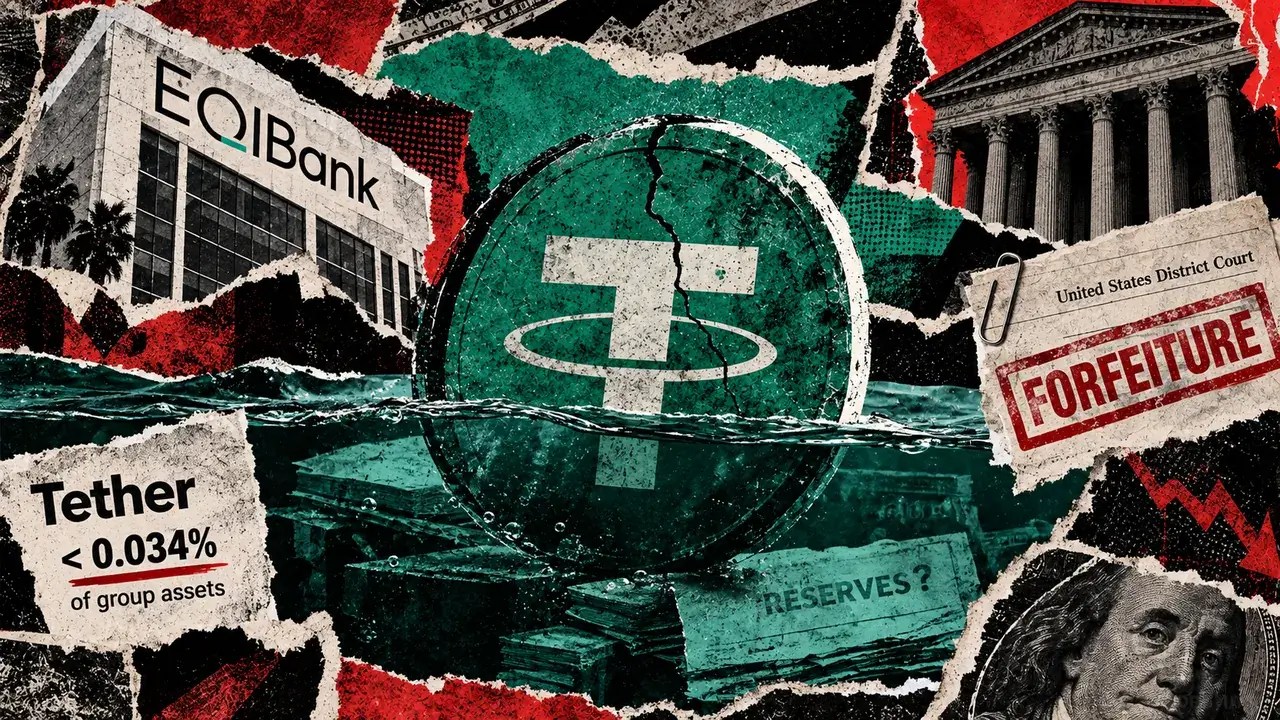
Tether has acknowledged its financial exposure to EQIBank amid the bank’s ongoing dispute with US authorities over a seizure involving payment processor Capstone Limited. This situation raises concerns regarding access to assets potentially backing the USDT stablecoin. On September 25, the stablecoin issuer informed PYMNTS that its exposure constitutes less than 0.034% of the Tether group’s total assets, though it did not provide a specific dollar amount or confirm whether those funds are part of the USDT reserves.
In July, the US government filed a civil forfeiture complaint. Court records indicate approximately $83.03 million across three bank accounts and roughly 1.18 million USDT at two digital addresses. Valued at a 1:1 ratio for USDT, this totals approximately $84.2 million. A subsequent court order identified the bank accounts as being held under Capstone’s name, but did not identify the listed property as belonging to Tether.
EQIBank filed a separate, related motion to recover the seized property, which was subsequently denied by the court. However, this denial did not resolve the ultimate forfeiture case or establish the rightful ownership of the assets. The government’s claim remains legally distinct from Tether’s undisclosed exposure to the bank.
The USDT reserve link remains unproven
The distinction in Tether’s financial disclosures is crucial. The less-than-0.034% exposure figure pertains to the Tether group’s assets, whereas its published USDT reserve metrics describe Tether International, a specific issuer entity, reported on a different date. Tether has not provided a bridging figure connecting these two distinct financial scopes.
As of June 30, Tether International reported $187.75 billion in assets against $183.64 billion in liabilities, resulting in a $4.11 billion excess. The underlying attestation reflects the issuer’s position at that specific date and does not reference any EQIBank balances. While the June excess provides context regarding the scale of the issuer’s reported backing, it cannot reveal the Tether group’s EQIBank balance from September or confirm whether those funds remain accessible.
A bank dispute escalates into a redemption issue if it restricts an issuer from utilizing funds required to meet user requests. The Capstone filing does not trace any seized balances into Tether International’s USDT reserves, and Tether’s exposure statement does not indicate any interruption in minting or redemption processes. Consequently, this presents a counterparty-access concern rather than an established shortfall or operational halt.


For USDT holders, the critical factors are the exact size and legal ownership of Tether’s EQIBank balance, whether any portion constitutes USDT reserves, and whether Tether retains access to those funds. The $84.2 million cited in the forfeiture case should not be interpreted as a quantified loss to USDT holders.
Also Read
- Core Lightning patches flaw that could let revoked channel state escape penalty
- Yen Climbs Nearly 3-Week High as Japan Signals Concern Over Weak Currency
- Aave’s Tokenized Stock Collateral Creates Weekend Oracle Gap for USDC Lenders
- Solana’s plan for fairer trades stalls as block producers still choose which orders get in


