






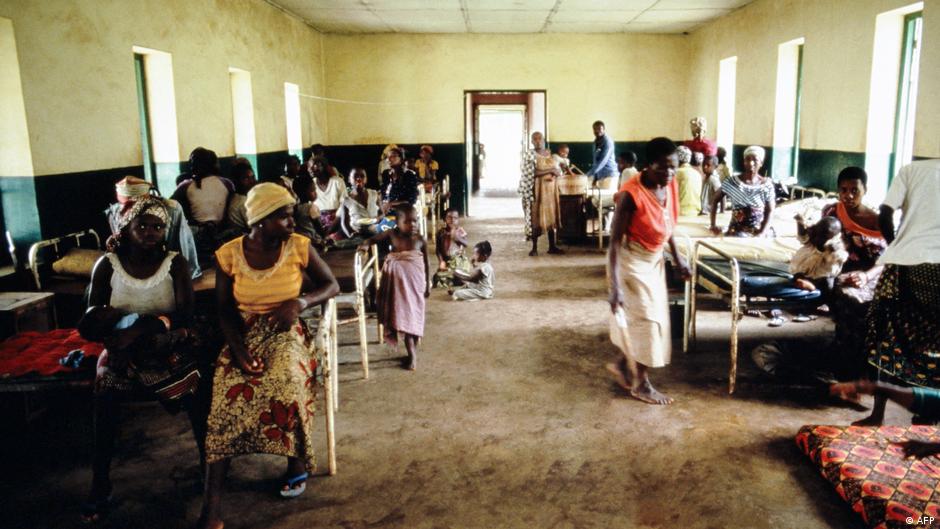
The Lake Nyos disaster caught everyone off guard. There were no warning signs before it occurred,” recalled Isaac Konfor Njilah, a Cameroonian geologist who leads a laboratory in the Earth Sciences department at the University of Yaoundé.
On the night of August 21, 1986, Lake Nyos erupted, sending a massive cloud of carbon dioxide racing through nearby valleys and villages. The gas displaced oxygen, suffocating people and livestock as they slept.
Situated in Cameroon’s Northwest Region, roughly 315 kilometers (196 miles) northwest of Yaoundé, Lake Nyos occupies an ancient volcanic crater within the Oku volcanic field. At the time of the incident, the surrounding population exceeded 3,000, with many residents dependent on agriculture and cattle ranching.
The tragedy claimed approximately 1,700 lives and about 3,500 head of livestock, ranking it among the deadliest natural disasters in Cameroon’s history.
How did a lake become deadly?
In the aftermath, scientists from Cameroon and abroad launched detailed investigations to uncover the cause.
They determined that carbon dioxide from deep underground had been accumulating at the lake’s bottom for years, trapped beneath more than 200 meters (656 feet) of water.
Prior to the eruption, the lake’s upper layers held oxygen‑rich water, while the deeper strata were saturated with dissolved carbon dioxide. Njilah notes that water has a strong affinity for absorbing carbon dioxide.
“When carbon dioxide rises from the Earth’s mantle, it continuously dissolves into the lake,” Njilah told DW.
Researchers often liken Lake Nyos to a giant bottle of carbonated water. For decades, CO₂ built up in the depths. When the equilibrium was disturbed, the gas escaped in a rapid chain reaction, unleashing a deadly cloud that swept across nearby communities.
Experts suspect a landslide may have triggered the release by disturbing the gas‑laden waters at the lake’s floor.
Although carbon dioxide is harmless at normal atmospheric concentrations, at high levels it acts as an asphyxiant, displacing oxygen in the air. Being heavier than air, the gas flowed downhill into villages, where many residents perished in their sleep before realizing what was happening.
Tragedy at another lake in Cameroon just two years prior
The Nyos catastrophe was not Cameroon’s first encounter with such a phenomenon. Two years earlier, on August 15, 1984, a similar event unfolded at nearby Lake Monoun, roughly 100 kilometers southeast of Nyos, claiming 37 lives.
Scientists were still investigating the Monoun incident when the far more devastating disaster struck at Lake Nyos. They eventually concluded that both events resulted from a rare limnic eruption, in which gas‑rich deep water surges to the surface and releases its dissolved gases.
In the years that followed, engineers installed degassing pipes in Lake Nyos to gradually vent the trapped carbon dioxide.
Today, Njilah asserts that the lake no longer holds sufficient dissolved CO₂ to pose a threat.
“The lake is now safe for people to return,” he told DW.
Survivors still live with the trauma
For survivors, however, the fear endures. Tsang Emelda Njah was only five years old when the disaster struck.
“We were at home when the house shuddered violently,” she recalled. “We thought the building might collapse, but we weren’t sure what was happening, so we fled outside.”
Kum Samuel, who was 17 at the time, returned to his village to confront a scene of utter horror.
“I found my parents lying dead. Chickens, flies, birds, dogs, and our elders lay together. I didn’t know what to do.”
For Ndong Frederick Bah, the losses were deeply personal.
“Nine of us went to bed that night, and I was the sole survivor of my family,” he told DW, adding that the next day, people who had heard about the disaster came and rescued him.
Entire communities were later relocated to new settlements. Although scientists have reduced the risk of another gas release, many survivors continue to grapple with the trauma.
“I am a child of Nyos,” said Tsang Emelda Njah. “But I still hesitate to approach the lake. I cannot be certain that whatever killed those people has been permanently stopped, and that uncertainty keeps us afraid.”
Anglophone crisis harms restoration
While experts consider the lake safe, long‑term reconstruction efforts have been hampered by Cameroon’s Anglophone crisis.
The conflict erupted in 2016 between government forces and separatist groups in the country’s predominantly English‑speaking Northwest and Southwest regions, where Lake Nyos is located.
According to Njilah, plans to rehabilitate affected communities and encourage residents to return to their ancestral lands have been disrupted by insecurity, rendering the area difficult to access.
“It is the survivors’ plight to go back home. They wish to return to their ancestral lands so they can pour libations on the graves of their forebears,” he said.
The ongoing violence has also obstructed scientific work and development initiatives.
“Nobody can venture there unless they are willing to risk a bullet to the head,” Njilah remarked. “This has hampered government and international agencies operating in the region.”
Blaise Eyong contributed reporting.
Anglophone crisis put kids’ right to education at risk
To view this video please enable JavaScript, and consider upgrading to a web browser that supports HTML5 video
Edited by: Keith Walker
Also Read
- Alan Ritchson’s ‘Motor City’ Seeks Streaming Boost After Modest Box‑Office Run
- European Parliament President Honors Siim Kallas, Architect of Estonia’s Post-Soviet Transformation
- Comcast Unveils New Xfinity Shield Security Suite for Internet Customers
- South Korea sending first container ship through Arctic route


