






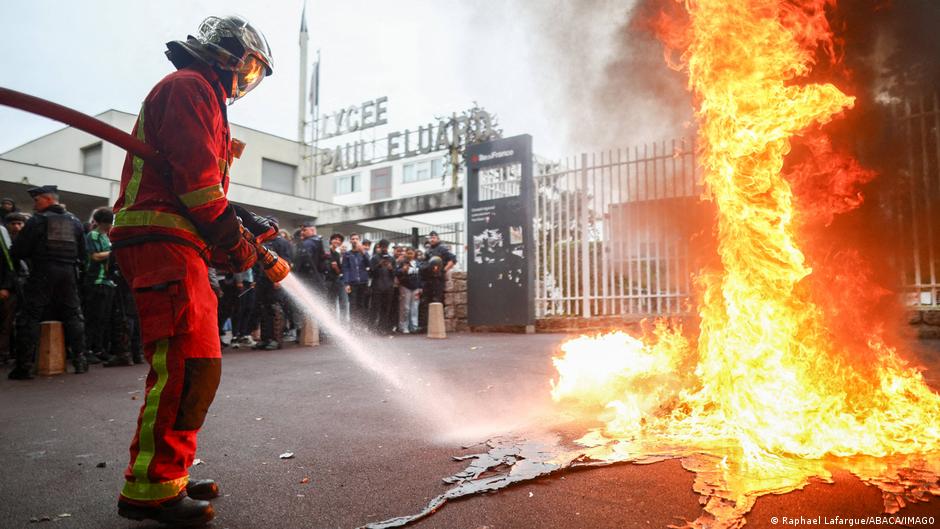
French security forces detained more than 600 people on Wednesday as high-school protests intensified in several parts of the country. Officials said clashes and arson incidents have also injured dozens of officers.
Interior Minister Laurent Nunez described an “escalation of violence” outside some schools. He said 83 police officers and gendarmes were wounded on Wednesday, and that 32 teachers and students were also injured. The demonstrations affected 356 schools, he added, while criticizing the targeting of law enforcement, the throwing of projectiles, verbal abuse, attempted arson, and what he called “urban violence.”
What is driving the student protests?
Students in French lycées, the equivalent of U.S. high schools, have been blockading schools since last week. They are protesting overcrowded classes, heavy academic workloads, inadequate learning materials, and shortages of teachers.
“There are cockroaches and rats everywhere in the school,” said Fadila, a 17-year-old student, who told Reuters that classroom temperatures could range from sweltering to near freezing depending on the weather.
The movement started in Ile-de-France, the Paris metropolitan region, before spreading to other areas. The cities most affected on Wednesday included Paris, Bordeaux, Lyon, and Lille, where police used tear gas during clashes, according to AFP.
How did the government respond?
President Emmanuel Macron said the students’ concerns were legitimate, but argued they did not justify violence or attacks on police officers and teachers. He said high schools should be open places for sharing knowledge, not blockaded schools with trash cans set on fire.
Macron and Nunez accused far-left groups of inciting the violence. Nunez said he had observed individuals in some locations acting as agitators, moving between schools to encourage students to commit violent acts.
In recent days, officials and politicians have criticized the left-wing party La France Insoumise, also known as France Unbowed or LFI, and its presidential candidate Jean-Luc Melenchon for rhetoric they said was inflaming student anger. Melenchon had accused the government on Monday of carrying out a crackdown with “obvious racist undertones” and urged LFI supporters to back the protests where possible.
Prime Minister Sebastien Lecornu rejected the accusation of racism as an insult, saying Melenchon was “racializing a debate about student security” and deepening division instead of helping to restore calm.
Also Read
- Google Restricts Access to Gemini 4 Argon AI Model Over Cybersecurity Concerns
- President Pushes Mega‑Scale Energy Projects Amid Voter Concern Over Economy
- Swiss Glaciers Shrink Dramatically, Losing a Fifth of Their Total Mass in Five Years
- Minneapolis Fed President Kashkari Warns Inflation Remains ‘Too High’ Despite Cooling PCE Data


