






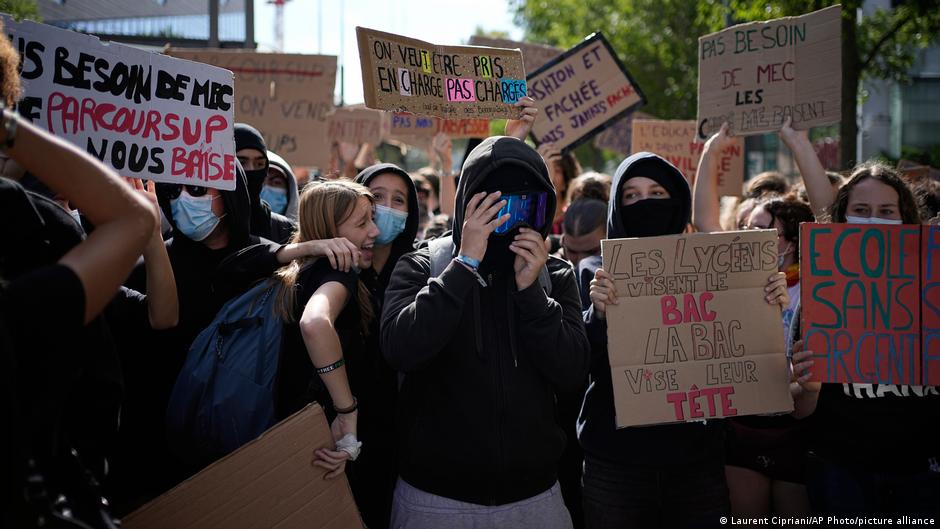
France students protest school conditions
To view this video please enable JavaScript, and consider upgrading to a web browser that supports HTML5 video
Why are the schools staying closed?
On Sunday, Education Minister Edouard Geffray announced that classes would be fully or partially suspended in roughly 400 to 500 high schools on Monday, citing unmet security requirements.
Geffray indicated that the closures were primarily precautionary, with additional large protests scheduled for Tuesday.
He expects the number of closures to remain similar to Friday’s tally, while a partial and gradual return to classes is planned.
Since the unrest began, 24 schools have been burned or vandalised and 78 education staff members have sustained injuries.
Geffray warned that ‘activists, especially from the far left, have infiltrated and hijacked the student movement, turning it into extreme violence.’
He added, ‘Clearly, this poses a risk to both our staff and our students.’
Ile‑de‑France regional president Valerie Pecresse reported that over one‑third of the region’s 468 schools would be closed on Monday.
What are the school protesters saying?
Teenagers attending French high schools, known as lycées, have voiced concerns about high teacher absenteeism, overly long school days, and deteriorating facilities.
They have also demonstrated against insufficient cooling during scorching summer days, when temperatures reached 40 °C (104 °F) in several towns, as the country lacks widespread air‑conditioning.
Organizers plan to keep the protests going on Tuesday, asserting that the government has yet to propose concrete measures to address the problems.
Prime Minister Sébastien Lecornu called on Sunday for local authorities to prioritize filling vacancies caused by long‑term absences and unfilled positions.
He also scheduled a meeting for Tuesday with regional leaders to discuss the renovation of school buildings that are frequently in poor condition.
Violent incidents at the school protests
The demonstrations have been accompanied by several violent incidents, with security forces occasionally deploying tear gas and batons to disperse the youths.
Since the movement began, more than 5,000 individuals—85 % of them minors—have been detained.
Last week, footage emerged of youths beating and kicking a policeman on the ground in Belfort, a town in the east.
Amnesty International’s French branch described police actions as ‘disproportionate’ last week.
Interior Minister Laurent Nunez defended the forces, stating they were ‘not cracking down on young people’ but rather ‘protecting’ students seeking to ‘peacefully voice their demands.’
Edited by: Elizabeth Schumacher


