






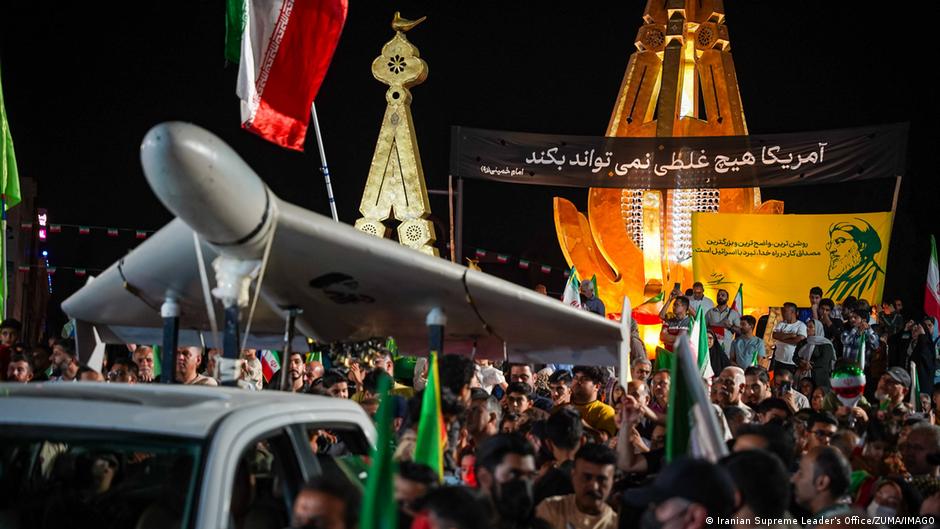
When the United States and Israel initiated military action against Iran in late February, their objective was to debilitate the Islamic Republic and its regional “Axis of Resistance.” This network encompasses Iranian-backed paramilitary factions such as Hamas in Gaza, Hezbollah in Lebanon, the Houthi movement in Yemen, and various Iraqi militias, all unified in opposition to U.S. and Israeli interests.
Analysts assumed, as Peter Salisbury—a fellow at the U.S. think tank Century International and lead author of its recent report “Beyond the Axis”—noted, that “by hitting the right leaders, weapons facilities and supply lines, an outside actor could induce catastrophic failure across the Iranian regime and its web of Middle Eastern allies.”
Yet despite the U.S. and Israel attaining many of those military goals, Iranian forces persisted in executing drone strikes against neighboring Gulf states and maritime traffic in the Strait of Hormuz, while their Lebanese and Yemeni allies escalated assaults on Israel and commercial vessels in the Red Sea.
The Shift Toward Operational Autonomy
According to Wolf-Christian Paes, associate fellow at the International Institute for Strategic Studies and a contributor to the “Beyond the Axis” report, the label “proxies” is misleading because it suggests a direct command-and-control linkage between Tehran and the coalition’s members.
“Unmanned aerial vehicle (UAV) proliferation illustrates this point,” Paes told DW. Several years ago, Tehran supplied complete systems and training to its partners. “Today these militias can build their own UAVs, based on Iranian designs, with most of the parts coming from countries other than Iran,” he added.
The report, compiled over two years of research, indicates that these factions can procure substantial numbers of engines for the Shahed-136 drone directly from Chinese manufacturers.
“Dual-use technology is inherently hard to regulate, and without a conventional smuggling hub, tracing the supply chain resembles finding a needle in a haystack,” Paes remarked, noting that countries such as China, Russia, and Oman have thus far made little effort to curb the transit of such components.
The “Beyond the Axis” report documents that drone-related conflict events globally surged from 140 in 2016 to over 58,000 in 2025—a 41,000% rise.
Changing Ties
“The expanding capacity of Iran’s partners to produce and launch drones autonomously is reshaping the character of their relationship with Tehran,” said Neil Quilliam, associate fellow with the Middle East and North Africa program at the London-based Chatham House think tank.
In his assessment, Yemen’s Houthi movement exemplifies this shift. The faction now enjoys a degree of operational independence scarcely conceivable a decade ago. “Iran and Lebanon’s Hezbollah laid the groundwork for the Houthis’ drone and missile programs, but prolonged conflict and isolation forced them to cultivate indigenous manufacturing,” Quilliam explained.
Throughout the 2023–2025 war in Gaza, the Houthis struck Israel and international Red Sea shipping with drones and missiles, claiming solidarity with Palestinians. When the conflict in Iran erupted from February to April 2026, the group renewed its offensive operations.
The report further observes that since at least 2022, a cadre of senior Houthi officers in Sanaa has forged ties along the African coasts of the Red Sea and Gulf of Aden. “Houthi smuggling networks are now present in Somalia, Djibouti, Eritrea and Sudan,” it states.
Lebanon’s Hezbollah Militia
For decades, Lebanon’s Hezbollah stood as Tehran’s most heavily equipped proxy, owing largely to its border with Israel. One day after Hamas’s October 7, 2023 assault on Israel, Hezbollah opened a northern front, precipitating a full-scale war in Lebanon.
“Israeli attempts to dismantle the group’s leadership and military infrastructure rendered Iranian aid indispensable for its recovery,” Quilliam noted.
A November 2024 ceasefire collapsed in early March 2026 after Hezbollah launched drone and missile attacks on Israel, triggered by the Israeli assassination of Iran’s supreme leader Ali Khamenei, to whom Hezbollah had pledged allegiance. In subsequent U.S.–Iran negotiations, the Lebanese front emerged as a central bargaining point.
“Hezbollah’s alignment with Iran in the latest conflict, together with Tehran’s demand that any truce encompass Lebanon, underscores the enduring tightness of their bond,” Quilliam said.
Hamas in Gaza and Paramilitaries in Iraq
Quilliam observed that Israel’s extended campaign in Gaza has curtailed Tehran’s access to Hamas. “That should not be read as a permanent diminution of Iranian relevance; the relationships, training pipelines, and technical know-how built over decades remain intact,” he told DW. He views Iran’s connection to Hamas as proof that military coordination can outlast temporary political ebb.
In Iraq, Iran-affiliated armed factions must reconcile local interests with loyalty to Tehran, Quilliam noted. Although enhanced drone self-reliance furnishes them with autonomous tools for power projection, “the challenge for Tehran increasingly lies in coordinating a growing number of capable actors whose interests only partially overlap.”
He argues that Iran maintains sway via political ties, training, intelligence exchange, and strategic coordination among these groups. “But influence is not the same as control,” he concluded.
A New Type of Challenge
Salisbury of Century International concurs that Iran remains the paramount node for these militias, yet the Tehran-proxy dynamic has evolved into mutual interdependence. “Capabilities, data and strategic needs flow in multiple directions,” he said.
Does this complicate efforts by Iran’s adversaries to dismantle these networks and mitigate the drone warfare threat?
“Looking ahead, the most significant fallout of drone proliferation across the so-called ‘Axis of Resistance’ may be the rise of multiple expertise hubs within what was once seen as an Iranian-led system,” Quilliam told DW. “This renders the broader network more resilient, harder to disrupt, and potentially more volatile.”
What is Iran’s ‘Axis of Resistance’?
To view this video please enable JavaScript, and consider upgrading to a web browser that supports HTML5 video
Also Read
- Senior GOP Leaders Confirm Recent Contact with Hospitalized Senator McConnell
- U.S. Rescinds Iran Oil Waiver Following Recent Strait of Hormuz Tanker Incidents
- MUFG Bank to Implement AI and Satellite Imagery for Real Estate Collateral Assessments by 2027
- Albanese to Meet Pacific Leaders in Brisbane Amid China Tensions


