






[Gadi Eisenkot Amplifies Moroccan Roots as He Challenges Netanyahu]
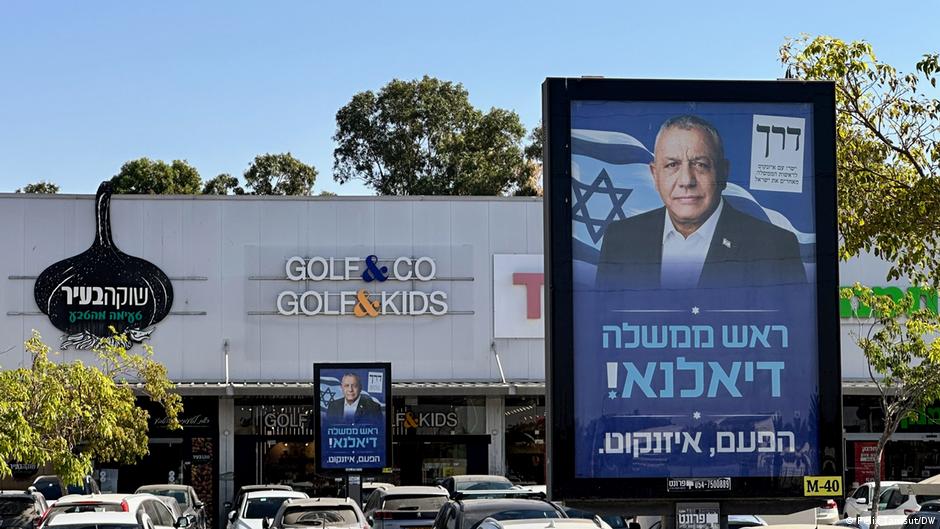
Campaign posters with various slogans promote the right-wing Likud and the far-right Otzma Yehudit parties. However, one poster is seen more than any others: that of the liberal Yashar party.
Its slogan, “Rosh Memshala Dialna,” combines the Hebrew term for “prime minister” with the Moroccan Arabic phrase “of our own.”
There is a strong reason why Eisenkot’s campaign in Sderot and other cities on Israel’s sociopolitical periphery centers on his Moroccan heritage.
Eisenkot’s Mizrahi background
Sderot — located in the Negev desert, roughly 75 kilometers (45 miles) south of Tel Aviv and just a kilometer from the Gaza border — hosts a large Moroccan Jewish community. Over recent decades, the city has become a symbol of Moroccan-Jewish culture in Israel, influencing music, cinema, and state politics.
Israel elections: Who is Gadi Eisenkot, Netanyahu’s challenger?
To view this video please enable JavaScript, and consider upgrading to a web browser that supports HTML5 video
Historically, Sderot is regarded as a right-wing stronghold and a key base for Prime Minister Benjamin Netanyahu’s Likud party. In 2022, Likud secured more than 40% of the vote in Sderot, compared to 23% nationwide. Other far-right coalition members also received significant support in the previous election.
This pattern reflects deeper historical divisions within Israel between Ashkenazim—Jews of European origin—and Mizrahim—Jews primarily from Middle Eastern and North African backgrounds. Estimates suggest that half of Israel’s Jewish population, approximately 4 million people, have Mizrahi roots.
Mizrahi Jews have experienced discrimination and marginalization since the early years of the Israeli state. This legacy continues to shape economic and social realities—and political discourse—in the country.
The issue has been highlighted in the 2026 campaign. Eisenkot, Netanyahu’s major challenger, hails from Moroccan descent and grew up in Eilat, a city with a sizable North African Jewish population. The Yashar party accused Likud of sidelining its Mizrahi politicians. Their campaign slogan, “Netanyahu: Let the Mizrahim give interviews,” mocked this exclusion.
The following promotional figure was included in the source material:
On live television, right-wing journalist Yinon Magal—one of Netanyahu’s most vocal supporters—claimed that Eisenkot was being controlled by elite Ashkenazim and dubbed him a “monkey.”
Netanyahu, who is of European origin, condemned the remark.
Morocco-born Daniel Ben-Simon, an award-winning Israeli journalist and former member of parliament, explained to DW that Eisenkot’s embrace of his heritage may have been forced upon him by Magal’s comments, though it carries historical significance.
“People do not use terms like ‘Dialna’ with pride,” Ben-Simon said, referring to Eisenkot’s promotion of the Arabic phrase “of our own” on campaign literature. He noted that Israeli society has long sought to erase the Arab identities of North African Jews.
Eisenkot’s advocacy for his heritage offers a means of “breaking framework”—creating a new Israeli-Moroccan identity. Ben-Simon observed that Eisenkot is the first politician to openly express this dual identity while feeling at home.
Israel’s historical divide
Following Israel’s establishment, the dominant socialist party, Mapai—led predominantly by Ashkenazim—implemented discriminatory policies against Mizrahim, often pressuring them to “Europeanize” rather than preserve their culture, heritage, or Arabic language.
Could Arab voters hold the key in Israel’s election?
To view this video please enable JavaScript, and consider upgrading to a web browser that supports HTML5 video
These historical inequalities manifested materially. In the early years of the state, European immigrants typically received better housing and employment opportunities, while many Jewish immigrants from Arab-speaking countries were directed to Ma’abarot, temporary transit camps—often in remote areas with limited infrastructure. Many later became “development towns,” which remained underfunded relative to Israel’s central regions, resulting in persistent poverty. Sderot, in the south, is one of the most renowned development towns.
For many Mizrahim, restricted access to employment, education, and infrastructure symbolized long-standing exclusion by the Mapai establishment. Likud, founded in 1973 as a right-wing alliance, effectively mobilized this frustration under Menachem Begin, and Mizrahi support for Begin contributed to the Mahapach—the upheaval that enabled Likud to first seize power. Since then, Mizrahim have frequently been associated with Likud, even though the party has never produced a Mizrahi leader.
Over the past two decades, Sderot’s proximity to Gaza has made the city a frequent target of rocket attacks from Hamas. During the October 7, 2023, Hamas-led attacks, Sderot was heavily impacted, with more than 50 individuals killed. In the three years since, the city’s population has grown by approximately 5,000 people, reaching 40,000, with many young families settling there—either driven by idealism or government assistance programs.
The following promotional figure was included in the source material:
Walking through the town, it is difficult to deny that the so-called national-religious community is increasingly dominant. This community tends to back Bezalel Smotrich’s far-right Religious Zionism party, a key member of Netanyahu’s coalition. While votes for Smotrich and his party function as de facto votes for Netanyahu’s bloc, the Likud party itself could potentially lose ground in Sderot.
Regardless of the election’s ultimate outcome, perceptions of Sderot as a Moroccan-Jewish city are unlikely to fade anytime soon. Ben-Simon noted that Eisenkot’s candidacy could provide an opportunity to reshape the future identity of Moroccan Jews within Israel.
“The connection cities like Sderot have to their Moroccan roots would deepen as a result of an Eisenkot victory,” Ben-Simon added.
Edited by: Shani Rozanes
Also Read
Keep Reading


