







The British pound opened the new November week under sustained pressure, with GBP/USD trading near 1.3080 and touching at least a 12-month low after falling in eight of the last nine sessions. The decline followed softer UK inflation and wage figures, which dimmed prospects for an imminent Bank of England interest-rate increase.
UK wage growth excluding bonuses eased to 3.5% for the three months through September, missing the 3.6% forecast and cooling from the prior 3.7%. Claims for unemployment benefits rose by 33,200, exceeding the expected 28,100, though the jobless rate unexpectedly edged down to 4.6% from a projected 4.7%. Inflation also came in marginally below estimates, with headline CPI at 3.6% year-on-year versus the expected 3.7%, while core inflation held steady at 2.8%.
While this data mix may be relatively constructive for the broader economy, it weakens the argument for aggressive monetary tightening by the Bank of England. Following the CPI release, markets priced a December BoE rate hike at 80%, down from 90%. October retail sales unexpectedly rose 0.7% month-on-month instead of showing flat growth, but the gain was insufficient to spark a sustained rebound in GBP/USD.
The interest-rate differential remains a key consideration. With the Bank of England’s benchmark rate at 4% and the Federal Reserve’s target range at 3.75%–4.00%, the pound technically holds a marginal yield advantage. Nevertheless, the Fed’s October meeting minutes indicated that most officials are open to further increases, with Governor Christopher Waller previously advocating for a potentially larger move. By comparison, the Bank of England appears more cautious, even though some policymakers have not ruled out additional tightening.
Market focus this week turns to the UK’s November PMI data and a speech by Bank of England Chief Economist Huw Pill. A more significant external driver will be Wednesday’s US core PCE index, forecast to rise 0.3% month-on-month (3.2% year-on-year). Stronger-than-expected inflation could reinforce expectations of a December Federal Reserve rate hike and push GBP/USD toward 1.3000, whereas softer figures may allow the pound to recover some lost ground.
Technical Analysis
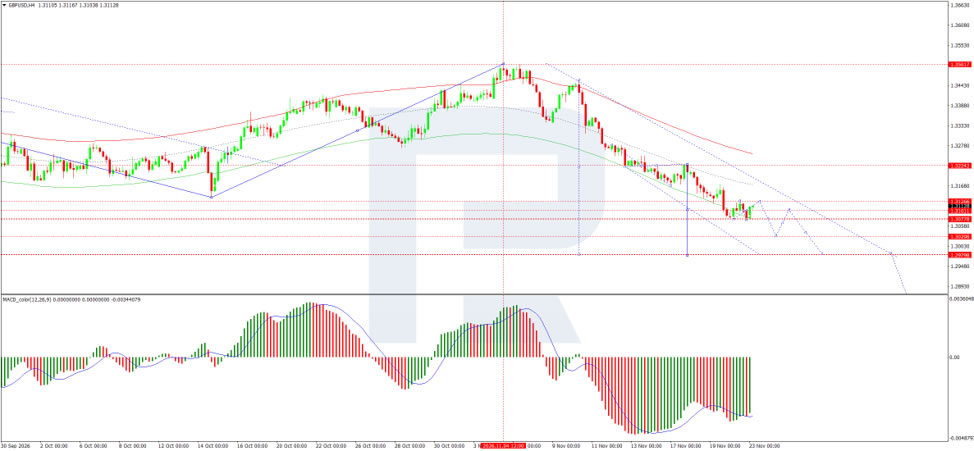

On the four-hour chart, GBP/USD remains in a steady downtrend after peaking at 1.3502. Price action continues to form a descending wave structure, consistently refreshing local lows. Spot is currently consolidating around 1.3113. A corrective bounce toward resistance at 1.3122 is anticipated today, followed by a resumption of the decline toward 1.3078 and then 1.3030. A breach below 1.3030 would open the path toward the local downside target of 1.2980. This move is regarded as an intermediate leg within a broader downward wave. The MACD indicator confirms seller dominance, remaining below zero despite tentative signs of short-term negative momentum easing.
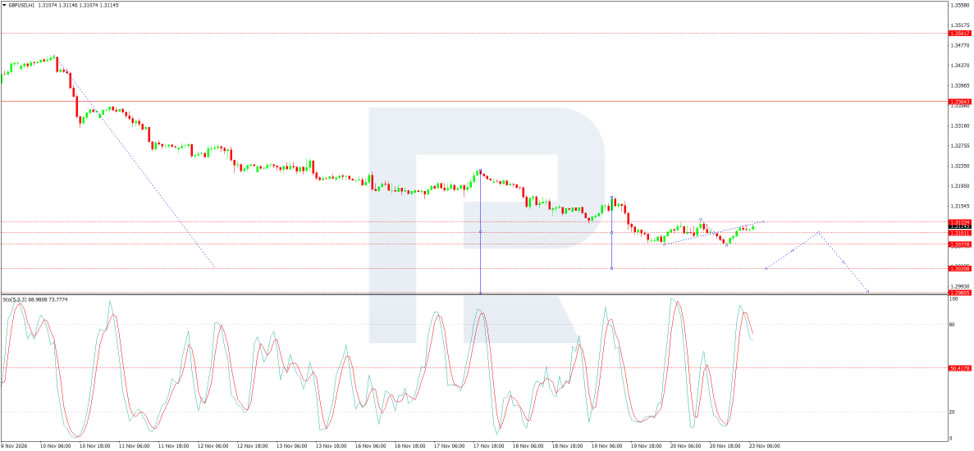
The hourly chart shows GBP/USD consolidating between support at 1.3078 and resistance at 1.3122. After testing a local low, price recovered above 1.3101, though the advance remains corrective for now. The most likely scenario today is a test of resistance at 1.3122 from below, followed by a reversal toward 1.3078. A close beneath this support would set the stage for further declines toward 1.3030 and 1.2980. The Stochastic oscillator sits below the 80 level, suggesting that short-term upward momentum is fading. A downward turn in its signal lines would raise the probability of a move toward 20. As long as price stays below 1.3122, the bias remains skewed toward sales aligned with the primary downtrend targets. Any breakout above resistance would force a short-term reassessment but would not alter the underlying bearish structure on the four-hour chart.
Conclusion
GBP/USD began the week under pressure at 12-month lows, dragged down by softer UK inflation and wage data that lowered December Bank of England rate-hike expectations from 90% to 80%. Although the pound still holds a slight rate advantage over the dollar, the Federal Reserve’s hawkish minutes and the likelihood of further tightening continue to support the US currency. Attention now centers on the UK PMI release and BoE Chief Economist Huw Pill’s speech, with Wednesday’s US core PCE index expected to serve as the primary catalyst. Technically, the downtrend remains firmly intact, with resistance at 1.3122 and support at 1.3078, 1.3030, and 1.2980. A breakdown below support would reinforce the bearish outlook, while a move above resistance would likely only pause the decline temporarily. Strong US inflation data could drive the pair toward 1.3000, while softer figures may provide the pound some relief.
Also Read
- BlackRock’s staked Ethereum ETF can delay redemptions if unstaked ETH runs short
- Weekend Crypto Rebound: Ethereum Retakes $1,710 While Venice Token Leads the Pack
- Morgan Stanley Trader Calls for Rethink of SA-CCR Capital Burden in FX
- Bitcoin Core Resolves Node‑Stalling Vulnerability, Prompting 29.x Users to Upgrade


