







The probability of a Federal Reserve rate increase in October has plummeted to just 17.7%, yet gold has failed to mount a meaningful rally. The reason is straightforward: markets continue to price an 82.7% likelihood of at least one more hike by December and a terminal rate plateau near 4.7% by late 2027—roughly 60 basis points above the Fed’s own September median projection. This dynamic makes Wednesday’s FOMC minutes, rather than the October policy decision, the critical test for bullion.
Why This Matters
Gold received what should have been favorable news: the odds of an imminent Fed hike collapsed. However, the metal barely responded. The market has merely delayed the tightening cycle without materially lowering the expected destination for rates—and gold is trading that destination, not the calendar. This distinction explains why the post-nonfarm payrolls rebound stalled just below resistance, and why the upcoming minutes carry more weight for gold than the October meeting itself.
The recovery peaked at 4,227.85, falling just short of the 4,230.70–4,234.68 resistance cluster before reversing. With spot prices back near the 4,145–4,160 region, the failure to reclaim former support reinforces the message from Fed pricing: removing an October hike from the equation is not the same as removing an extended tightening cycle.
October Fades, but the Rate Plateau Persists
The shift in near-term Fed expectations has been dramatic. October hike probabilities dropped from 64.2% on September 25 to 22.1% on October 2 and 17.7% in the October 4 FedWatch snapshot. The October meeting now carries an 82.3% probability of no change.
Yet the remainder of the curve tells a different story. By December, the same snapshot assigns a 68.7% probability to a 4.00–4.25% target range and another 14.0% to 4.25–4.50%. This implies an 82.7% chance that rates will sit at least one hike above the current 3.75–4.00% range by year-end.
The tightening trajectory extends further. Based on the probability distribution, the expected midpoint rises from approximately 3.92% in October to 4.12% in December, 4.39% in March, and 4.61% in June, before reaching roughly 4.70% around September–October 2027. The modal outcome shifts to 4.50–4.75% from June 2027 onward.
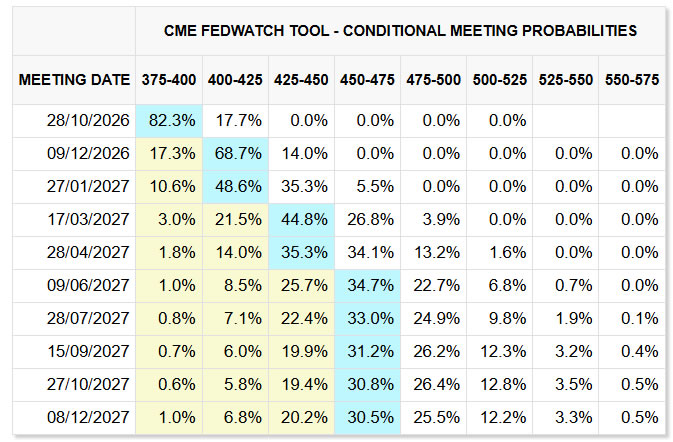

This is the dilemma gold faces. The market has moved away from an immediate October hike but still prices a gradual tightening path extending well into 2027. A one-meeting delay alters only a few weeks of carry cost. A substantially lower rate plateau would change the opportunity cost of holding a non-yielding asset far more meaningfully. The October skip is therefore a timing adjustment; gold requires evidence that the destination itself is declining.
The Market Is More Hawkish Than the Fed’s Own Projections
That makes Wednesday’s FOMC minutes unusually significant. The Fed’s official September Summary of Economic Projections placed the median federal funds rate at 4.1% for both end-2026 and end-2027, followed by 3.9% in 2028, 3.6% in 2029, and 3.2% over the longer run. At face value, those medians align with roughly one additional quarter-point hike from the current range and little further change through end-2027.
The market is pricing something materially firmer. The probability-weighted FedWatch midpoint approaches 4.69% by late 2027, nearly 60 basis points above the Fed’s 4.1% end-2027 median. That gap is the core issue for gold.
Wednesday’s minutes do not need to sound conventionally dovish to support bullion. They need only provide less support for extended tightening than the market currently assumes. Conversely, evidence that a meaningful contingent of officials favored continued rate increases beyond the next move would validate the market’s higher plateau and reinforce pressure on gold.
The Federal Reserve has confirmed that minutes from the September 15–16 FOMC meeting will be released Wednesday, October 7 at 2:00 p.m. ET. Because they predate the latest labor-market data and subsequent market repricing, their significance lies in how the September discussion compares with today’s curve, rather than whether the language sounds hawkish in isolation.
What the Minutes Need to Reveal
The first question is how broad support was for further tightening beyond the next hike. Language such as “many,” “several,” or “some” participants could matter more than another general warning about inflation.
The second is pace. A meeting-by-meeting approach with substantial patience would align comfortably with an October skip. A discussion implying repeated hikes through 2027 would be more consequential because it would support the portion of the curve currently weighing on gold.
The third is the Committee’s view of restrictiveness and neutral policy. The September longer-run median rose to 3.2%, reinforcing the possibility that the neutral rate itself is higher than previously assumed. But a higher neutral estimate does not automatically validate a 4.6–4.7% policy plateau through much of 2027.
Inflation risks will also matter, particularly any discussion of energy prices, inflation expectations, and repeated supply shocks. Those are the channels through which oil can extend the tightening cycle even if labor demand is slowing.
A Hawkish Set of Minutes Could Still Be Dovish for Gold
This creates a counterintuitive setup. Minutes stating that inflation remains too high, policy must stay restrictive, and another hike is likely might sound hawkish. But if the discussion broadly supports one more hike followed by a prolonged hold, it would still look comparatively dovish against a market pricing rates near 4.7% late next year. That would challenge the extra tightening embedded in the curve and give gold a more substantial catalyst than merely shifting one hike from October to December.
The opposite scenario is more problematic for bullion. If the minutes show broad concern that rates may need to rise repeatedly into 2027, the market’s extended-cycle pricing gains validation. In that case, lower October odds would matter even less.
The distribution also shows why the outcome is not predetermined. By December 2027, only 7.8% of the supplied FedWatch probability sits at 4.25% or below, while 16.0% sits at 5.00% or above. The curve is clearly tilted toward a high-rate regime, but it is not tightly anchored. A sufficiently soft inflation signal later in the month could still move that plateau sharply.
Gold Is Getting Little Help From Its Other Supports
Oil provides another test of the thesis. Crude declined on Monday as supply expectations improved, which should marginally reduce the inflation impulse feeding into Fed pricing. Yet gold rose only around 0.4% in early trading. Together with the collapse in October hike odds, that muted response suggests the market still needs a more durable decline in the expected policy path before materially repricing gold higher.
Investor positioning also cuts both ways. World Gold Council data show global gold-backed ETFs attracted $18 billion in August, lifting holdings by 121 tonnes to a record 4,189 tonnes. That confirms substantial underlying investment demand, but the scale of buying during August’s rally also means a large amount of positioning was accumulated at materially higher prices.
Official demand provides another structural support. The PBoC reported adding 20.2 tonnes in August, extending its buying streak to 22 consecutive months and taking reported holdings to around 2,387 tonnes. That demand can help establish a floor over time, but it has not prevented gold from correcting when the U.S. rate structure moves against it.
The distinction matters: structural buyers can limit the depth of a decline without determining its short-term direction. For now, Fed pricing is still doing that.
Technical View on Gold
The technical structure reinforces the macro argument. Gold’s post-NFP rebound topped at 4,227.85, just below a major resistance cluster around 4,230.70–4,234.68. The zone combines the 61.8% retracement of the 3,942.43–4,697.07 rebound, former support, and the falling 4H trendline from 4,697.07. The 4H EMA55, currently around 4,211.87, adds another barrier inside the recovery zone. Bias therefore stays bearish while 4,234.68 holds.
Immediate support sits at 4,110.50, almost exactly alongside the 4,113.82 61.8% projection. A firm break would resume the decline from 4,697.07 and target 3,937.19, the 100% projection of 4,697.07 to 4,234.68 from 4,399.58. That puts the market directly back into the broader 3,937–3,942 decision zone.
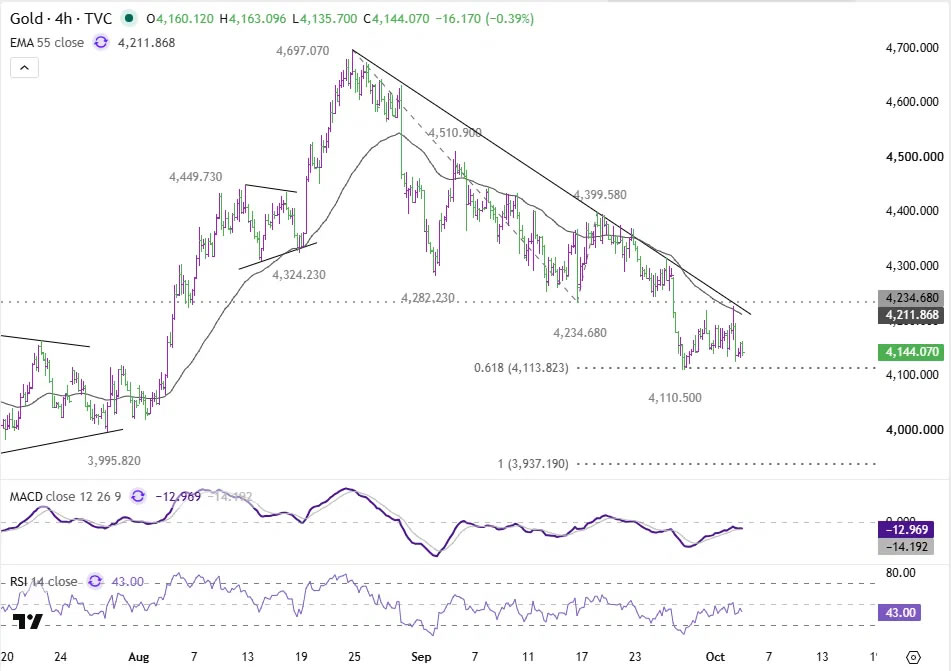

That area matters beyond the short-term decline. The larger fall from 5,598.75 to 3,942.43 can still be interpreted as a corrective zigzag, with the 4,098.74 A-wave low followed by the rebound to 4,890.97 and a C-wave decline to 3,942.43. Holding around 3,937–3,942, particularly with the existing bullish momentum divergence, would preserve that corrective interpretation. However, a daily close below 3,942.43 would weaken it materially.
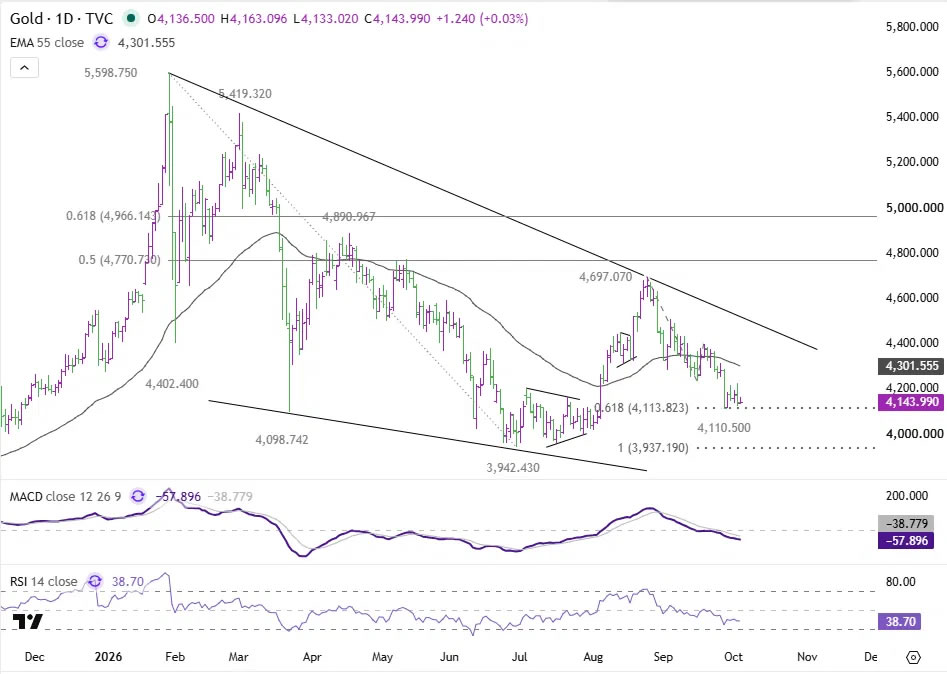

On the upside, a firm break above 4,234.68 would be the first sign that the decline is losing control. Resistance would then come at 4,282.23, the daily EMA55 around 4,301.56, and ultimately 4,399.58, whose break would provide much stronger confirmation that the corrective decline has completed.
For gold, Wednesday therefore comes down to a simple question: do the minutes validate the market’s high 2027 rate plateau, or expose how far that plateau has moved beyond the Fed’s own September baseline? Until 4,234.68 breaks, sellers retain the technical advantage.
Key Takeaways
- October Fed hike odds have fallen to 17.7%, but December pricing still implies an 82.7% probability of at least one more hike—gold is reacting to the destination, not the delay.
- The market-implied rate plateau near 4.69% by late 2027 sits nearly 60 basis points above the Fed’s own 4.1% September median, and that gap is what Wednesday’s FOMC minutes need to address.
- A hawkish-sounding set of minutes could still be dovish for gold if it implies only one more hike followed by a prolonged hold, rather than repeated tightening through 2027.
- Structural demand from ETF inflows (121 tonnes in August) and the PBoC’s 22nd straight month of buying can limit gold’s downside but hasn’t been enough to override Fed-pricing pressure.
- Gold’s bias stays bearish while 4,234.68 resistance holds; a break below 4,110.50 would expose the 3,937–3,942 decision zone.
Also Read
- Ethereum has a 25-day wait to start staking, with nearly 1.5 million ETH in line
- European Debt Markets Grapple with Widening Spreads Ahead of Key Economic Data
- Rupee Stalls Near 96 per Dollar as Oil Costs and FPI Exits Fuel Volatility
- OKXICE Seeks U.S. Approval for Round‑the‑Clock Tokenized Stock Trading


