




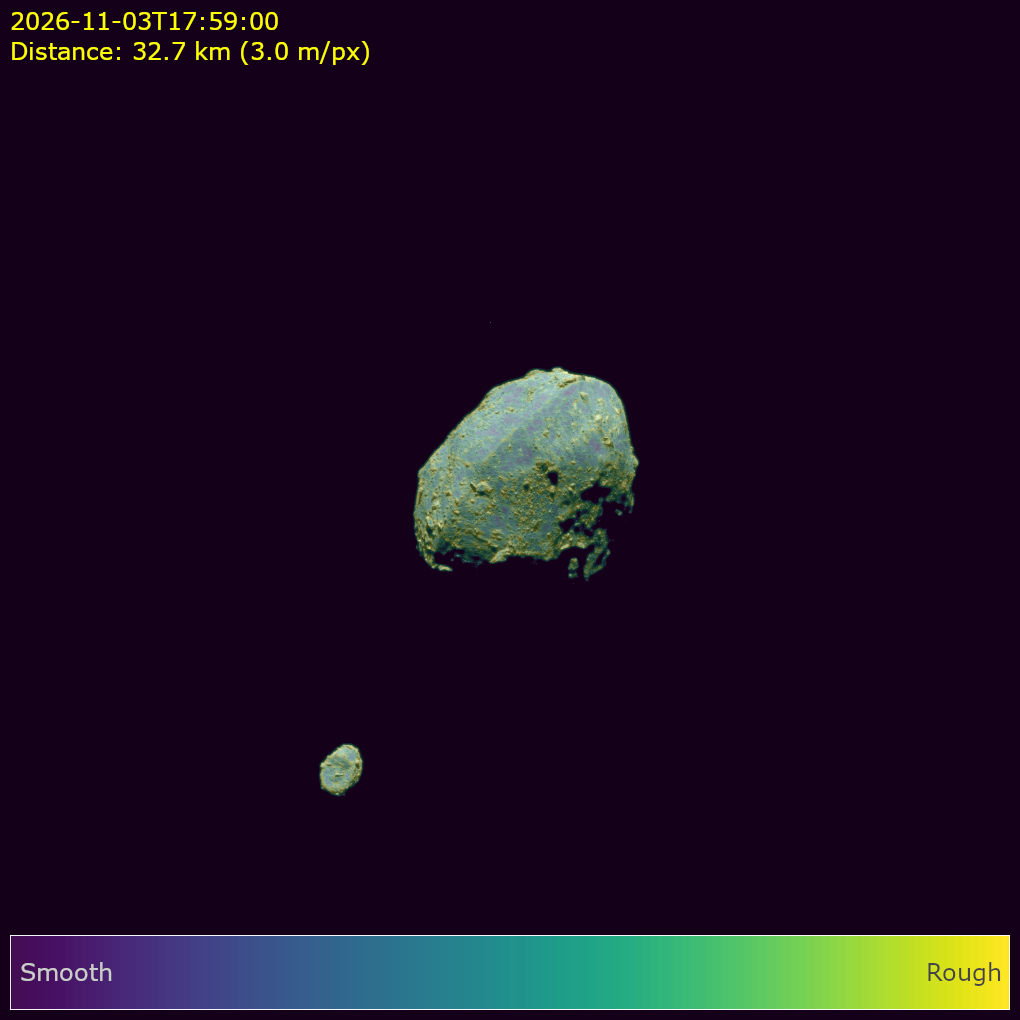
A false-color image of Dimorphos and Didymos showing surface roughness. Blue and purple areas are smoothest, while green and yellow areas are roughest.
(Image credit: ESA)
In September 2022, humanity’s first asteroid-deflection test ended in a violent encounter when a NASA spacecraft struck a skyscraper-sized rock.
The doomed probe’s final view captured Dimorphos’s pebbled surface racing toward it at about 14,000 mph (22,500 km/h). From millions of miles away, the Hubble and James Webb space telescopes recorded a brilliant impact flash and a newly liberated swarm of boulders spewing into space around the asteroid.

Later observations confirmed that the Double Asteroid Redirection Test (DART) was a resounding success, shortening Dimorphos’s orbit around its larger companion, Didymos, by 33 minutes. But with no other spacecraft nearby, little was known about the impact’s effects on Dimorphos—until now.
On Wednesday (Nov. 25), the European Space Agency (ESA) released the first close-up images of Dimorphos and Didymos since NASA’s historic strike four years ago. Captured by ESA’s Hera spacecraft, now in a rectangular orbit around the pair, the new views reveal the sibling asteroids in extraordinary detail from as close as 15 miles (24 kilometers).
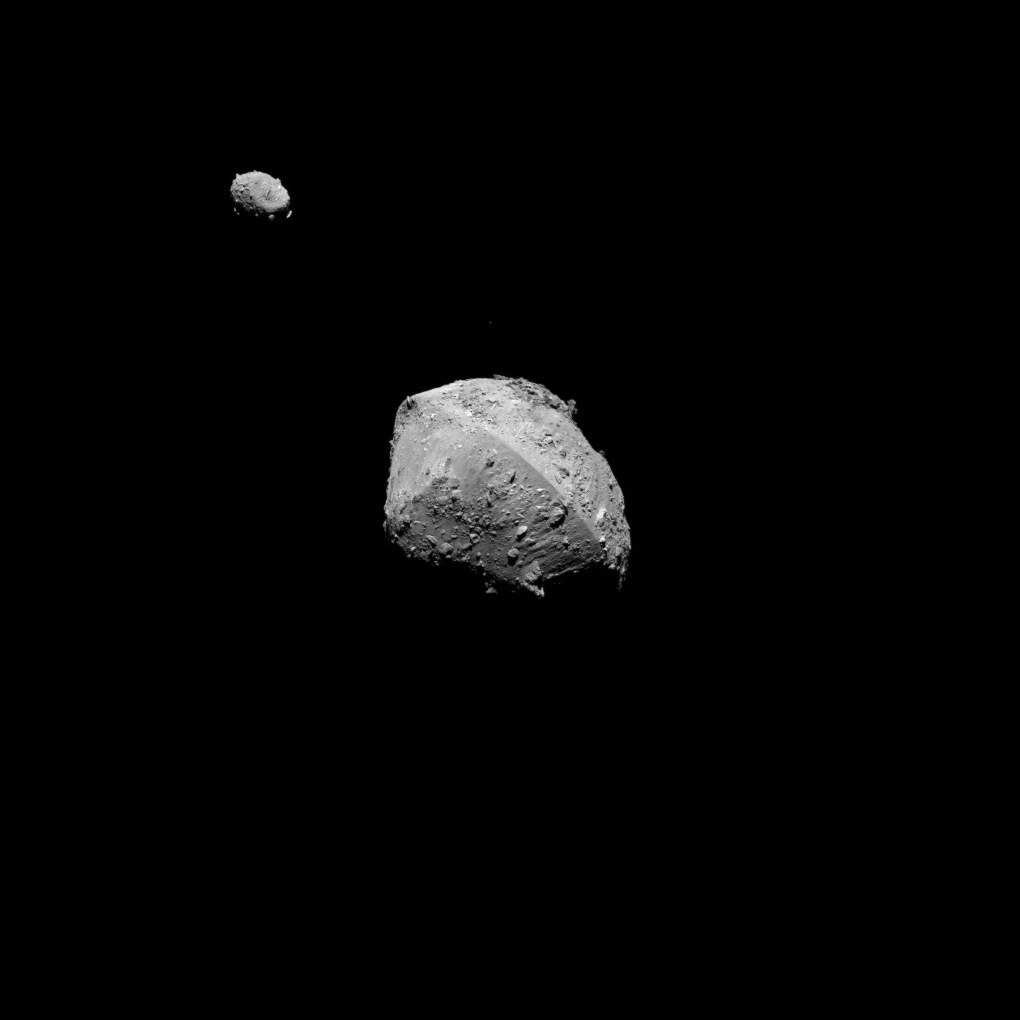
Hera’s images show that DART dramatically reshaped Dimorphos. One hemisphere of the roughly 500-foot-wide (150-meter) asteroid has been flattened by an enormous impact crater that ESA compared to the size of a sports stadium. Time-lapse imagery of Dimorphos in orbit shows the asteroid tumbling chaotically around its companion—a consequence of its newly uneven shape and the force of the DART impact.
Zooming in, Hera identified a puzzling cigar-shaped structure at the center of the impact crater. Mission scientists do not yet know what the tubular object is, but they hope to get a clearer view when Hera moves about 1.2 miles (2 kilometers) closer to the asteroid pair in December.
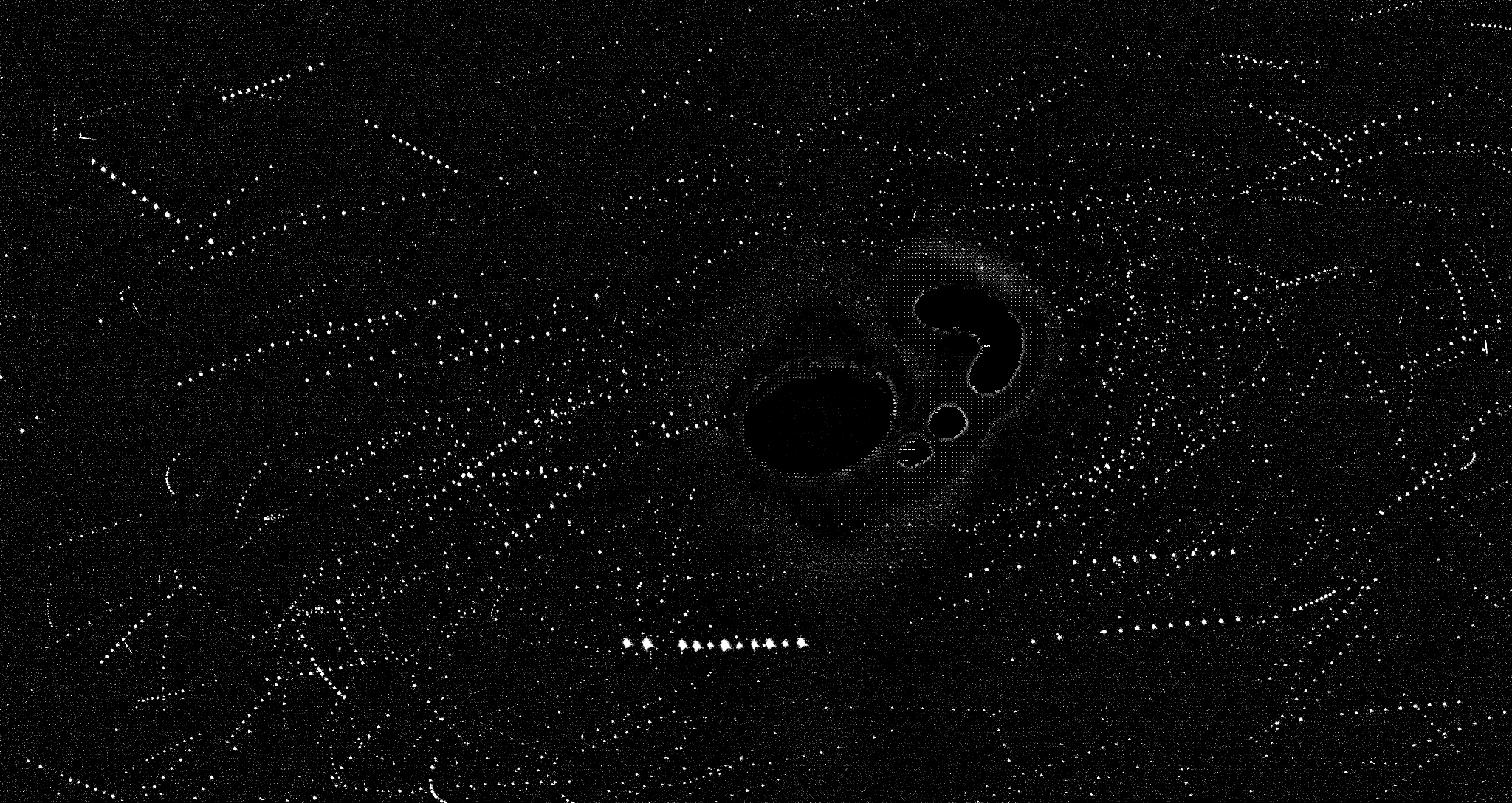
Looking around the asteroids, Hera also spotted hundreds of previously unknown boulders circling the system, most only a few feet in diameter. Ejected rocks like these are likely responsible for many of the new craters that have appeared on Dimorphos and Didymos since the DART impact.
Michael Küppers, ESA’s Hera mission scientist, described the boulders as a “big surprise” and noted that mission controllers will need to account for the rocky swarm as Hera moves closer for the next phase of its mission.
After Hera closes the gap with the asteroids in December, it will deploy two small CubeSats, Juventas and Milani, turning the mission into a three-part investigation. According to ESA, Juventas will use low-frequency radar to study Dimorphos’s interior, while Milani will analyze the composition of dust and surface material nearby.
With Juventas and Milani expected to approach Dimorphos and Didymos even more closely than Hera, the best images of this historic asteroid system are still to come.
These insights will help scientists determine precisely how effective the DART impact was and under what conditions similar methods could be used to protect Earth from potentially hazardous asteroids in the future.
Also Read
- Experimental Decavalent Vaccine Targets All Ten Known Group B Streptococcus Serotypes
- Herman Miller’s Black Friday Event Brings Rare Discounts on Iconic Office Chairs and Desks
- Classified Briefing Alleges Iran Relied on SpaceX Starlink to Coordinate Drone Strikes on U.S. Forces
- Laptop Screen Care: Can You Safely Use Alcohol Wipes?