



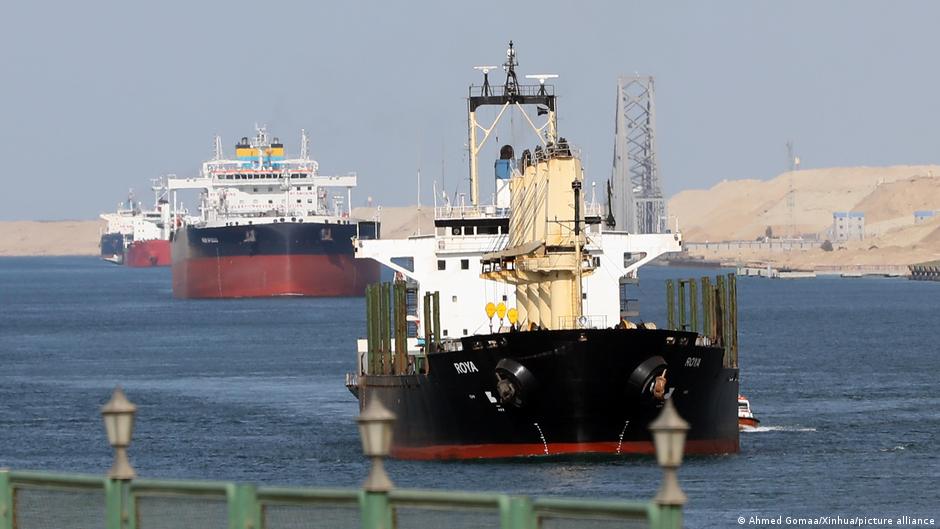
New statements from Yemen’s Houthi rebel group signal a targeted approach to restricting maritime traffic in the Red Sea, with explicit exclusion of Saudi Arabian vessels while keeping other routes passable. The militia’s formal declaration underscores their intent to control access points while avoiding total shutdown of the strategic waterway.
The Houthis have escalated their territorial control in southern Red Sea areas, most notably capturing the volcanic island of Mayun (Perim) at the strait’s entrance, alongside additional Yemeni coastal regions and adjacent islands. This expansion intensifies pressure on Saudi Arabia, which maintains an active opposition stance following an unsuccessful military campaign against the Houthis.
Energy Markets Feel Red Sea Disruptions
To view this video please enable JavaScript, and consider upgrading to a web browser that supports HTML5 video
Declining Red Sea shipping volumes carry significant financial risks for Egypt, whose national revenue increasingly depends on Suez Canal transit fees. Preliminary data shows maritime movement through the Bab el-Mandeb Strait has remained relatively stable, with Reuters reporting 24 ships on Saturday and 27 on Sunday—near 10-day averages. However, Kpler intelligence indicates Monday’s traffic dropped to 21 vessels, reflecting gradual reductions from July’s peak of 47 daily transits.
The strait’s strategic significance as a chokepoint means even limited Houthi interference could ripple through global supply chains. Stephan Roll of the German Institute for International and Security Affairs warns that while full Houthi control of the strait would not directly commandeer the Suez Canal, it provides a vulnerable vector to destabilize critical Asian-European maritime traffic patterns.
Egypt’s vulnerability has intensified following 2023 Houthi attacks that reduced Suez Canal revenues by $6 billion (€5.2 billion). The canal previously generated $9-10 billion annually before the crisis. Recent financial recoveries—including a 23% increase in the 2025-2026 fiscal year to $4.67 billion (€4.5 billion)—now face renewed uncertainty as the crisis escalates. Shipping firms’ recent use of the Red Sea route, driven by elevated fuel costs from African detours, made this recovery particularly precarious.
Strategic Pipeline Vulnerability Compounds Risks
A secondary threat emerged after Saudi pipeline attacks attributed to Iraqi groups forced Yemen’s east-west oil transport system offline for several weeks. The 1,200-kilometer pipeline previously moved 4-5 million barrels daily as an alternative to the blocked Hormuz Strait, risking 4% of global oil supply per Reuters analysis. Qatar’s Middle East Council on Global Affairs and Korea’s East Asia Institute have both highlighted dangers posed by potential dual chokepoints in Persian Gulf and Red Sea regions.
Egypt’s policy options remain constrained by its indirect involvement in the conflict. Steffen Krüger of the Konrad Adenauer Foundation notes limited Egyptian military capacity, referencing historical 1960s Yemen interventions that strained Cairo’s resources. While Egypt formally participates in the Saudi-led coalition, its role has become largely symbolic. Diplomatic negotiations appear inevitable, as Egypt seeks to balance its Saudi alliance against economic repercussions from further escalation.
Recent developments include a Houthi offer through London’s International Chamber of Shipping to discuss Red Sea security protocols with Egypt—a proposal Cairo reportedly declined to avoid perceptions of legitimizing Houthi authority. Crown Prince Mohammed bin Salman’s recent Cairo visit underscores Saudi Arabia’s determination to secure Egyptian opposition to Houthi maritime expansion.
Egypt now faces a critical period of observation as the conflict’s trajectory becomes clearer. The ultimate impact will depend on whether Houthi forces restrict shipping to Saudi-linked vessels or pursue broader disruptions, creating unprecedented challenges for Egypt’s economically vital Suez Canal operations.
This article was originally published in German.
Also Read
- Prediction Markets Signal Democratic Edge in Senate Despite Tight Race
- PCAOB Launches Fellowship Programme with Appointments of EY and Deloitte Veterans
- Egypt’s El-Sisi Condemns Any Plan to Displace Palestinians from Gaza
- Space Development Agency Admits Orbital Mesh Network Delayed by at Least a Year