






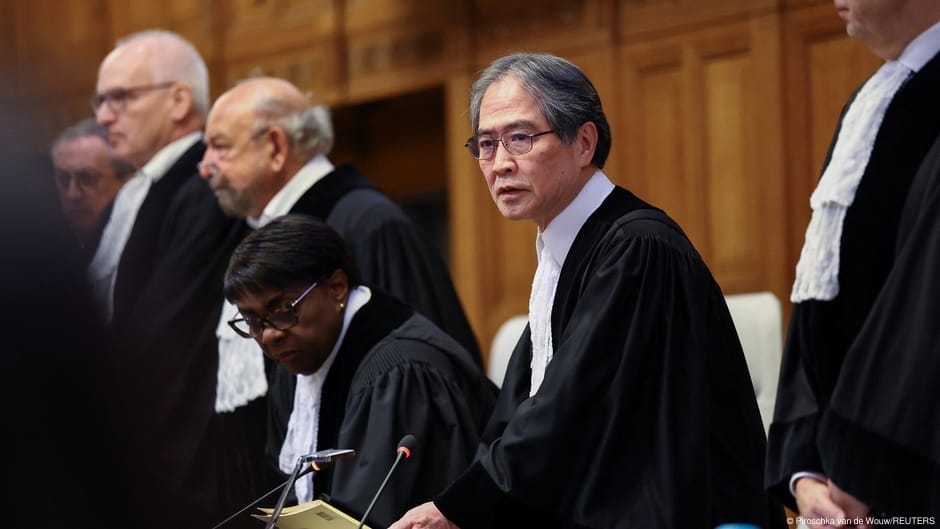
The International Court of Justice found that Myanmar had breached several obligations under international treaties aimed at preventing genocide.
Judge Yuji Iwasawa, President of the International Court of Justice, announced that the 15‑member bench reached a 9‑to‑6 decision finding Myanmar guilty of genocide against the Rohingya in Rakhine State.
The panel also concluded that Myanmar was liable for a series of additional, specific violations, with a majority vote.
According to the Court, the totality of the evidence leads to the reasonable inference that Myanmar’s actions were intended to destroy a substantial portion of the Rohingya population in northern Rakhine State,” ICJ President Yuji Iwasawa said.
Iwasawa urged Myanmar to pursue reparations for victims and, where feasible, for their families.
He also called on Myanmar to facilitate the safe return of refugees and to investigate and, if warranted, prosecute individual perpetrators within its security forces.
What is the case about?
The case concerns the 2017 military crackdown in Rakhine State, a western coastal region of Myanmar, targeting the predominantly Muslim Rohingya minority.
Tensions had been building for years, but the most intense phase of the crackdown began in August 2017 after a coordinated attack by a Muslim militia on police and military installations and personnel.
A subsequent UN fact‑finding mission estimated that roughly 10,000 people died during the ensuing clearance operations, and about 700,000 displaced persons fled to Bangladesh, where they now live in the world’s largest refugee camp.
In 2019, The Gambia filed a complaint with the International Court of Justice in The Hague, alleging a deliberate campaign of arson, rape and murder intended to eradicate the Rohingya minority, in whole or in part.
Myanmar’s powerful military, which has regained full de facto control of the country despite an ongoing civil war, maintains that its actions constitute a legitimate counterinsurgency.
Aung San Suu Kyi, then the civilian president, adopted a more nuanced position and travelled to The Hague to contest the charges, describing them as incomplete and incorrect.
Rohingya caught in the middle of Myanmar’s civil war
To view this video please enable JavaScript, and consider upgrading to a web browser that supports HTML5 video
What else did Judge Iwasawa say as he read out the verdict?
The Court affirmed that the Rohingya constitute a distinct ethnic group with their own language and culture, and self‑identify as such, thereby qualifying as a protected group under international genocide legislation.
Myanmar’s security forces killed thousands of Rohingya civilians, committed acts of sexual violence, and inflicted extreme violence against children, and also targeted Rohingya attempting to flee the fighting, Iwasawa said.
Judge Iwasawa affirmed that the 2017 clearance operations inflicted serious physical and psychological harm on a substantial number of the protected Rohingya group.
Iwasawa noted that while some civilian involvement in the clearance operations may not have been directly ordered by the state, the government and its security forces failed to take meaningful steps to prevent atrocities against non‑Rohingya civilians and, in fact, contributed to rising ethnic and religious tensions.
Iwasawa observed that Myanmar’s genuine failure to investigate the alleged atrocities, combined with its refusal to grant access to evidence, witnesses, or requested information, compromised the Court’s ability to obtain reliable information from within the country.
He added that the lack of reliable, firsthand information from Myanmar hampered the Court’s understanding of facts that were only available internally.
This is a developing story, more to follow…


