



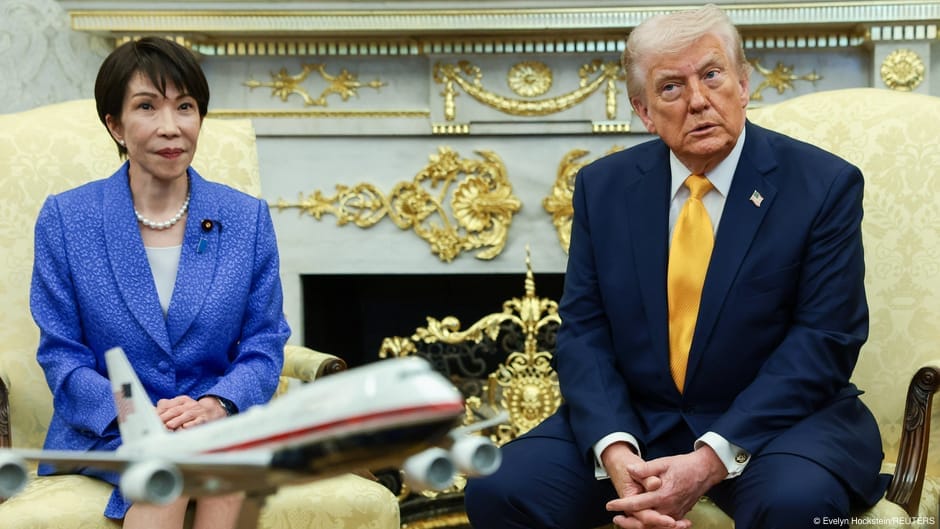
With the leaders of the United States, China and Russia convening on the sidelines of the upcoming APEC summit in just one week, Japan is intently monitoring any potential shift in Washington’s Indo‑Pacific policy.
The APEC summit, hosted this year in Shenzhen, China, is scheduled for November 18‑19.
Tokyo worries that the recent midterm setback for President Donald Trump may prompt him to pursue a rapid diplomatic victory — one he can claim as a demonstration of statesmanship — while overlooking the concerns of America’s regional allies.
Japan has moved quickly to gauge the mood within a White House still reeling from the November 3 election results.
Japanese Foreign Minister Toshimitsu Motegi met with U.S. Secretary of State Marco Rubio on Monday on the margins of the G7 foreign ministers’ meeting in Paris.
After the talks, Japan’s Foreign Ministry issued a statement indicating that both parties agreed to further develop security cooperation to bolster the deterrence and response capabilities of the Japan‑U.S. Alliance.
They also pledged to keep close communication regarding the Indo‑Pacific situation, without disclosing further details.
Will Japan become the Indo-Pacific’s most trusted power?
To view this video please enable JavaScript, and consider upgrading to a web browser that supports HTML5 video
Why is Japan worried?
Sebastian Maslow, a politics professor at the University of Tokyo, warned that, as a domestic lame‑duck, President Trump may leverage his executive powers to pivot toward foreign policy.
He added that a U.S.–China agreement could enable President Xi Jinping to increase pressure on Japan, exacerbating already strained Sino‑Japanese relations and placing Prime Minister Sanae Takaichi in a challenging position as she reconsiders U.S.–China ties.
Margarita Estévez‑Abe, an associate professor at Syracuse University’s Maxwell School and specialist in Japanese politics, noted that Japan fears a transactional Trump who might use Taiwan as a bargaining chip.
She observed that following the May summit with Xi, Trump called U.S. arms sales to Taiwan “a good negotiating chip with China.”
Tokyo is also frustrated that the Trump administration has not supported Japan regarding China’s rare‑earth export restrictions imposed after Takaichi’s remarks on Taiwan, treating the China‑Japan dispute as solely Japan’s issue.
Efforts to preserve the geopolitical balance
Japan also expresses concern about U.S. foreign‑policy positions toward North Korea and Russia.
Estévez‑Abe cautioned that, although Trump has not undermined the U.S.–Japan alliance as he has strained NATO, his outreach to Moscow and Pyongyang raises concerns for Tokyo.
She added that, because the United States depends on Japan as its primary Indo‑Pacific military base, it has no interest in bolstering Russia or North Korea against Japan. However, if U.S. restraint heightens the threat to Japan, confidence in the alliance may erode — a scenario Japan hopes to avoid.
How China uses fishing boats for military power
To view this video please enable JavaScript, and consider upgrading to a web browser that supports HTML5 video
In the end, Tokyo seeks to maintain regional geopolitical balance and prevent escalation of existing tensions, while increasingly doubting the commitment of a long‑standing security and trade partner that has supported Japan since 1945.
Maslow noted that Japan’s security strategy focuses on preserving the status quo by defending the liberal international order and containing China’s influence in the Indo‑Pacific. Nevertheless, Japan regards the U.S. alliance as a cornerstone of its foreign policy and security, and currently has no alternative plan should the partnership dissolve.
Diversifying security partnerships
He explained that Japan’s military modernization remains anchored in the U.S.–Japan alliance. While there are calls for an autonomous defense capability, achieving this in the near term is unrealistic given constraints in Japan’s defense industry and shortages of essential resources, including critical intelligence.
In the past decade, Tokyo has actively broadened its security partnerships, enhancing defense cooperation with EU members and NATO, establishing a quasi‑alliance with Australia, and participating in various minilateral frameworks across the Indo‑Pacific, such as with the Philippines.
This underscores Japan’s ambition to assume a more proactive role in shaping both regional and global security, Maslow observed.
How Japan, South Korea and Taiwan hedge vs. US shifts
To view this video please enable JavaScript, and consider upgrading to a web browser that supports HTML5 video
Estévez‑Abe said Tokyo hopes no major clashes will occur in the region over the next two years of Trump’s term and that U.S. resolve will not be tested before a new, “strategically more amenable” administration takes office.
Maslow emphasized that hope alone is insufficient; Japan must continue to safeguard the alliance and demonstrate its own security commitments through increased defense spending and by protecting economic security.
Also Read
- Hariri Crime Group Members Arrested in Daylight Tel Aviv Operation
- Securitize Acquires River One, Expanding into the $6 Trillion Asset-Backed Finance Market
- US Consumer Inflation Accelerates Beyond Forecasts in October CPI Report
- Saudi Adventurer Bravery Rescues Elderly Couple from Madinah Floodwaters