






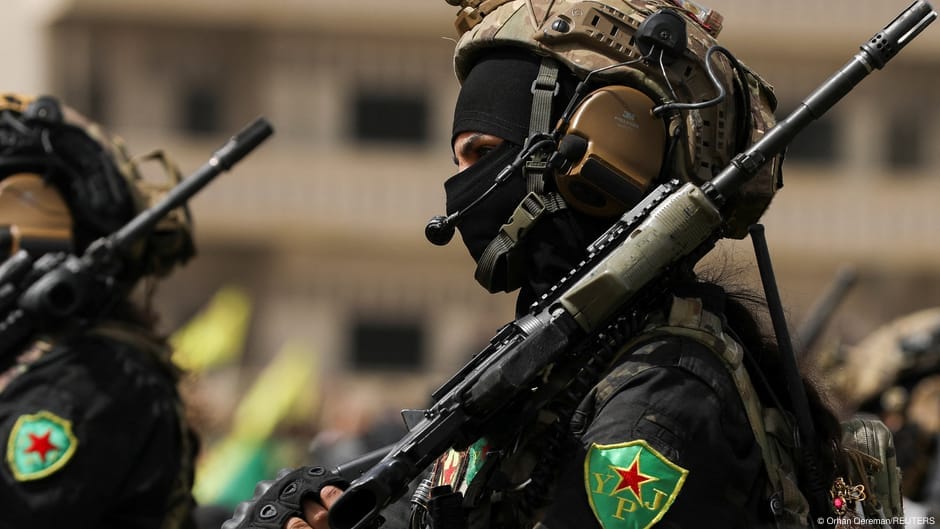
The year 2026 has proven challenging for Kurds across the Middle East. In Syria, the de facto self‑governing system that emerged in 2012 during the civil war has effectively ended.
In Iraq, internal divisions among the principal Kurdish parties persist while the central government in Baghdad intensifies pressure on the semi‑autonomous Kurdistan Region.
In Turkey, initiatives aim to conclude the decades‑long conflict with the Kurdistan Workers’ Party (PKK), which declared its dissolution last year. Nevertheless, the disarmament process is incomplete, and the PKK remains designated a terrorist organization by Turkey, the United States, the European Union and several other states.
Syria: The end of self-governance
For Syrian Kurds, the year brought a significant setback. In January, the new Damascus leadership seized control of large portions of the northeast. A January‑18 agreement required the Kurdish‑dominated Syrian Democratic Forces (SDF) to cede territory and key infrastructure to the central government, with their fighters slated for integration into the Syrian armed forces, effectively ending the de facto autonomous governance structure.
The United States, which had long supported the SDF as an ally against the Islamic State, began aligning itself with the new Damascus government.
Dastan Jasim of the German Institute for Global and Area Studies (GIGA) in Hamburg described the situation as a textbook illustration of the limits of Kurdish alliance politics.
“The bitter truth is that Western alliances with the Kurds are typically arrangements of convenience and seldom yield lasting political consequences,” she told DW.
Nevertheless, she noted that there was no alternative to confronting ISIS, emphasizing that the struggle was a matter of survival. She added that cooperation with the United States did not deliver the enduring political guarantees the Kurds had anticipated.
Political scientist Thomas Schmidinger of the University of Vienna in Austria suggests that Kurdish self‑governance in Syria may yet exert influence through experiences and lessons learned in education, women’s organizations, and local structures.
Schmidinger holds that the knowledge gained in these domains could remain relevant at the grassroots level, even though it remains uncertain which specific aspects will endure.
“The Kurds will undoubtedly continue to play a role, albeit not as an autonomous region but within the broader state framework,” he told DW.
For an entire generation raised within a de facto autonomous self‑governing region, the termination of Kurdish autonomy — a quasi‑state entity with its own armed forces — represented a profound rupture and deep disappointment. Many had viewed it as the foundation for a future independent Kurdish state.
Iraq: Autonomy without common policy
Kurdish communities in northern Iraq — known as Kurdistan — continue to face difficult circumstances. Beyond mounting pressure from Baghdad’s central government, the longstanding rivalry between the two dominant parties — the Kurdistan Democratic Party (KDP, also known as PDK) and the Patriotic Union of Kurdistan (PUK) — undermines the autonomy institutions at a critical moment. More than two years after regional elections, no stable regional government has been formed, and the parties are consolidating their influence while pursuing divergent regional alliances.
“The situation is very unstable,” GIGA’s Dastan Jasim observed.
Although autonomy is enshrined in the constitution, a lack of well‑functioning institutions hampers effective decision‑making.
Schmidinger also notes that instability among Iraqi Kurds is largely driven by the political elites of the PUK and the PDK.
An October 2026 analysis by the British think tank Chatham House warned that significant consequences could arise.
“The ongoing stalemate between the KDP and the PUK threatens to trigger an irreversible decline in the very structures that have enabled Kurdish self‑governance over the past two decades,” the analysis states.
Baghdad and neighboring states may benefit from this shift. Moreover, the erosion of Kurdish autonomy may already be underway: on Tuesday, November 24, Iraq’s central government ordered the border crossings of the Kurdish autonomous region and several oil fields previously under Kurdish control to be placed under central government authority without prior notice.
Kurdistan Regional Government Prime Minister Masrour Barzani described the measure as “unacceptable.”
This development is likely to intensify disputes between Baghdad and Kurdistan over oil exports and jurisdictional responsibilities, although the extent remains uncertain. Many Iraqi Kurds are expected to regard the Syrian developments as a cautionary example, especially given that the United States has also withdrawn its military presence from Iraq.
The uncertain future of the Kurds in the new Syria
To view this video please enable JavaScript, and consider upgrading to a web browser that supports HTML5 video
Also Read
- France Enters Technical Recession Amid Budget Strains and 2027 Election Uncertainty
- The Ukraine War at Sea: A Maritime Perspective
- How the inaugural SAIF has become a key platform for global and regional innovators
- Earnings Volatility Watch: Options Price Massive Swings for Credo, Marvell, and Salesforce


