






Metaplanet’s rapid Bitcoin accumulation has placed an executive compensation provision under shareholder scrutiny, with investors urging the Tokyo-listed company to unwind the resulting windfall.
The controversy stems from an options pool that expanded alongside repeated equity issuances used to finance the company’s Bitcoin purchases.
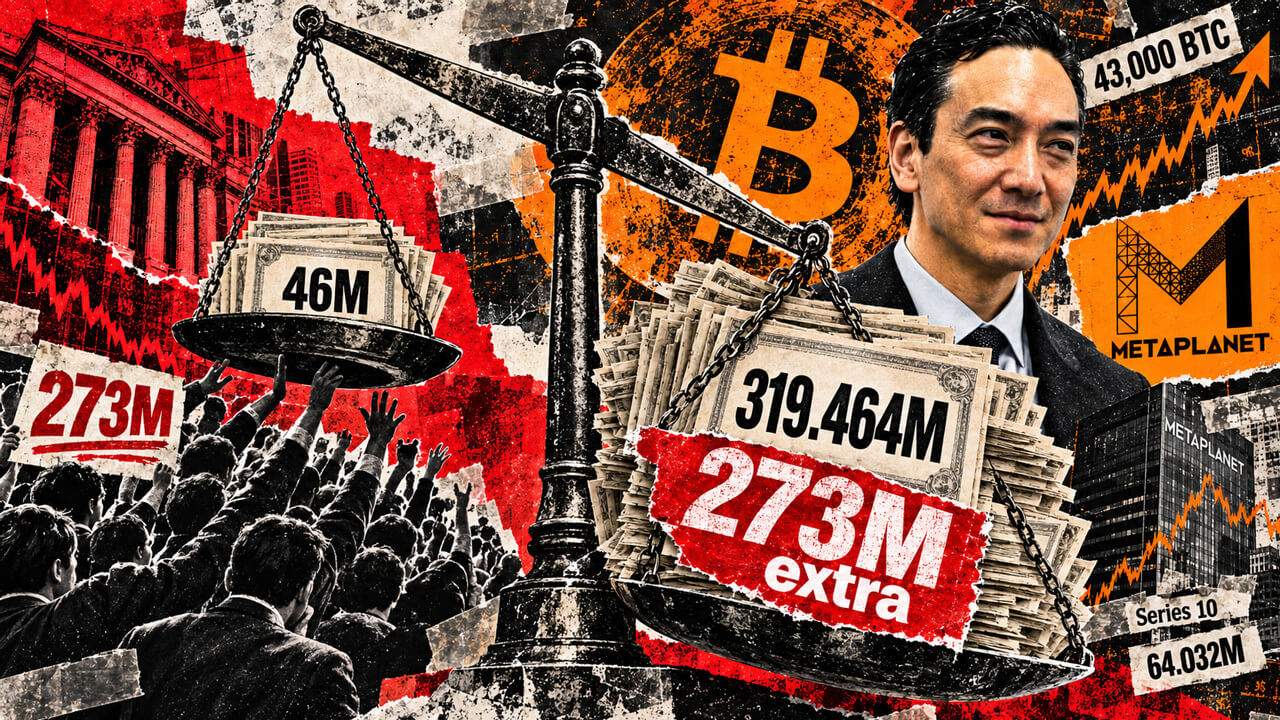
Investors are seeking the cancellation of approximately 273 million potential shares added to the management compensation package during that period.
Bitcoin fundraising enlarged the executive pay pool
At the center of the dispute are Metaplanet’s Series 10 stock-acquisition rights. Shareholders approved the plan in early 2023, before the company shifted toward digital assets, when it covered 46 million shares.
The plan included an adjustment mechanism intended to keep the shares underlying the options equivalent to roughly 20% of a defined fully diluted share count.
That calculation became far more consequential after Chief Executive Simon Gerovich adopted a Bitcoin treasury strategy in April 2024. Metaplanet repeatedly raised equity capital to buy Bitcoin, ultimately expanding its holdings to 43,000 BTC.
Shares outstanding increased from approximately 153.9 million when the Bitcoin strategy began to 1.28 billion by the end of June 2026. As the Series 10 formula adjusted with the capital structure, the executive options pool grew from 46 million to 319.464 million potential shares.
Metaplanet removed the adjustment mechanism on Aug. 18, preventing any further expansion.
In its notice, the company acknowledged that the provision “amplifies the dilution borne by existing shareholders” and could create concerns about how capital-raising decisions align with the interests of stock-acquisition rights holders.
Even so, Metaplanet preserved the compensation pool at its enlarged level instead of restoring it to the original size.
The decision left management with roughly 273 million additional potential shares that had accumulated before the mechanism was abolished.
Gerovich converts part of the award into 64 million shares
Shareholder opposition intensified after Gerovich exercised a portion of his compensation award shortly after the August amendment.
On Aug. 28, the chief executive exercised 92,000 Series 10 rights and received 64.032 million newly issued shares. The transaction increased his direct holdings from 15.56 million to nearly 79.6 million shares.
Gerovich paid the legacy exercise price of ¥10 per share, for a total cost of approximately ¥640.3 million.
With Metaplanet shares valued at ¥244, the newly issued shares were worth about ¥15.6 billion, creating an unrealized gain of nearly ¥15 billion over the exercise cost.
The shares remain subject to a five-year lockup introduced by the August amendment, which generally bars sales or transfers until August 2031.
The dilution, however, occurred when the new shares were issued.
Gerovich held 276,000 of the 459,000 outstanding Series 10 rights as of June 30. After exercising 92,000 rights, he would retain approximately 184,000, assuming no other changes. Other executives and employees hold additional rights, while further portions of their awards are scheduled to vest through 2028.
Compensation overhang affects Bitcoin per share
Investors are closely monitoring the compensation pool because it directly affects Metaplanet’s Bitcoin per fully diluted share, one of its key treasury metrics.
As of June 30, the company held 43,000 BTC against approximately 1.63 billion fully diluted shares, equal to about 2,635 satoshis per share. The calculation includes the potential dilution from the Series 10 awards.
Shareholder Ragnar is among those calling for the roughly 273 million potential shares added beyond the plan’s original scope to be canceled. He wrote on X:
“The only way out is to roll back the 273 million extra shares, and to replace them with a new, retroactively applied incentive program.”
Removing those potential shares from the denominator would increase Metaplanet’s Bitcoin-per-share exposure to approximately 3,166 satoshis, a gain of roughly 20%, assuming all other factors remained unchanged.
Ragnar has questioned why executives should retain the additional compensation after Metaplanet concluded that the mechanism increased shareholder dilution and raised concerns about capital-raising incentives.
He also cited an international offering conducted last year, saying the adjustment clause generated another 96.25 million potential shares. According to Ragnar, investors publicly challenged the arrangement in September and October 2025, several months before the company eliminated the mechanism.
The additional shares were not subject to new performance requirements tied to Bitcoin-per-share growth or other shareholder-return measures, although Metaplanet’s August changes imposed the five-year sales restriction.
Ragnar argues that the company should replace the enlarged award with compensation linked directly to future performance instead of preserving benefits accumulated under the discontinued formula.
Governance scrutiny extends to MMXX
The compensation dispute is unfolding alongside a separate governance debate involving MMXX Ventures, a recurring Metaplanet shareholder and former lender.
Gerovich recently described himself as a “significant but non-majority shareholder” in MMXX’s parent company, adding that he does not take part in the entity’s investment or trading decisions.
Investors continue to seek more information about MMXX’s ownership and voting arrangements, as well as Gerovich’s economic exposure to transactions involving Metaplanet.
Metaplanet has proposed transferring as many as 90,000 remaining Series 10 rights—equivalent to 62.64 million potential shares—into a new long-term incentive vehicle for executives and employees. The structure could include performance and service requirements without adding shares beyond the existing ceiling.
Gerovich has acknowledged deficiencies in the company’s communication and said Metaplanet is continuing to review its governance and compensation practices.
That response has not addressed investors’ central demand. Metaplanet has stopped increasing the executive options pool through future equity issuances, but management has not agreed to surrender the roughly 273 million potential shares created before the adjustment mechanism was abolished.
Also Read
- Switzerland’s CHF Stablecoin Project Enters Pilot Testing With Nine Institutions
- US forces strike Iranian tankers linked to IRGC after warship attack claim
- Gold Dips Toward $4,350 as Middle East Tensions Fuel Inflation Jitters Ahead of Key US Data
- Why Bitcoin bulls shouldn’t mistake a shrinking dollar reserve share for central bank buying


