







Monad, an EVM-compatible blockchain, officially activated its MonadTen revision on the mainnet at 14:30 UTC on September 2. This key milestone introduces the MIP-8 upgrade, which overhauls how the network charges smart contracts for reading storage. The system transitions from individual slot-by-slot warming to grouping consecutive slots into larger pages.
For instance, in block 101672712, reading slot 0 cost 8,100 gas, while reading slot 1 on the same page cost only 100 gas. Reading slot 128, which begins a new page, again incurred the full 8,100 gas charge.
The official MonadTen release recorded the activation at Unix timestamp 1788359400. Any transactions executed prior to this timestamp were governed by the previous MonadNine rules.
Storage layout now changes the bill
According to the final MIP-8 specification, a storage page is defined as 128 words of 32 bytes each, totaling 4,096 bytes. The first storage load (SLOAD) operation on any page costs 8,100 gas. Subsequent reads within that same warmed page cost only 100 gas for the remainder of the transaction, subject to standard rollback rules if a call frame reverts.
Under the previous pricing model, two adjacent but untouched storage slots would each cost 8,100 gas. With the new page-based pricing, the first slot costs 8,100 gas, and the second slot costs just 100 gas, provided they reside within the same page.

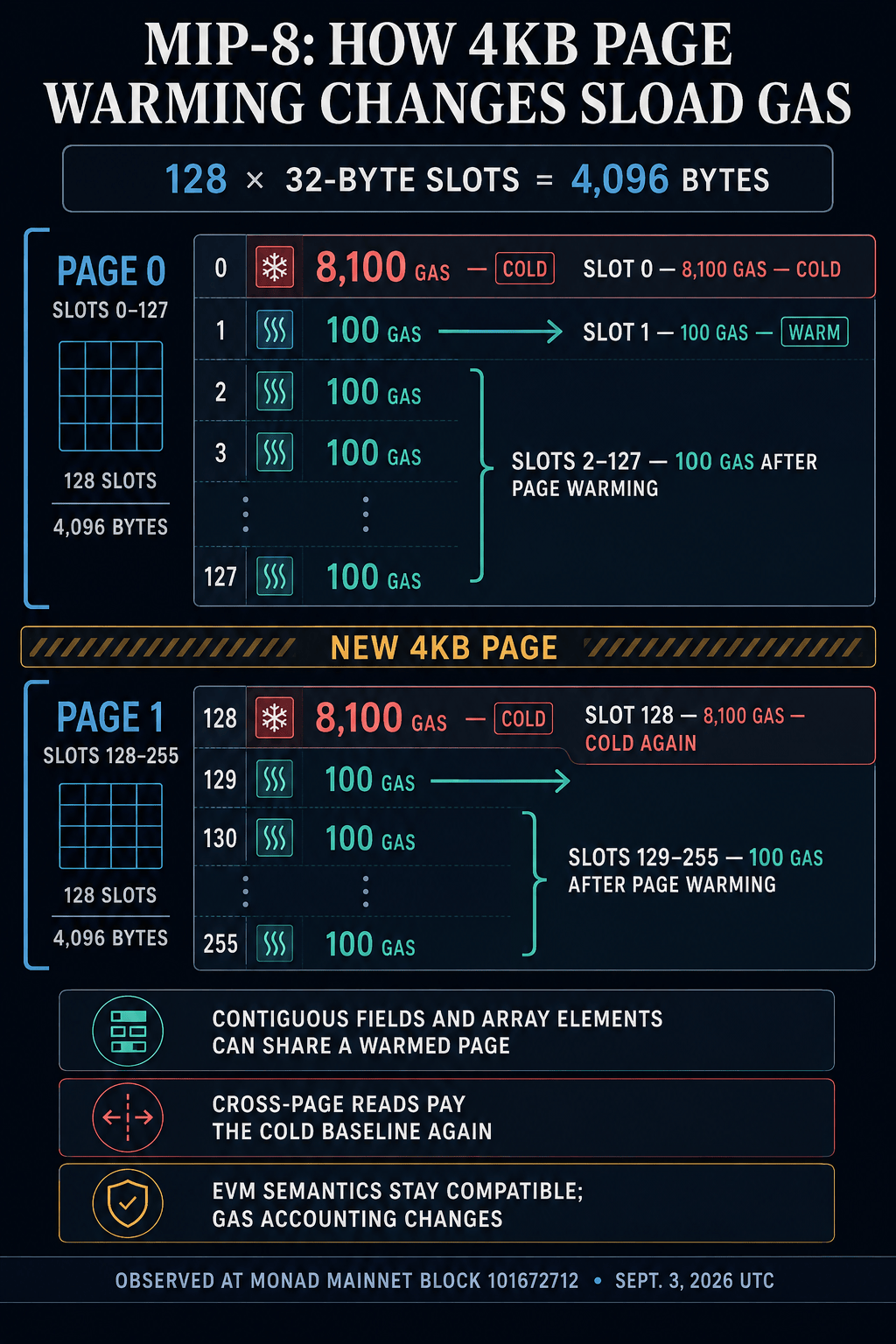
Common Solidity layouts can inherit this discount automatically. Sequential state variables, struct fields, and array elements occupy consecutive slots, making repeated reads highly likely to stay within a warmed page and benefit from the reduced cost.
While a mapping key generally resolves to a separate, dispersed page, fields inside a struct stored under that key remain contiguous and can still share the page-level discount.
Hashed or unaligned storage patterns keep Monad’s existing cold baseline intact. Reads that cross page boundaries still cost 8,100 gas each. Ultimately, savings depend on how many slots a transaction touches and how closely those slots cluster within the same 128-slot boundary.
MIP-8 preserves core EVM execution semantics while shifting the assumptions used by tooling that builds access lists, storage proofs, or gas estimates. EIP-2930 entries now warm entire pages, and proof formats must be updated to represent this page model. The specification identifies contracts that hardcode storage opcode gas costs as the primary compatibility risk class.
For developers, the practical incentive is clear: data read together is significantly cheaper when stored close together.
Also Read
- EUR/JPY Price Forecast: Trades near 181.50 after rebounding from descending channel bottom
- New Zealand Dollar Advances Toward 0.5900 as Traders Await US Employment Data
- Bitquery report finds 96,000 fake-address text outputs clogging Bitcoin’s unspent transaction database
- WTI hovers around $89.50 as US military escorts tankers through Hormuz earlier this week


