







A blockchain data research company, Bitquery, released a comprehensive study on September 2 examining four distinct methods through which text appears in Bitcoin. The analysis scanned 965,135 blocks and demonstrated that identical word content can generate substantially different costs for network nodes depending on the embedding method used.
The research identified 13,062 OP_RETURN taunt transactions that introduced no additional spendable state to the network. In contrast, 96,231 fake-address text outputs persist within the unspent transaction output (UTXO) set, continuing to occupy node storage capacity.
A notable campaign occurring between March 21-26, 2026, referenced Bitcoin Core developer Luke Dashjr using the same two-sentence message across multiple transactions. Bitquery’s analysis documented 13,062 transactions originating from 13,062 separate sending addresses distributed across 579 blocks, with combined transaction fees totaling 0.1014 BTC. While the blockchain permanently records this text, timing information, input details, and fee data, it provides no means of identifying the responsible party or establishing motive.
Examining the broader dataset, Bitquery categorized 4,412,782 OP_RETURN outputs as containing readable text content. The computational burden these impose on nodes differs significantly from fake-address text, as Bitcoin’s architecture handles these two output categories through distinct mechanisms following transaction confirmation.
OP_RETURN outputs do not require retention within the UTXO database that nodes utilize to verify coin spendability, though the text remains preserved in Bitcoin’s immutable block history. The Bitcoin developer documentation characterizes this null-data construction method as superior to alternatives that generate seemingly spendable outputs and consequently expand the UTXO set unnecessarily.
Fake-address text operates by inserting readable byte sequences into the field typically reserved for an address hash. Network nodes interpret this as a standard spendable output, even though the embedded text corresponds to no known private key, rendering any associated funds permanently inaccessible.
Bitquery’s classification identified 96,231 such outputs spanning 3,286 transactions, with an estimated 3.2 BTC locked in effectively unspendable states. These outputs remain as current operational data within nodes unless they are eventually spent through some mechanism.

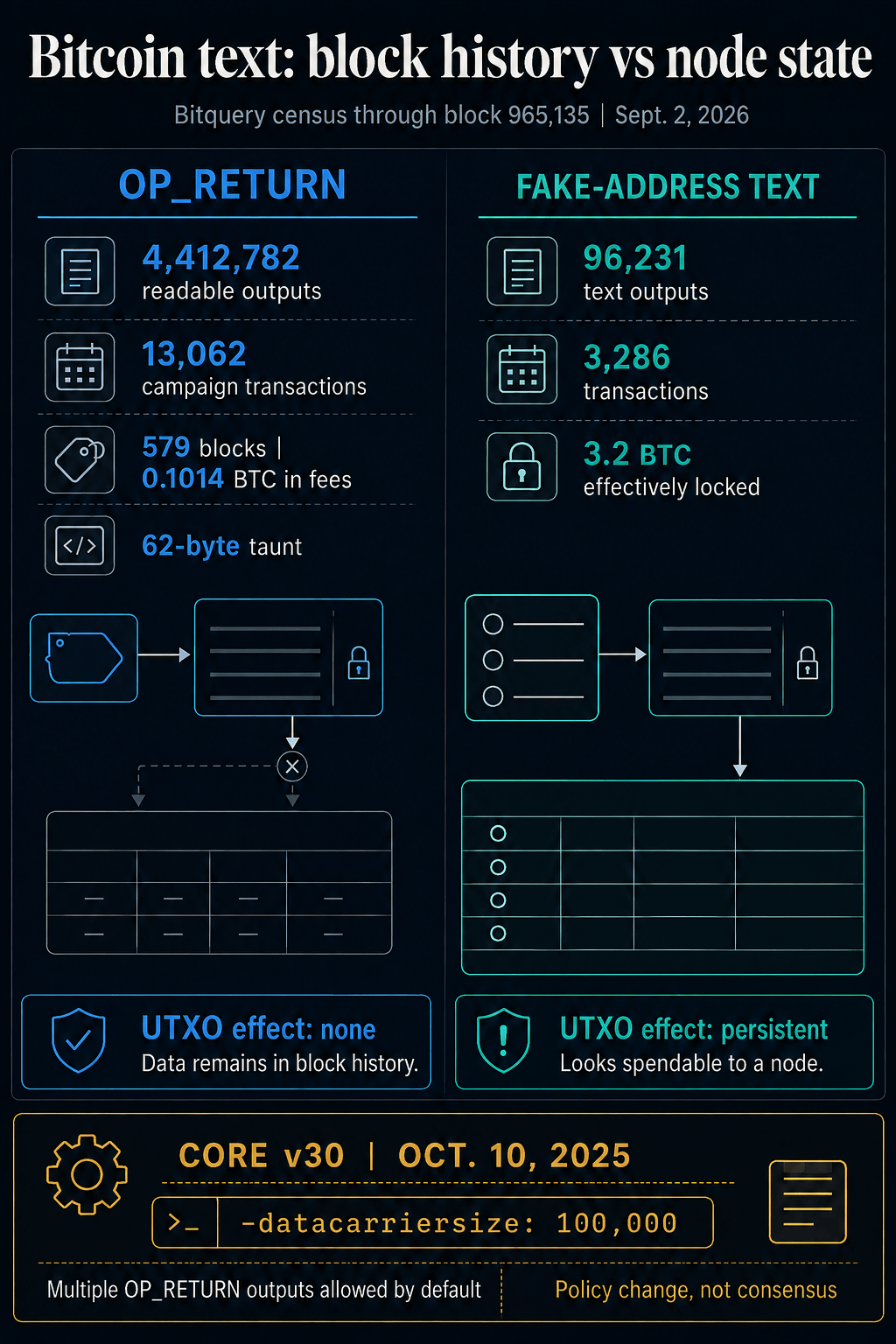
The release of Bitcoin Core 30.0 in October 2025 modified default relay policies to facilitate larger OP_RETURN transactions. The update elevated the default -datacarriersize parameter to 100,000 and permitted several OP_RETURN outputs beneath an aggregate threshold for both relay and mining operations.
These modifications to standardness policy did not alter the fundamental consensus rules governing block validity.
Bitquery’s findings indicate that messages exceeding the previous 80-byte payload threshold appeared only sporadically in most months prior to version 30, then escalated to thousands of occurrences by February 2026. The simplified default propagation parameters provide one plausible explanation for this increase, though the observational data cannot conclusively establish that the v30 release alone triggered the shift.
The March taunting campaign’s text content measured 62 ASCII bytes, fitting comfortably beneath the prior ceiling. This campaign effectively demonstrates the minimal expense associated with repeating OP_RETURN text following the v30 protocol changes.
The Bitquery study faced certain limitations, including missing coinbase field data for 191,427 historical blocks and the exclusion of witness inscriptions from the analysis. Consequently, the research compares four measured text embedding channels rather than providing an exhaustive inventory of all text content within Bitcoin.
Within this analytical framework, OP_RETURN methodology expands block historical records without inflating the UTXO set, whereas fake-address text generates the persistent node-state burden that concerns network efficiency advocates.


