






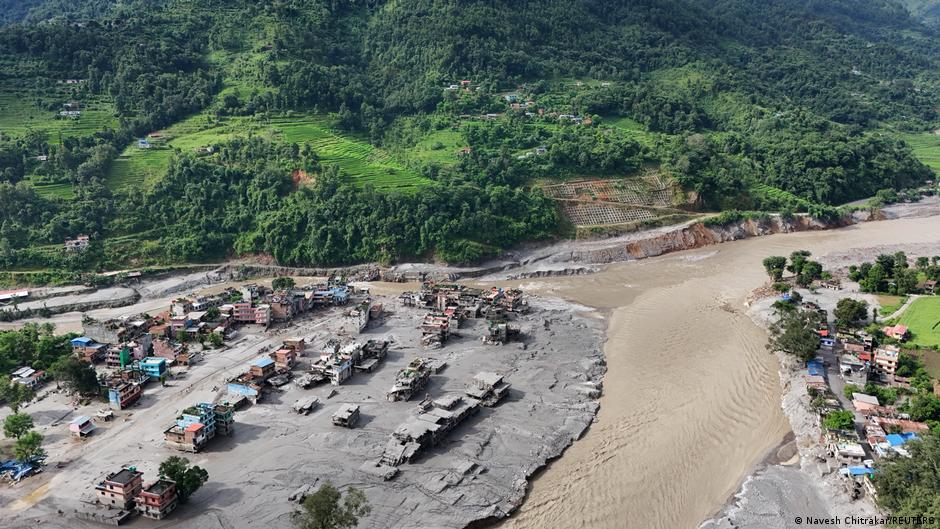
The death toll in Nepal has climbed into the hundreds after a devastating flash flood on Wednesday, and the full extent of the damage remains uncertain.
Residents of the affected regions informed DW that numerous villages are still isolated, lacking both road access and communication links to Kathmandu.
Bidhya Rajput, a journalist stationed in Kathmandu, reported that her residence in Sole village, Nuwakot District, was carried away by the Trisuli River.
She said, “As far as we know, only four or five residents of Sole village managed to escape to higher ground; the sudden surge left the rest with no chance to flee.”
Authorities have identified Nuwakot, Rasuwa, and Dhading districts as the hardest‑hit areas by the lethal flooding.
Rajput informed DW that her husband’s parents are still unaccounted for; her father‑in‑law, a teacher, may have been swept away while heading home from work, according to the school principal.
Her husband has ventured toward the village to seek news of his relatives, even though many roads are damaged or washed away. She added that no information has emerged from the area since early Thursday morning, when power and mobile service were cut.
“Rescue and relief operations have largely focused on larger cities,” she noted, “and state aid has not yet arrived in Sole.”
Villagers recalled that the same region experienced flooding the previous year, but many were able to reach higher ground then, and the water levels were lower than those seen on Tuesday.
Rajput remarked, “If residents had received early warnings and anticipated the scale of this flood, they could have sought safety as they did last year. This time, they were denied even that opportunity.”
‘Two of My Close Relatives Are Still Missing’
Usha Kiran Timsena, an opposition politician from Nuwakot, said that police and local authorities had issued warnings about an impending massive flood, yet many residents underestimated the flood’s scale and rapid onset.
She told DW, “Many who lived a little distance from the rivers dismissed the threat and found themselves unable to escape once the waters reached their homes.”
“Two of my close relatives have been missing since yesterday morning, and there has been no news or contact since,” she added.
Devastating Flash Floods Strike Northern Nepal
To view this video please enable JavaScript, and consider upgrading to a web browser that supports HTML5 video
Officials reported that over three dozen bridges—both motorable and suspension—as well as about a dozen hydropower dams, have been destroyed by the floodwaters.
Sujan Lohani of Dhading told DW that he had not anticipated the Trishuli River’s flooding to cause such extensive and widespread damage.
The principal bridge spanning the Trishuli River, which links his district headquarters to Kathmandu, has been washed away.
He told DW, “I am concerned that my cousin may still be in the village. We are cut off from Kathmandu.”
Hundreds of Survivors Airlifted from Affected Regions
Nepalese authorities are scrambling to reach survivors in the impacted zones. With more than 1,300 people still unaccounted for—including hundreds of foreign nationals—as of Thursday, neighboring India and China are coordinating with Kathmandu on the disaster response.
Rescue crews are airlifting stranded and injured individuals to the capital, while police, military personnel, and civilians are constructing temporary shelters for those displaced.
“We are deploying every possible effort to save lives,” said Nepal’s Minister for Information and Communication, Bikram Timilsina, in an interview with DW.
Timilsina, who represents the flood‑affected Nuwakot‑1 constituency in the House of Representatives and is presently in the region, described the devastation as enormous.
He said, “Entire villages have been washed away, many lives have been tragically lost, and numerous people remain out of contact.”
Timilsina added, “I do not believe our state apparatus had ever envisioned a flood or disaster of this scale.”
At the same time, Timilsina noted that the state has mobilized all available resources—including more than a dozen helicopters—to ferry survivors to safety and deliver aid. According to the minister, at least 414 stranded individuals, including 164 foreigners, had been airlifted by midday Thursday.
What Experts Say About the Flood’s Cause
Scientists continue to debate the precise trigger of the natural disaster, even as Beijing asserts that a high‑altitude glacier collapse set off the floods.
Sudip Thakuri, a climate scientist and associate professor at the Central Department of Environmental Science, Tribhuvan University, told DW that early assessments suggest the flood likely originated from an avalanche on the Nepali side of the Nepal‑China border.
He explained, “Thus far, our conclusion is that a large avalanche initially dammed a river flowing south from China’s Tibetan Autonomous Region. When the landslide dam formed by the avalanche broke, it may have also dragged a downstream subglacial lake with it, unleashing massive flooding.”
Another climate scientist, Rijan Raj Kayastha, who lectures at Kathmandu University, warned that additional glacial lakes in the vicinity could pose a further flooding risk.
Separately, Chinese officials cautioned that a lake in Tibet’s Gyirong region, located upstream of the flooded zone in Nepal, is already overflowing, with an additional three million tons of water expected to flow into it over the next three days.
Edited by: Wesley Rahn
Also Read
- Parents and teachers in Ituri call for school reopening delay as Ebola crisis escalates
- Greek Orthodox Priest-Musician Defines Traditional Church Stance on Homosexuality While Emphasizing Pastoral Acceptance
- Evaluating the Sustainability of High-Yield Monthly Dividend ETFs Offering 8% to 13% Returns
- Salesforce Shares Break Out Post-Earnings: Technical Analysis Signals Further Upside


