




Scientists long believed that RNA, which kick-started life on Earth 4 billion years ago, could form only small, simple structures. However, new research demonstrates that naturally occurring RNA molecules can adopt large, sophisticated geometries, such as filaments and cages. This discovery raises questions about whether these structures were present during life’s earliest stages.
According to the RNA world hypothesis, RNA-based life preceded modern organisms that rely on DNA and proteins. RNA, a molecular cousin of DNA, retains roles in contemporary cells but no longer serves as the primary genetic material. Primordial organisms used RNA to store genetic information and catalyze reactions, functioning as enzymes. Proteins eventually dominated as enzymes due to their greater folding diversity, composed of 20 amino acids with unique structures, whereas RNA consists of just four nucleotide subunits with similar shapes.
A study published on bioRxiv in July 2025 challenges this assumption, showing that RNA can form complex structures. “We show RNA can do things which we have never seen before,” said Lin Huang, an RNA biologist at Sun Yat-Sen University. “It suggests that at the origin of life, RNA could assemble into all kinds of shapes,” he noted.
Huang and colleagues hypothesized that RNA molecules with sequences folding into “kissing stem loops”—structures resembling shoelace loops—could link together. These loops from different RNAs might bond, forming larger complexes. The researchers identified bacteriophage-encoded RNA molecules capable of forming such loops and observed their assemblies using cryo-electron microscopy. Some RNAs formed filaments resembling cellular cytoskeletons, while others built cages resembling viral capsids.
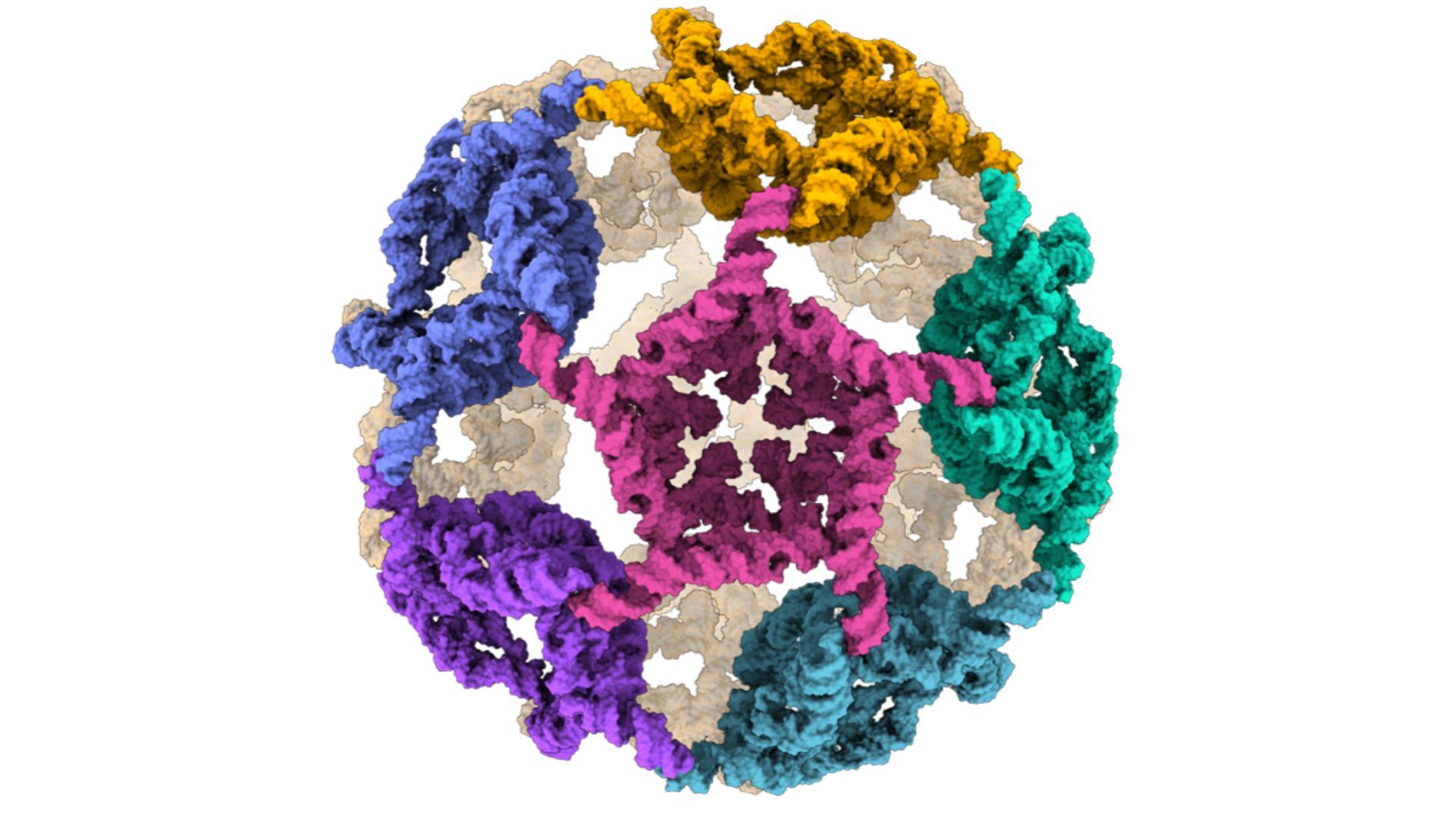
These RNA-based structures, some matching the size of viral capsids, prompt speculation about their role in early genome packaging. However, confirmation requires environmental replication under primordial conditions. “Environmental parameters are crucial,” noted Anna Medvegy, an evolutionary biologist not involved in the study. “If these structures form under high-temperature, low-pH conditions, it strengthens their relevance to the RNA world.”
The RNA filaments and cages were constructed in labs using short RNA strands (under 200 subunits). Short RNAs being less prone to degradation than longer ones, this supports the plausibility of such structures forming in early Earth environments. Further testing is needed to determine if cellular factors in bacteriophage-infected bacteria disrupt or enable these assemblies.
Insights from this study extend beyond origins of life. RNA-based cages could revolutionize biotechnology, paralleling DNA origami drug delivery systems. “These findings highlight RNA’s untapped potential,” Huang suggested, opening avenues for medical innovations leveraging RNA’s structural versatility.
Ren, Y., Zhang, Z., Chen, K., Li, M., Xie, Y., Bai, T., Huang, B., Xiao, B., Westhof, E., Lilley, DMJ, Wang, J., Miao, Z., Wei, X., & Huang, L. (2026). Structural assemblies for an RNA world. bioRxiv.