







[Mild NZD Support from Narrow Centre‑Right New Zealand Election, Currencies Remain Cautious]
A narrow centre‑right lead following Saturday’s New Zealand election has slightly reduced the immediate risk of a more dovish Reserve Bank of New Zealand (RBNZ) policy stance, providing only mild support to the New Zealand Dollar. However, the party coalition holds a one‑seat majority that remains fragile, as special votes still need to be counted until 27 November, and neither the AUD/NZD nor the NZD/USD pairs have confirmed a technical reversal.
Why Is the New Zealand Election Giving NZD Only Mild Support?
The New Zealand Dollar entered the week on firmer ground after Saturday’s general election resulted in a narrow centre‑right majority, slightly lowering the immediate chance of a pivot in the Reserve Bank of New Zealand’s monetary‑policy stance. The political edge, however, remains unsecured: the centre‑right bloc holds only a one‑seat majority, and a significant number of special elections—about 400,000 voters (≈14 % of the eventual total)—are still pending, with official results due on 27 November. Market reactions have been restrained overall; NZD/USD climbed roughly 0.6 % to 0.5591, while AUD/NZD dipped 0.13 % to near 1.2315. These modest moves indicate that the election has offered limited direct support to the Kiwi, with broader risk sentiment playing a larger role. Crucially, neither the AUD/NZD nor the NZD/USD pairs have signalled a reversal, preserving a structural vulnerability despite the political shift.
Centre‑Right Leads, but Special Votes Could Change the Outcome
The preliminary results awarded National 42 seats, ACT 13 and New Zealand First 12, delivering the centre‑right coalition 67 seats out of a 131‑seat parliament—just one seat above the 66‑seat majority floor. Labour emerged with 36 seats, the Greens 16, Te Pāti Māori five, and the Opportunity Party captured seven seats, potentially becoming a key player in any coalition talks.
- Centre‑right bloc: National 42, ACT 13, New Zealand First 12, total 67 seats, one above the 66‑seat majority threshold.
- Opposition and others: Labour 36, Greens 16, Te Pāti Māori 5, Opportunity Party 7.
The arithmetic of the parliament remains uncertain, as roughly 400,000 special votes—about 14 % of the eventual total—are still pending and will be counted after 27 November. Westpac observes that special votes tend to erode the centre‑right’s narrow election‑night edge, especially given National’s unique electorate overhang, which complicates the usual translation of party‑vote shifts into seat totals.
One particularly important contest is the Wairarapa electorate, where National leads Labour by just 139 votes. According to Westpac’s analysis, a Labour win here could shrink the centre‑right coalition to 66 seats within a 130‑seat parliament, leaving it vulnerable to minor adjustments in the party list.
Westpac considers another centre‑right government the more likely outcome, potentially requiring support from the Opportunity Party. Nevertheless, the narrow majority and unsettled seat allocation suggest that coalition negotiations could be complicated, with either political bloc facing constraints on major policy initiatives.
Stay ahead of the New Zealand election count and the RBNZ’s next signals for the Kiwi; join the ActionForex Telegram channel for regular market updates and analysis.
RBNZ Mandate Offers Modest Support, but Policy Uncertainty Persists
The most immediate impact on the New Zealand Dollar stems from the RBNZ’s monetary‑policy mandate. A centre‑right government would maintain the current framework, whereas a centre‑left administration would be more inclined to re‑introduce a dual‑mandate that emphasises both inflation stability and employment.
Such a shift could be perceived as somewhat dovish, as it would give employment conditions a formal role alongside price‑stability objectives in the RBNZ’s policy framework. In effect, the centre‑right lead provides only selective support for the NZD relative to a centre‑left regime that might revive a broader mandate.
Meanwhile, the RBNZ continues to face economic uncertainty regardless of the election outcome. Following weaker‑than‑expected third‑quarter labour‑market data, Westpac projects a December rate hike as more probable than not, while policymakers are expected to balance calls for continued tightening against growing concerns over deteriorating job conditions.
The RBNZ has indicated that persistent labour‑market weakness may slow the pace of rate tightening without necessarily altering the ultimate path of the Official Cash Rate. A gradual alignment of New Zealand rates with global benchmarks would therefore restrain the upside potential for the NZD.
NZD Strength Reflects More Than the Election
Monday’s currency movements offer limited evidence that investors have significantly re‑priced New Zealand’s political outlook.
NZD/USD climbed roughly 0.6 % from its weekly opening, whereas AUD/NZD fell 0.13 % to approximately 1.2315. The pair briefly touched 1.2295 before rebounding, staying comfortably above the key support level of 1.2266/83.
The broader market context also supported risk‑sensitive currencies. The NZD led among the major currencies in the early session heat map, with AUD in second place and the USD lagging. Asian equities saw a rebound, driven by the Nikkei’s 3.44 % gain and Kospi’s 1.56 % lift, indicating that broader sentiment outside New Zealand helped lift the Kiwi.
The contrast between NZD/USD and AUD/NZD is noteworthy. Although the election may have afforded the Kiwi a slight relative edge, the muted pullback of the AUD has prevented the political outcome from prompting a decisive reassessment of the currency.
ActionForex’s Technical View: AUD/NZD, Uptrend Still Favored Despite Pullback
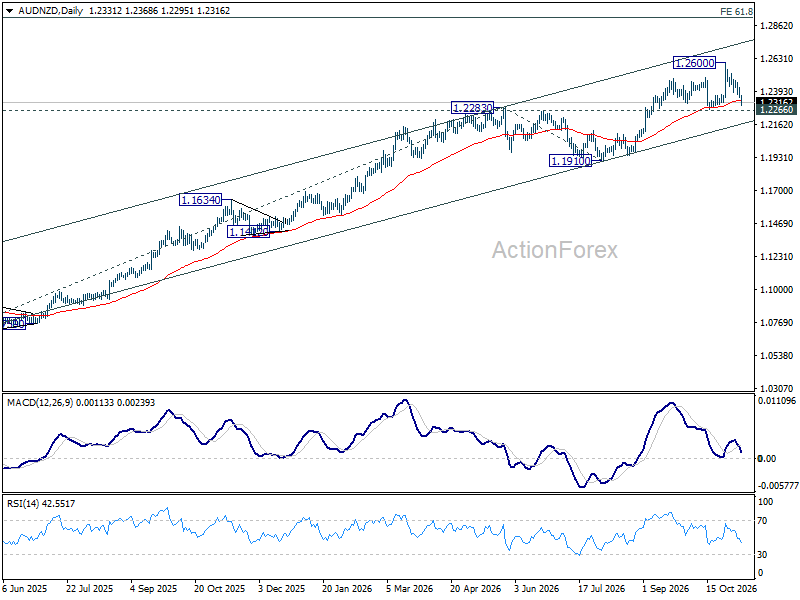

Daily Chart — 1.2266/83 Support Holds the Key
The preferred interpretation is that the move below 1.2600 is coalescing into a short‑term consolidation, rather than signalling a reversal of the prominent uptrend that originated at 1.0649 in 2025.
The weekly chart reinforces the view that the ascent from 1.0649 has not yet been fully realised. Although the price fell from 1.2600, the broader pattern of ascending highs and higher lows persists, with the market staying above the upward‑sloping weekly average.
ActionForex’s Technical View: NZD/USD, Downside Risks Remain Significant
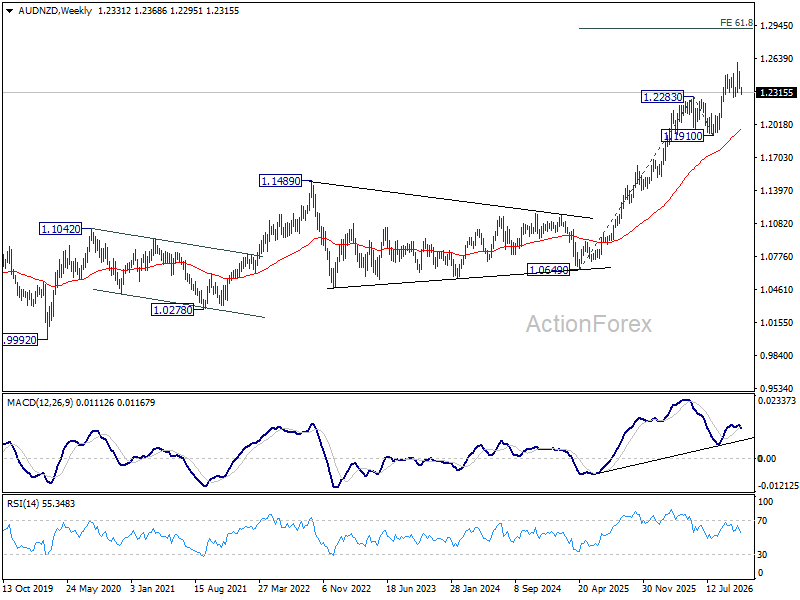
Weekly Chart — Broader Bullish Structure Remains Intact
The technical implication is that Monday’s NZD outperformance has not yet challenged AUD/NZD’s medium‑term bullish structure. A sustained break below 1.2266/83 would therefore be important evidence that the election‑related improvement in NZD sentiment, or other relative currency influences, is developing into a more durable shift.
ActionForex’s Technical View: Daily Chart — Bottoming Requires Break Above 0.5709

Also Read
- Eurogroup convenes to discuss ECB presidency succession
- Australian Dollar Under Pressure as RBA Signals Pause and Risk Assets Recede
- Gold Rebounds on Falling Oil and Yields as 4,200 Resistance Approaches US CPI Data
- Canton Network Records 10% Monthly Growth in Real-World Asset Valuation, Maintains Tokenization Market Leadership


