








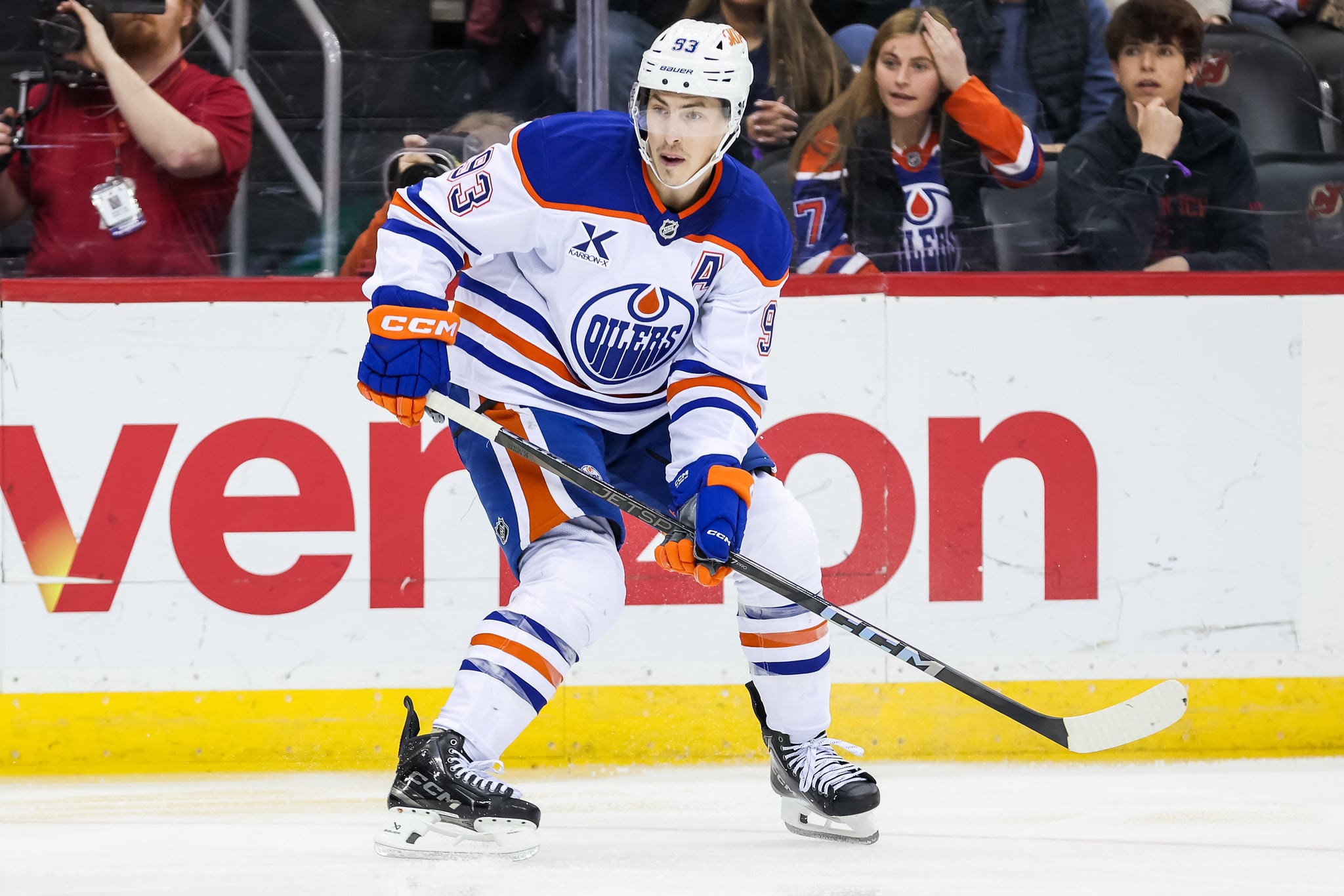
Ryan Nugent‑Hopkins has become synonymous with the Edmonton Oilers. Selected first overall in the 2011 NHL Draft, he arrived in Edmonton during one of the franchise’s darkest eras. After enduring multiple losing seasons, coaching shifts, and extensive personnel turnover, he helped the Oilers emerge as a consistent Stanley Cup contender.
Nugent‑Hopkins never requested a trade, voiced public complaints, or sought external opportunities; instead, he stayed steadfastly loyal to the organization and its community.
His devotion has made “Nuge” one of the favorite players of the Modern Oilers era. By January 2026 he became the first rookie to log 1,000 NHL regular‑season games solely for Edmonton. The club previously lauded him as a premier two‑way forward whose impact spans the ice, power play, and penalty killing units.
Beyond the rink, Nugent‑Hopkins serves the community, earning Edmonton’s nomination for the 2026 King Clancy Memorial Trophy—an honor recognizing leadership and charitable outreach.
Replacing him means seeking more than additional productivity; the Oilers must substitute his versatility, hockey IQ, leadership qualities, and deep ties to Edmonton.
Oilers Cannot Ignore Nugent‑Hopkins’ Age
Nugent‑Hopkins, now 33 and slated to turn 34 in April 2027, remains a vital top‑six forward, yet Edmonton can no longer assume he will sustain that level indefinitely.

He recorded 56 points in 72 games during the 2025‑26 season, contributing five points on the power play and two while shorthanded. He added at least fifty points in four of the preceding five seasons, among which his 104‑point career year came in 2022‑23.
His value extends beyond raw scoring; Nugent‑Hopkins excels at multiple positions, playing shift‑back wing alongside Connor McDavid, rotating centre during injuries, and contributing on both the top power‑play and penalty‑kill squads, allowing the coaching staff to fine‑tune line combinations without substantial disruption.
Anton Lundell Could Grow Into the Role
Anton Lundell appears the most natural stylistic heir to Nugent‑Hopkins. The Florida Panthers centre posted 18 goals and 44 points in 64 games last season. Though below the targeted 60‑point threshold, his output averages about 56 points across a full schedule. At age 25, he retains ample capacity for further offensive improvement.
Lundell already operates in every phase of play. With 15 power‑play points and two shorthanded goals in 2025‑26, he demonstrates Floridian confidence in both defensive and offensive roles. He could anchor Edmonton’s third line early, then shift to the top six as warranted, or pair with McDavid or Leon Draisaitl on the fliers.
Convincing the Flames to part ways would be challenging; Lundell is contracted through 2029‑30 at a modest $5 million cap hit, leaving limited incentive for Dallas to consider a trade.
Robert Thomas Would Add Elite Playmaking
Robert Thomas offers greater offensive potential than Lundell while meeting Edmonton’s demand for versatility. Scoring 25 goals and 64 points in just 64 games for St. Louis the prior season gave him an 82‑point average, complemented by 11 power‑play assists, two shorthanded goals, and a +22 rating.
As a right‑shot centre, Thomas excels as a distributor who could bolster McDermid’s and Draisaitl’s wings, anchor Edmonton’s second power‑play unit, supply backup to the penalty kill, and become a credible top‑six centre if the Blades chose a front‑two overload.
Thomas is a cornerstone for St. Louis and carries an $8.125 million cap commitment through 2030‑31, meaning the Blues possess little motive to trade him unless their long‑term strategic direction shifts.
Nevertheless, Edmonton should keep his situation in mind; talent of his caliber and age tends to fade quickly, so the club must be prepared to act fast if a comparable player surfaces.
Dylan Larkin Is the Most Attainable Proven Player on This List
Dylan Larkin stands out as the most readily available proven option, especially given lingering questions about his future with the Detroit Red Wings. He carved out 34 goals and 67 points in 74 games during 2025‑26, consistently producing near the 70‑point mark—recording 79 points in 2022‑23, 69 in 2023‑24, and 70 in 2024‑25.
Larkin contributes speed, leadership, elite faceoff ability, and solid special‑team experience. He would suit a spot in Edmonton’s top six and bring a dangerous transition presence to the roster. However, being 30, carrying an $8.7 million cap hit through 2030‑31, and protected by a trade exception, he functions as a medium‑term successor rather than a permanent fix.
If the Oilers prioritize immediate success, Larkin could bridge the gap between today’s Nugent‑Hopkins and the next generation of Canadian talent emerging from the pipeline.
Nico Hischier Is the Ideal—but Nearly Impossible Replacement
Nico Hischier embodies the perfect Nugent‑Hopkins replacement in theory. The New Jersey Devils captain posted 28 goals and 66 points in 82 games last season, showcasing responsibility as a 200‑foot centre, reliable power‑play contributor, and steady penalty‑kill performer. At 27, he is young enough to remain a core player for several more years.
Captain Hischier can centre his own line, slide onto a wing beside the Oilers’ marquee scorers, or absorb demanding defensive liabilities—bringing leadership that partially offsets Nugent‑Hopkins’ intangibles. Yet availability is the chief obstacle: New Jersey signed him to a five‑year, $58.5 million extension in July 2026, locking the cap through 2031‑32 and rendering a trade virtually unrealistic.
For Edmonton, Hischier serves primarily as a blueprint rather than a concrete target—a 60‑to‑70‑point forward adaptable to any deployment who elevates the lineup wherever assigned.
Edmonton Must Start Planning Now
The Oilers need not relocate Nugent‑Hopkins from his current position; he remains productive, flexible, and essential to the club and its city. The focus should be on lessening his workload well before age forces a rotation decision. Integrating a younger, two‑way centre would enable Nugent‑Hopkins to ease into a more sustainable role while preserving his established impact on prime and special‑teams.
Lundell offers the optimal mix of age, cost efficiency, and two‑way upside. Thomas delivers the highest offensive ceiling. While Larkin presents the quickest win‑now opportunity, Hischier represents the ideal archetype Edmonton ought to pursue. Nonetheless, Nugent‑Hopkins occupies a legacy spot that fans view as non‑negotiable, making a permanent vacancy unlikely irrespective of his age.
The prudent approach is to identify and develop a successor while Nugent‑Hopkins is still capable of contributing to the next iteration of the Oilers, ensuring continuity amid physical decline.
Also Read
- Emiliano Martínez Eager for Premier League Debut in Chelsea vs Arsenal Clash
- Pakistan Pin Hopes on Miracles Despite Daunting Deficit at Lord’s
- WWE Eyeing Major Push for Royce Keys and OTM, Drawing Comparisons to Iconic Faction Debuts
- Fulham latest: Talks held to sign Romanian right-back as Everton want Tete


