




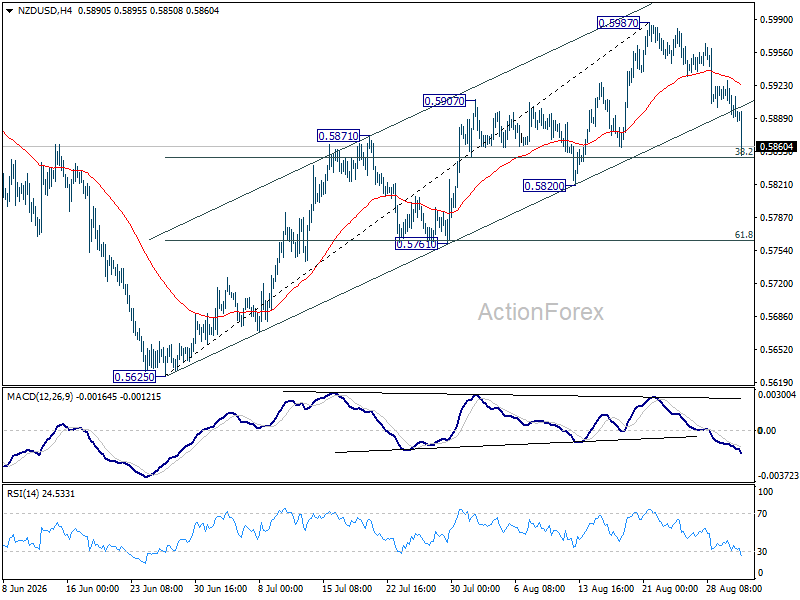
The Reserve Bank of New Zealand increased the Official Cash Rate by 25 basis points to 2.75% on Wednesday, continuing what it characterized as a measured process of “gradually removing monetary stimulus” while inflation remains above its target. The committee reached its decision by consensus and stated that the current approach reduces the risk of requiring more aggressive rate increases later. Nevertheless, the New Zealand dollar sold off sharply following the announcement, suggesting that markets interpreted the guidance as more dovish than anticipated rather than questioning the direction of policy itself.
RBNZ acknowledged that headline CPI inflation had reached 4.1% in the June quarter, largely driven by elevated fuel and related prices linked to the Middle East conflict. However, the bank emphasized that inflation excluding vehicle fuels had moderated to 2.9%, that most core measures remained within the 1–3% target band, and that longer-term inflation expectations continued to anchor near 2%. Central forecasts project CPI at 3.9% in both the September and December quarters, before easing to 3.7% in March 2027, 2.6% in June, and 2.1% by December 2027. The committee noted that “indicators of medium-term inflation are consistent with inflation returning to target.”
Policy projections still point higher, though only incrementally. The projected OCR track rises from approximately 2.6% in September to 2.8% in December, 3.0% in March 2027, 3.1% by mid-2027, and 3.2% by year-end. RBNZ indicated that, conditional on its central outlook, the OCR “may need to increase further,” while stressing that “the future OCR path is not pre-determined.” The growth outlook also remains subdued in the short run, with June-quarter GDP projected to be flat before expanding 0.5% in both the September and December quarters, while unemployment is expected to hover around 5.5% through year-end.
This balancing act helps explain the negative reaction in the New Zealand dollar. RBNZ delivered hawkish action, but without hawkish urgency: inflation risks remain elevated, yet the committee continues to see substantial spare capacity, weak household demand, and downside risks to the recovery. Four members judged inflation risks to be skewed to the upside, while two viewed them as balanced. Markets had therefore appeared to seek stronger validation of a faster tightening cycle. Instead, RBNZ signaled a measured normalization designed to avoid the need to “raise it faster and to a higher level later.”
CPI Inflation Projections
Quarter
CPI Inflation y/y
Jun 2026
4.1%
Sep 2026
3.9%
Dec 2026
3.9%
Mar 2027
3.7%
Jun 2027
2.6%
Sep 2027
2.4%
Dec 2027
2.1%
Mar 2028
1.9%
GDP Growth Projections
Quarter
GDP Growth q/q
Jun 2026
0.0%
Sep 2026
0.5%
Dec 2026
0.5%
Mar 2027
0.6%
Jun 2027
0.6%
Sep 2027
0.6%
Dec 2027
0.6%
OCR Projections
Quarter
OCR
Sep 2026
2.6%
Dec 2026
2.8%
Mar 2027
3.0%
Jun 2027
3.1%
Sep 2027
3.1%
Dec 2027
3.2%
Mar 2028
3.2%
OCR figures are RBNZ quarterly-average projections, not meeting-by-meeting policy targets.
Key Takeaways
- RBNZ raised the OCR from 2.50% to 2.75%, delivering a second consecutive hike and continuing the process of “gradually removing monetary stimulus.”
- The New Zealand dollar nevertheless sold off sharply, indicating that markets viewed the guidance as more dovish than expected.
- Headline CPI inflation reached 4.1%, but RBNZ stressed that the figure excluding fuels was considerably more moderate at 2.9%.
- The central forecast keeps headline inflation at 3.9% through the end of 2026, before falling to 3.7% in Q1 2027, 2.6% in Q2, and 2.1% by Q4.
- RBNZ still views further tightening as possible, stating that the OCR “may need to increase further,” but also stressed that “the future OCR path is not pre-determined.”
- Growth remains soft, with Q2 GDP projected to be flat before 0.5% expansion in both Q3 and Q4, while unemployment stays around 5.5%.
- The policy message is therefore hawkish action paired with a dovish reaction: RBNZ is tightening, but the projected pace is gradual, and the committee continues to emphasize spare capacity and two-sided risks.
Also Read
- Silver Price Forecast: XAG/USD slips below $64.00 as inflation fears increase
- Leaked compliance records shatter anonymity of 291 crypto users by matching names directly to wallet activity
- Circle processed $32 trillion in USDC transfers, yet 95% of its revenue relies entirely on interest rates
- Japanese Yen Reaches Fresh Low Since Late July Against US Dollar Amid Fiscal Concerns and Rate Gap