




Stellar Lumens (XLM) has emerged as a key infrastructure for the rapidly growing Real World Asset (RWA) sector. Initially recognized for its blockchain capabilities in issuing traditional assets on-chain, the network has attracted institutional attention for its cost efficiency and reliability.
Following early experimentation by major firms like Franklin Templeton through its BENJI fund, several prominent issuers have since launched token offerings on Stellar. Among them: WisdomTree introduced significant tokenized treasury products, while newer entrants such as Ondo (USDY), Mercado Bitcoin, Centrifuge, RedSwan, and PayPal’s PYUSD expanded the ecosystem beyond initial pilots.
While these developments drove substantial growth in RWA capitalization on the Stellar network, XLM’s market performance hasn’t mirrored this success. Over the past year, despite an uptick in network activity and adoption, XLM experienced a roughly 50% decline from its yearly highs—highlighting a disconnect between ecosystem utility and speculative returns.
From One Pilot On Stellar To An All-Star Line-Up
The evolution of RWAs on Stellar can be divided into distinct phases. Early projects like BENJI laid the groundwork, followed closely by issuers such as WisdomTree. However, it wasn’t until mid-2026 that newer platforms including Spiko, Tradable, Realiz, and others gained traction—marking what many refer to as the second wave of institutional entry into digital asset markets.
These entities arrived several years after the original projects yet quickly captured significant portions of the total value locked across supported networks. Despite strong momentum in terms of capital deployment, the broader cryptocurrency landscape—including XLM specifically—remained volatile amidst shifting macroeconomic conditions and evolving investor sentiment.
Stellar Surpasses $4 Billion in RWA Market Valuation
According to data tracked via Dune Analytics, the aggregate market cap denominated in RWAs hosted on the Stellar blockchain has surged nearly fourfold within just twelve months—from approximately $0.4 billion at the end of 2024 to over $4 billion currently.
Notably, more than three-quarters of this increase occurred during 2026 alone, driven primarily by fresh listings rather than renewed interest in legacy deployments.
Leading contributors include:
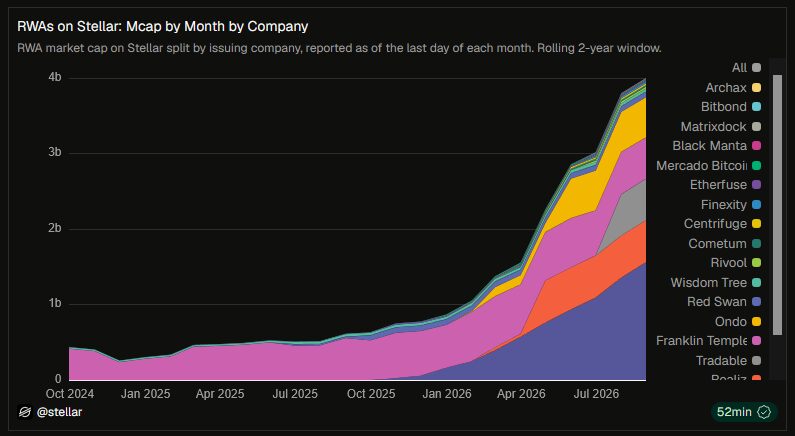
- Spiko – Fast-rising platform managing close to $1.5 billion worth of tokenized securities.
- Realiz — Emerging issuer holding approximately half a billion dollars in circulating assets.
- Tradable – Established player commanding around $550 million in active obligations.
- Ondo — Managing roughly $535 million mainly through USDY stablecoin mechanisms.
- Franklin Templeton (BENJI) – Veteran initiative maintaining consistent presence with ~$550 million outstanding.
Also Read
- Malaysian Ringgit Weakens Against US Dollar Amid Rate Hike Anticipation
- Australian Dollar falls as US-Iran conflict lifts USD, GDP data eyed
- OpenClaw 2.0 Launches with Multi‑User Cloud Sessions, New Security Hardening, and Expanded Developer Ecosystem
- 21 Companies Led By Big Banks To Launch A USD Stablecoin By 2027