






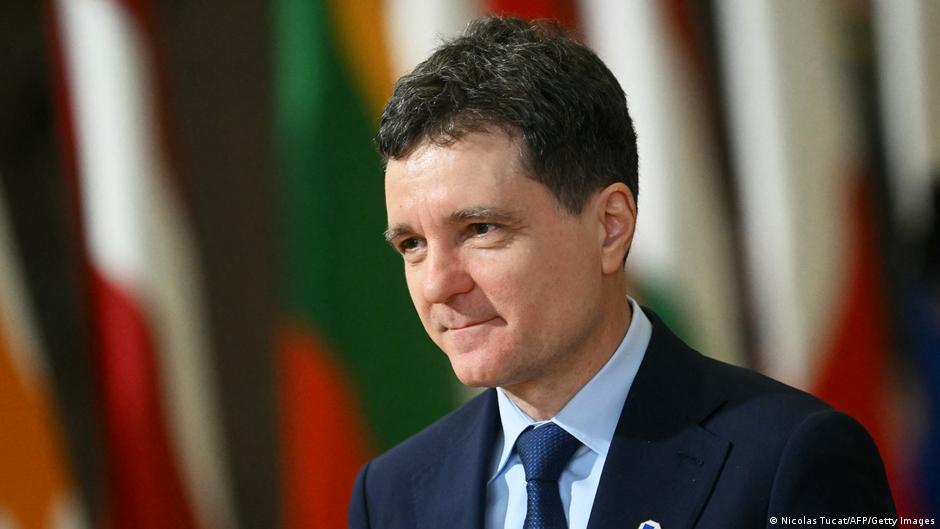
President Nicuşor Dan, known for his chess hobby, faces scrutiny as Romania navigates a prolonged political crisis. His latest move has raised concerns about democratic protocols.
Observers are questioning why Dan, once a civil‑society advocate, is taking such an unorthodox step.
The collapse of Romania’s four‑party coalition two months ago plunged the nation into a severe financial and socioeconomic crisis, leaving it without a functioning government.
In an unexpected Sunday announcement, President Dan nominated Adrian Vestea of the National Liberal Party (PNL) as the new prime‑ministerial candidate, replacing the previously withdrawn contender.
Adrian Vestea, current president of Brașov County Council, has a troubled résumé. His university degree comes from an institution of dubious accreditation, and he previously failed to secure repairs for access roads to a key Romanian NATO military base, among other missteps.
Dan bypassed the constitutional requirement to consult parliamentary parties before making the nomination. Moreover, he advanced Vestea’s candidacy without informing the PNL leadership.
PNL Chairman Ilie Bolojan, currently serving as interim prime minister, denounced the nomination as a “hostile act” and an “attempt to divide the PNL.”
Critics, who once praised Dan as a staunch defender of the rule of law, now accuse him of disregarding democratic and constitutional norms.
Political instability in Romania
Romania’s chronic political instability, marked by frequent government changes, has contributed to one of the EU’s largest budget deficits. In 2024 the deficit surpassed 9 % of GDP.
The country must enact sweeping administrative and tax reforms and overhaul a judicial system widely seen as corrupt. Failure to do so threatens a deep financial crisis and the loss of billions in EU funding, yet Romania’s political elite remains resistant to change.
Russian meddling?
In 2024, pro‑Russian far‑right candidate Călin Georgescu unexpectedly topped the first round of Romania’s presidential election. The Constitutional Court later annulled the vote, citing alleged Russian interference. Despite widespread Russian propaganda, the extent of its decisive impact on the election remains contested.
A new presidential contest in spring 2025 was won by Bucharest Mayor Nicuşor Dan, who presented himself as a moderate, pro‑European conservative. His campaign emphasized a cosmopolitan, patriotic vision, pledging to steer Romania out of its turmoil, maintain a pro‑European course, and deliver “honest Romania”—a promise of greater transparency and responsiveness to citizens’ demands.
Upon taking office in May 2025, Dan succeeded in building a four‑party coalition that included the National Liberal Party (PNL), the Social Democrats, the green‑liberal Save Romania Union, and the Democratic Union of Hungarians in Romania (UDMR).
However, the Social Democrats (PSD) soon adopted an opposition stance, alienated by Ilie Bolojan’s reformist agenda. In April 2026, after just ten months, the PSD withdrew from the coalition and, with far‑right support, engineered a successful no‑confidence vote that toppled it.
Since then, President Dan has pressed to assemble a new, pro‑European government to avert early elections, where far‑right parties are projected to gain a parliamentary majority.
The arithmetic remains problematic: both the PNL and the USR have declared they will not govern with the PSD, though a minor PNL faction—among them Adrian Vestea—remains open to cooperation. Yet any administration that excludes the far right still requires the PSD’s support, creating a deadlock.
Has Romania’s president violated his principles?
Prominent philosopher and commentator Andrei Cornea argues that Dan has long reneged on his stated principles. Instances include refusing to sign legislation toughening penalties for fascist propaganda and appointing officials of dubious integrity to anti‑corruption agencies.
“It seemed to us that Nicusor Dan, whatever mistakes he may have made from our perspective, remained a democrat,” writes Andrei Coprnea in the weekly Magazine 22. “For a long time, we believed that Nicusor Dan was ‘our president.’ Once again—for the umpteenth time—we were wrong. Now we know: He is ‘their’ president!”
This article was translated from German


