






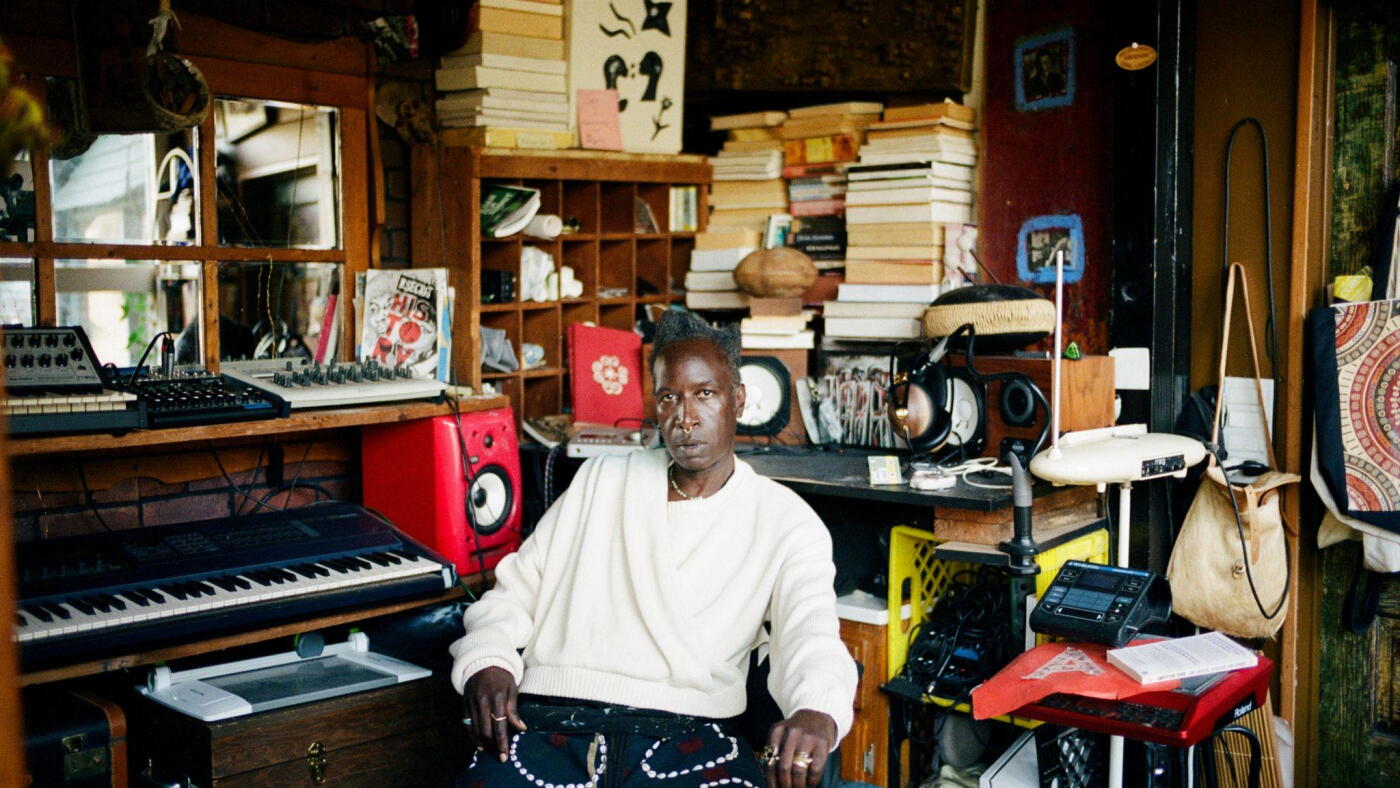

“There’s a time and place for confrontation and there’s a time and place to just let it pass you by,” Williams says. “But overall, my issues are with power and with people’s relationship to power.”
Sam Lee
hide caption
toggle caption
Sam Lee
Saul Williams has always seemed to exist outside the bounds of conventional artistry—a cosmic figure who arrived fully formed at the end of the millennium, channeling something both sacred and sharply critical through his work. There is no other explanation for how a contemporary mystic could emerge so powerfully, delivering his gift while navigating the space between the spiritual and the sociopolitical.
My first experience seeing him perform live was at a small Atlanta café around 1999. Slam, the independent film he co-wrote and starred in, had just won Sundance’s Grand Jury Prize and the Caméra d’Or at Cannes the previous year. When he took the stage that night, he immediately requested all lights be extinguished, his form barely visible in the darkness. The only illumination came from the persistent flash of a student photographer kneeling in front, capturing his movements as he moved through his performance.
I went through five rolls of film that evening. Yet nothing captured the arrival of Saul Williams more precisely than his own prophetic verses.

YouTube
Nearly three decades later, Williams is directing his attention toward the process of becoming—his own and, potentially, that of society at large. Following his recent appearance in the Oscar-winning blockbuster Sinners and his Grammy-nominated spoken word album Saul Williams Meets Carlos Niño & Friends At Treepeople, the multidisciplinary poet, actor, and musician is releasing an album titled Leap Life and a book titled Songs My Mother Taught Me: Why the Artist Must Take Sides this fall. Both projects emerged from Williams’ deliberate decision to shift direction. After years of using social media to advocate vocally for Palestinian freedom, he explains via Zoom: “I was tired of putting all of my thoughts into captions. I’m not an influencer. My strong point is actually music, poetry, performance. That’s my bag.”
The resulting book represents his most direct and accessible prose to date. A demystification of the artist himself, it chronicles his own radicalization and its origins—guided not by anger or bitterness but by love, adventure, and curiosity. The album, conversely, may be his most enchanting work. Leap Life serves as both a figurative and literal expression of humanity’s eternal connection to the ancestral realm, a ceremonial meditation designed to reconnect listeners to their most enduring strength. This message applies specifically to Indigenous peoples and descendants of American slavery, but extends more broadly to all those living—as Williams frequently reminds readers throughout Songs—under empire.
Though unplanned, both projects are releasing within weeks of each other. Together, Williams’ compelling portrait of evolution—from the precocious child of activist parents raised in a drafty, 27-room house in Newburgh, New York—becomes a catalyst for creating art that functions as a tool of resistance against racial capitalism, fascism, imperialism, and the American project itself.
In examining his own evolution, the past three decades have required Williams to become something he never anticipated: an “investigative poet.” When we spoke, two weeks after Secretary of State Marco Rubio delivered a speech reminiscent of McCarthyism and the Red Scare, Williams remained open-hearted and uncynical. We discussed everything from Western propaganda to Jay-Z’s defensive responses to public criticism. Where I identified threats, he perceived potential for a better future—not built on false hope, but grounded in the land and the people.
This interview has been edited for length and clarity.
Rodney Carmichael: Leap Life isn’t a collection of songs as much as it is a conjuring. It feels like you’re channeling the voice of the ancestors on this one. What is it that you—or they, by proxy—want us to tap into? And, why does it feel like now is the time?
Saul Williams: I believe we are living through a crucial moment, not just in Black history or global history. We stand at a point of confrontation where things must change. That transformation depends on us and how awakened we are to this moment. The forces of seduction, distraction, and indoctrination all work to convince us that we might sit this one out. I don’t believe that’s possible. I think we must call upon our greatest and innermost selves to navigate this moment.
Someone asked me yesterday: “Do you think things get worse before they get better?” I answered, “Yes, certainly.” We make things worse by believing that what happens “over there” doesn’t affect us. We extend the struggle by being short-sighted and abandoning solidarity—whether with migrants at our borders or victims of American imperialism. This is also a turning point because we are learning so much. Looking at the state of the world now, all I can say is that I am not rooting for the U.S. to win.
YouTube
The book Songs My Mother Taught Me serves as a perfect companion piece to the album. You do an excellent job of unmasking imperialism within it. And by the end, you turn that mask into a mirror and show us how we are all complicit, living at the core of empire. Was there a moment of revelation for you, when you came to understand the role you’ve played in it?
I’m not sure whether my understanding grew or simply my ability to articulate what I understood developed over time. The most startling moment of that unveiling has been the past three years. That’s when I realized that even people within my circle—those who had been in my personal and intimate space, who had dined at my table, championed my work, published my work—whom I believed shared my perspective, were willing to embrace a level of hypocrisy that seemed glaringly obvious to me.
I’m speaking primarily about my relationship to Palestine, with a particular focus on liberalism and those who claimed to be allies. Some responded, “Oh, I am very progressive within our borders.” That is essentially the Democratic Party’s position. Democrats and Republicans may differ within our borders, but outside them, they share the same view of America’s role—whether in West Asia, the African continent, or Haiti. It’s disheartening. I can’t say I didn’t understand this before, but there were elements I had not examined closely enough. That unveiling had intimate repercussions—there are people who will never enter my personal space again, and I will not speak to them again.
You’re discussing the importance of artists choosing a side. That’s the theme of your book and a principle you drew from Paul Robeson, whom you dedicated your life to studying at a young age. I’m curious how your intimate knowledge of his story—especially his blacklisting during the Red Scare—has prepared you for recent years, where your outspokenness about Israel’s attacks on Palestinians may have ostracized you to some degree?
I wouldn’t call it fear, but my premonition is that the worst is yet to come. Just ten days ago, Rubio stated that people who identify as anti-capitalists and anti-fascists would be labeled as domestic terrorists. According to my beliefs—because I definitely identify as anti-capitalist and anti-fascist—I am already a domestic terrorist according to that designation. I see the game being played. When you consider the number of people stripped of their passports in the 1950s and the political repression that occurred then, nothing has changed.
Being familiar with Robeson all this time definitely helped me in terms of awareness and preparedness for what might come. When I learned of Trump’s relationship to Roy Cohn, most people make that connection through Angels in America. But Roy Cohn’s connection to McCarthy is profound. He’s right there signaling McCarthy, finding ways to blacklist and take down artists and activists. And this was the mentor of our current president. These are not things I only started feeling with Trump. They’ve been accelerating. But it’s a door that Democrats opened with Biden.
I want to return to your earlier development because Songs My Mother Taught Me is the story of your radicalization and how it was fueled as you came of age. What’s interesting is that it doesn’t come from anger or rage or bitterness, but from love and adventure and curiosity. How difficult has it been to sustain that outlook as your understanding of what you’re up against has grown over time?
Not difficult at all. The thing is, I genuinely like people. I enjoy observing them, learning from them, and with them. I would say that overall, people are genuinely kind. There are points of indoctrination and rigidity you encounter. There’s a time and place for confrontation, and a time and place to let things pass. But overall, my issues are with power and people’s relationship to power—how power corrupts individuals, how individuals yearn for proximity to power, or the behavior they excuse because of power. Most of us can observe this together and try to make sense of it.
YouTube
On the song “The Dagger,” you declare that “music is the weapon.” In reading your book, it becomes clear that a large part of our music—especially hip-hop—has been weaponized against us as Black people. So how do artists “make songs that crumble empires,” as you write, when the means of expression has been so thoroughly co-opted?
I don’t know if it’s the song that crumbles empires. The song has the potential to crumble whatever has been built inside the individual, breaking down barriers so they can be mobilized to participate with a growing community in crumbling that empire. There are songs I love that have served me in my journey and growth. But I can’t point to a song and say, historically, once that song was written, empire was over. Fela Kuti had extraordinary revolutionary music. But there is still much work to do in Nigeria. An entire genre was born from Fela’s music—Afrobeats—and you almost feel like people took the rhythm without taking the message.
I listen to music regularly and periodically hear songs that inspire me beyond a good beat. There are songs that make you think, Whoa, this song is saying something. Of course, that becomes rarer in pop music. But I think these things happen in cycles. I was part of the spark of a new cycle of popularity in revolutionary poetry. But it’s not the first and only time. It happened twenty years before in the Black Arts Movement. It happened twenty years before that with the Beatnik movement. Twenty years before that with the Harlem Renaissance. Perhaps it just happens every twenty years.
I think it’s similar with music. There’s energy in the music between ’68 and ’72, for example, coming out of our community. Much of it responded to the idea of Black power. It’s true that the role of COINTELPRO—and the way Black power was co-opted into meaning Black capitalism—spilled into the music. There’s no denying that many people are confused about whether a non-capitalist society is even possible. That’s when we talk about those points of indoctrination and how thorough they are. Music’s job, then, becomes about finding shortcuts to unraveling that conditioning. What does music do? It harmonizes. We can harmonize an entire stadium, an entire audience. When that music carries a message—something beyond I don’t like you if you’re broke or Your ass is perfect—there’s a chance to open that magical door. That’s what I’m seeking through art: Are there life hacks that could occur if we make the right song? If we all get into it, can it push us to withhold our labor for a week? Can we all spend a month working on that song? How do we inspire artists to be excited about making songs that contribute to our overall progression as human beings, as a society, as a people?
So is it time to throw hip-hop out with the bathwater, so to speak? Can we take it back? Is it time to birth something else?
Those things don’t happen by choice. They happen inevitably. Hip-hop is not about to be thrown out with the bathwater. Maybe what we can discard is our conception of what a hero is and what a hero isn’t.
Look at the recent celebration surrounding Jay-Z.
[Laughs] If you weren’t gonna say it, I was gonna say it.
Reasonable Doubt came out in 1996. I was alive in 1996. I lived in New York in 1996. I lived in Brooklyn in 1996. And you can look at the charts. What was the album of 1996 that deserves the biggest celebration ever? It’s The Score. There’s no doubt this person has had a huge influence on society. But we can question what that influence is, especially when we talk about our confusion about capitalism and all of these things.
But the level of influence of Lauryn Hill and the Fugees from 1996 is great. So what are we doing here? It’s not even a whitewashing of history; it’s like a money-washing of history. It’s dangerous. And I always felt that way about Jay-Z. I feel like I’d like him as a person. I shook his hand once when he walked up to me and said what’s up, but I’ve never had a conversation with him. He always seemed like dudes I went to high school with. I remember when guys in the hood would dress like they played tennis. Literally, they’d wear fresh white Diadoras and a white headband. And there were other guys, like me, who were really into dancing. We had a different type of swag. And we were cool with those cats, but, to me, those cats were always kind of conservative. They always had fades. They sold drugs. Which is cool; I have no judgment about that. But the thing that gets me is when I pair that up against an André 3000. I’ve just always been way more interested in the crazy cat than the conservative cat.
There was a time in 2019 when I had posted an email from Jay-Z. I was on The Breakfast Club in 2014 when I was doing the Tupac-inspired stageplay Holler if You Hear Me. I wasn’t supposed to be on, but I bullied my way on. I waited for Charlamagne tha God in the parking lot. Seriously, I was doing that play; I had some type of Pac energy in me. So in that interview, I referenced the moment in a Jay-Z song [“Moment of Clarity”] where he said, “I can’t help the poor if I’m one of them.”
And I just said, “Thank god Harriet Tubman didn’t think that way.”
Yes, I remember this interview.
So you remember this? Try to find it. It’s not online anymore.
The Breakfast Club took the whole interview down?
This is the story I’m telling you. Maybe a couple of months or a year after it came out and went viral, I got an email. Charlamagne had forwarded it from Jay-Z, but Jay-Z’s email address was blacked out. I don’t know if that was by directive or if it was Charlamagne’s choice. But this email was like, We both have a certain standing in the community, and we shouldn’t be seen judging each other or criticizing each other in public. If his email address had been there, that would have been a new moment in history because I would have written him privately and begun a dialogue.
[NPR has reached out to representatives of Jay-Z for comment.]
YouTube
A large part of what you are discussing now, and in the book, is this obsession with power and wealth. You point out the privileges even those of us without wealth enjoy by living within the empire—from comfort and apathy to lethargy and obliviousness. Your great-grandmother emigrated to America from Haiti through Ellis Island in 1917, yet you are very clear-minded about not being invested in the American project. What do you think would happen if Black America en masse stopped fighting and dying to hold this country up to its democratic ideals as it always has? Because I think the fear is that the country would fall apart—and we’d fall apart with it.
There’s a book I read called Everything For Everyone: An Oral History of the New York Commune, 2052-2072 by M.E. O’Brien and Eman Abdelhadi. It’s speculative fiction that discusses how war in Iran triggers something larger that leads to the falling apart of the U.S. military and thus the U.S. empire. It came out in 2022; a very interesting book. Octavia Butler didn’t get to finish her Parable trilogy—I would see this as the third book. When everyone talks about those two, I say, read this next.
America has never been democratic if we consider Indigenous sovereignty—whether on Turtle Island, in Puerto Rico, Hawaii, Haiti, Congo, Palestine. If we were to follow through with the process of challenging ourselves and the institutions as they exist, perhaps it would bring us closer to the democratic principles we dream of. There are things we thought we’d see in our lifetime. For some people, it’s flying cars. But there are others who thought we’d be a step closer toward Medicare for all or free education. And for many Americans, these are things that will never happen.
There are tons of places where this happens regularly. I’m in England right now. I just got back from France. It’s also the case in Iran. When we go to the places the U.S. has recently been attacking—like Iran, Venezuela, Cuba—these are all places that have higher literacy rates than the U.S. In double digits! And by literacy rates, I don’t mean these people can read. I mean they have the ability to discern propaganda when they hear it, to know when they’re being lied to and to read between the lines. They don’t fall for the same stuff our grandparents fall for on Facebook. Or that we fall for when they tell us that anti-colonial resistance is terrorism.
The thing I would love to see first has everything to do with land back. That’s why I start with Indigenous sovereignty—because that’s how we solve the ecological question. Indigenous communities have always had the answers about how we need to be interacting with the land. We just ignored them and said they were primitive. And then after hundreds of years, we go, Maybe they had a good idea there.
I do believe that this idea of Western civilization is really just rooted in Black death and Indigenous erasure. It’s rooted in genocide. And I am not afraid to experiment to see where we land. Danger is at hand. But the idea of collapse from the inside—the role we can play—that is not the danger. That is only a danger to the capitalist core of this country. We would find ways to feed each other, support each other, and create better relationships between each other. Better schools. Better systems. I would just like to see us outlive our hypocrisies. It doesn’t mean we would not develop new ones. But the tried and true ones we’ve seen for so long are just a bit tired.
Also Read
- Reading and Leeds Festival unveils major overhaul, but will it draw in a new crowd?
- Netflix Unveils First Look at ‘Unabomber’ Thriller Featuring Jacob Tremblay
- 8 Overlooked Anime Series That Only Get Better With Age
- AZ Chike and Tyler, the Creator Channel Classic Cinema in New “Look Like My Mama” Video


