<br>
Laser experiment revises diamond melting point by over 1,300°F<br>
Scientists have used a high‑powered laser to melt diamonds and measure the mineral’s melting point with unprecedented precision, discovering that earlier estimates were off by more than 1,300 °F (≈700 °C).
Although diamonds are the hardest natural substance, they can melt when subjected to intense laser pulses. Characterizing their response to such shock loading is essential for refining nuclear‑fusion concepts, which aim to replicate the stellar processes that could provide a clean energy source.
Diamond also exhibits unusual behavior. While most measurements agree with theoretical models, a persistent ~2,240 °F (≈1,244 °C) discrepancy—about 20 % of the predicted melt temperature—has puzzled researchers. Additionally, scientists have debated whether the crystal first transforms into another solid carbon phase before ultimately becoming liquid.
Because the required temperatures and pressures are extreme, reproducing diamond’s melt in a laboratory has been notoriously difficult. A recent breakthrough now appears to resolve the long‑standing uncertainty that has challenged researchers for decades.
In a study published on August 13 in Nature Physics, the team fired ultraviolet laser pulses at microscale synthetic‑diamond samples, generating shock waves that drove the material from a transparent state to a mirror‑like one. The abrupt rise in optical reflectivity, coupled with precise brightness measurements, allowed the scientists to pinpoint the melt temperature with high accuracy.
“We were able to take tiny diamond samples and shock compress them to temperatures hotter than the surface of the sun and to pressures higher than the center of Neptune and Uranus — and still measure atomic structure, temperature, density and optical reflectivity,” study co‑author Marius Millot, a research scientist at Lawrence Livermore National Laboratory in California, said in a statement.
The results showed that diamond melts more than 1,300 °F cooler than earlier estimates, bringing the experimental value into agreement with theoretical predictions and finally resolving the long‑standing discrepancy.
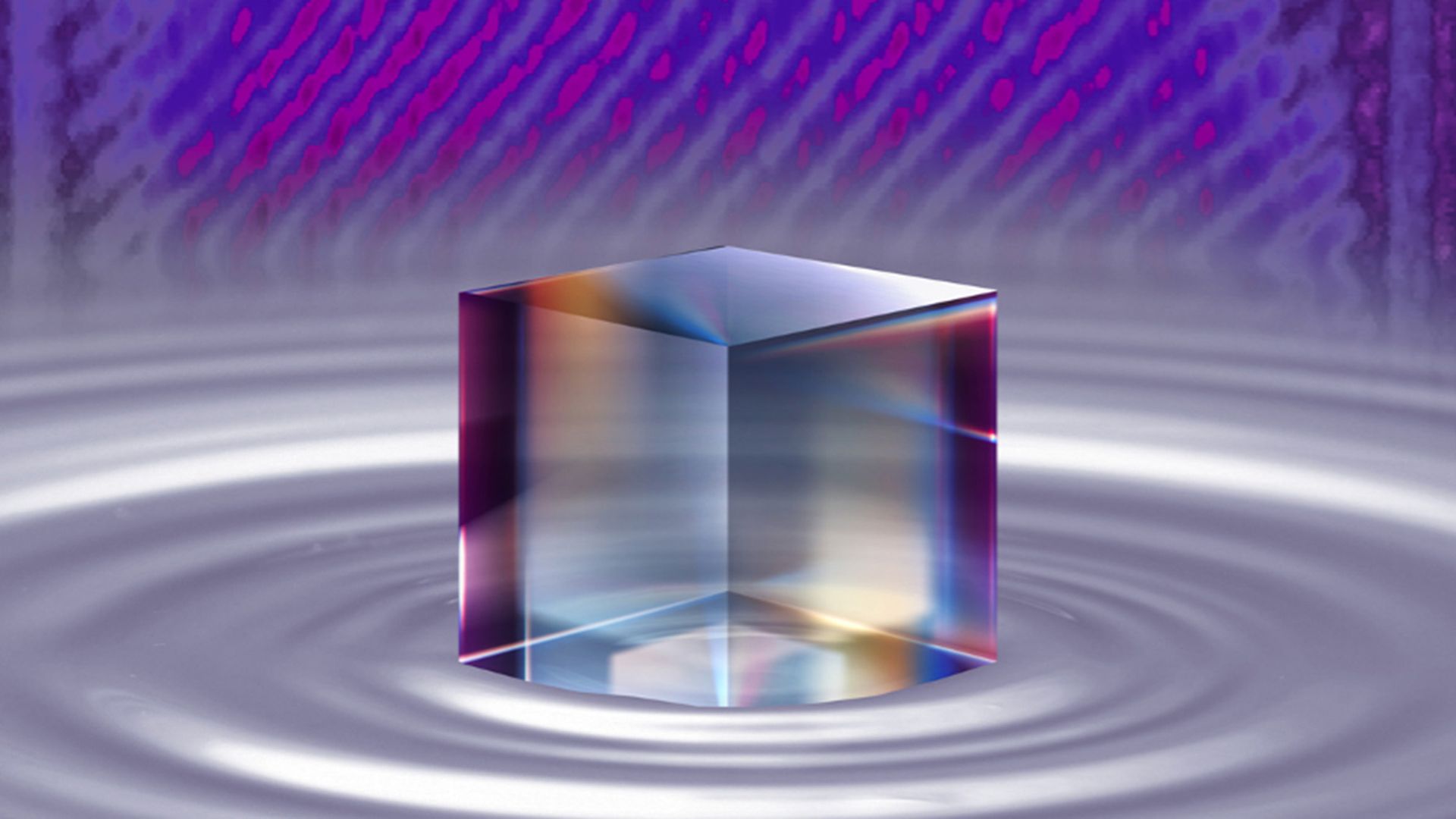
An artist’s concept of a solid chunk of diamond floating in a metallic liquid carbon pool. The new experiment proves this sort of situation is possible deep within other planets.
(Image credit: James Wickboldt/LLNL)
X‑ray diffraction analysis revealed that the diamond did not first transform into another solid carbon phase before melting, likely because the required atomic rearrangement energy exceeded the conditions of the experiment.
Nevertheless, the authors propose that multiple or differently timed shocks could induce such a solid‑solid transition, and that the shock geometry may influence the pathway. This knowledge is crucial for inertial‑confinement‑fusion experiments, where laser‑driven diamond capsules are compressed to contain deuterium‑tritium fuel at pressures exceeding 30 Pbar and temperatures above 180 million °F (≈100 million °C), the regime required for a net fusion yield.
The experiments determined that, at pressures of roughly 660–1,060 GPa and temperatures near 12,140 °F (≈6,727 °C), solid diamond can float within a surrounding liquid‑carbon medium. With increasing pressure, more diamond converts to liquid carbon, a metallic and denser phase distinct from Earth’s common carbon allotropes. This liquid conducts electricity, and under the right (hypothetical) conditions a solid diamond could remain buoyant within it, analogous to an ice cube in water.
These findings also enhance our understanding of the ice giants Uranus and Neptune. Observations from Voyager 2 and terrestrial labs suggest that diamonds may precipitate within their interiors and that liquid‑carbon oceans could host floating diamond fragments. The updated melt‑point data enable more accurate models of the planets’ deep interiors and carbon cycling.
Millot, M., Coppari, F., Lazicki, A., Kim, Y., Landen, O. L., Smalyuk, V. A., Celliers, P. M., & Eggert, J. H. (2026). Diamond melting in shock compression experiments at 1 TPa pressures. Nature Physics.