








Aleksandar Vucic, accustomed to the public eye, had for years been the dominant figure in Serbian politics, with loyal media outlets amplifying his messages, from TikTok outbursts to top‑time news coverage. On 25 October he suffered a decisive defeat to the Student List, and the political landscape has shifted rapidly since.
At a press conference marked by a noticeably smaller media presence, Vucic accused the victors of practising “revolutionary terror.” He warned, “If they continue to terrorise those who think differently – through beatings, destruction and other acts – and the state authorities do nothing, we will be forced to organise ourselves.”
Vucic cited the immediate resignation of the director of the state broadcaster RTS and the dismissal of senior editors as examples of this “terror.”
On Monday a small group of protesters occupied the Informer TV station, a channel long criticised for demonising Vucic’s opponents. Thousands of complaints have been filed over the years, and journalists’ associations now demand that its broadcasting licence be revoked.
Tabloid outlets that had supported Vucic have softened their rhetoric. Unlike Informer, they no longer label the Student List as “terrorists” and “mercenaries.”
Old accusations against Vucic
The Student List, formed from the student uprising, comprises professors, activists and artists. In the 25 October election it secured 53 % of the vote, while Vucic’s Serbian Progressive Party (SNS) obtained just 39 %.
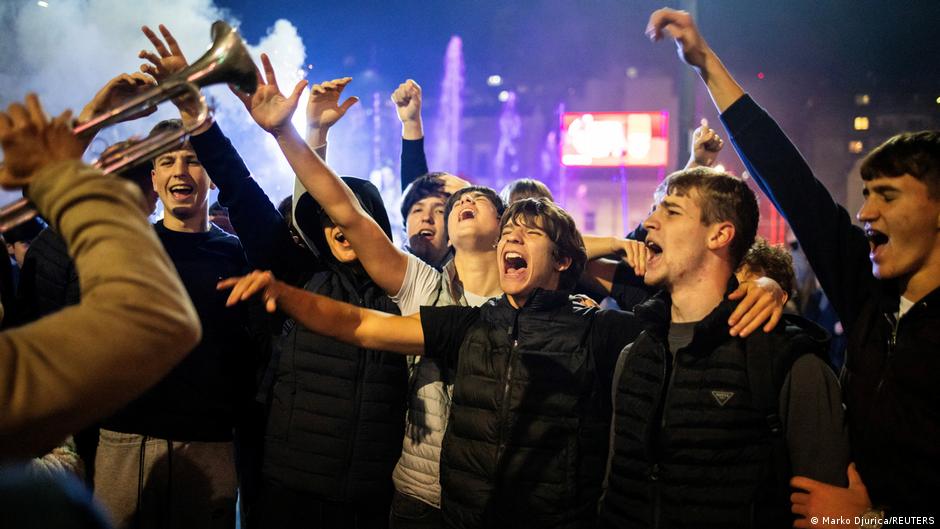
Since the election, actions have accelerated. In several cities citizens have peacefully removed Vucic’s portraits from municipal buildings. The public prosecutor’s office for organised crime has opened investigations, including into alleged electoral fraud, and a special commission is reviewing the conduct of the Higher Public Prosecutor’s Office in Belgrade, which critics say served Vucic’s interests and persecuted his opponents.
Long‑standing allegations against Vucic include tight control of the media by his regime, the awarding of state contracts only to loyal companies, and alleged links between Vucic, his party and organised crime.
The immediate catalyst for the protest movement was the collapse two years ago of a concrete canopy at the newly renovated railway station in Novi Sad, which claimed sixteen lives. The disaster is widely believed to have resulted from poor construction work and corrupt procurement practices.
Those who celebrated the election result only a few days ago are now growing impatient. The new parliament has yet to be convened, and the SNS still holds many key positions of power.
“A society that was oppressed for so long by a party that acted like a feudal lord now, understandably, expects justice,” Dejan Bursac from the Institute for Philosophy and Social Theory at Belgrade University told Deutsche Welle. “In this power vacuum, people are getting impatient.”
Vucic and his allies have pledged to mount a strong opposition, forecasting a swift return once “this lot” have ruined the country. However, most critics are calling for Vucic to face investigation and prosecution. “The SNS people are acting as if they had lost a local election somewhere in democratic Scandinavia, not as if they were part of a deeply corrupt and criminal regime,” Bursac said.
How much damage can the old government do to the new one?
In Serbia it is common for politicians to switch allegiances to where power lies. Vucic himself has noted that many former allies are now turning their backs. “We will see cases of people resigning or staying in the shadows, even offering themselves as informants to the next government,” said Zlatko Minic of Transparency Serbia, an anti‑corruption watchdog.
The key question is how much harm the outgoing administration can inflict. “There is still time for many officials to award contracts and create financial obligations for the agencies they run without necessarily committing a criminal offence,” Minic cautioned.
The Student List has, however, been in contact for some time with police and administrative officials who oppose Vucic’s governance. The victors may now be able to block certain actions. On Wednesday the List again demanded the resignation of senior police and judicial officials, and urged whistleblowers to come forward if the outgoing government attempts to “destroy documents.”
Against all odds: How Serbia’s students took on Vucic
To view this video please enable JavaScript, and consider upgrading to a web browser that supports HTML5 video
In a symbolic gesture, Student List representatives held their first press conference in Pioneers Park, directly in front of the parliament building. The park had been fenced off by Vucic’s supporters in 2025 and turned into a pro‑government encampment that, according to investigative reporters, also served as a base for thugs who attacked anti‑government demonstrators. The morning after the election win, supporters arrived with bin bags and cleaned the park.
No change in foreign policy
The victorious Student List is a broad coalition that brings together left‑ and right‑wing factions, as well as pro‑European and pro‑Russian forces. Its priority is domestic reform, and it aims to advance EU accession talks by implementing genuine changes. The List opposes sanctions against Russia and the recognition of Kosovo—positions that enjoy near‑unanimous support across Serbian society.
“Our plan is to stabilise and develop the country, not to destabilise it with some abrupt change of course on foreign policy,” said Oliver Toskovic, a psychology professor who will become a member of parliament, in an interview with Deutsche Welle.
Toskovic added that, unlike under Vucic, the EU will not be used as a “cover.” Serbia’s EU accession process has stalled recently, with Vucic accusing “the West” of fomenting a “colour revolution” in the country.
“We are heavily dependent on Russia for energy. This is a mistake of the previous government,” Toskovic continued. “For that reason, sanctions at this moment would destabilise the country, which would be harmful both for us and for the EU.” The direction of energy policy under the new government remains unclear.
Where Vucic frequently clashed with Kosovo, Croatia and Bosnia‑Herzegovina, the List’s leading members have pledged better neighbourly relations and reduced tensions. On Kosovo, lead candidate Ilija Srdanovic has said the party is open to dialogue with Pristina and has already spoken with the Croatian prime minister.
The electoral process is still incomplete. A repeat vote will take place on 1 November at roughly 50 polling stations that reported irregularities in the first round. Once those votes are counted, parliament can be convened. Government formation is expected to be swift, but the prospective cabinet members have not yet been disclosed.
This article has been translated from German.


