







Heading into Fed Chair Kevin Warsh’s Jackson Hole keynote, precious metals are displaying notable divergence. Gold remains essentially flat, while Silver has surged over 2.01% to trade above 70, and Platinum has climbed approximately 2.64%. This split has pushed the gold-silver ratio down to 65.14, extending a compression trend visible over recent sessions.
Gold’s stagnation is particularly striking given that it has been among the most crowded longs in CFTC-tracked positioning and is the metal most directly tied to the debasement and Fed-independence trade the speech is expected to test. A market pausing specifically on gold while its sister metals advance ahead of its primary catalyst is a pattern worth flagging. While the most straightforward explanation is simply that the gold-silver ratio has been compressing for days on unrelated catalysts, the timing warrants attention until the speech concludes.
Currency markets have remained relatively muted in anticipation of the remarks. The Australian Dollar is the strongest major for the week, buoyed by rising speculation of an RBA rate hike. The US Dollar sits in second place, though its performance appears more consolidative than driven by genuine strength. Meanwhile, the Loonie is the worst performer despite slightly stronger-than-expected Canadian monthly GDP, with the Kiwi trailing close behind. These dynamics could shift rapidly following Warsh’s address.
Silver Breaks 70 While Gold Refuses to Follow
Silver has asserted clear dominance among precious metals just hours before Fed Chair Kevin Warsh’s Jackson Hole keynote, climbing more than 2% and breaking back above 70. Platinum is also advancing strongly, up around 2.6%, whereas gold remains essentially unchanged. This divergence has driven the gold-silver ratio down further to around 65.14, extending a compression trend already visible over recent sessions.
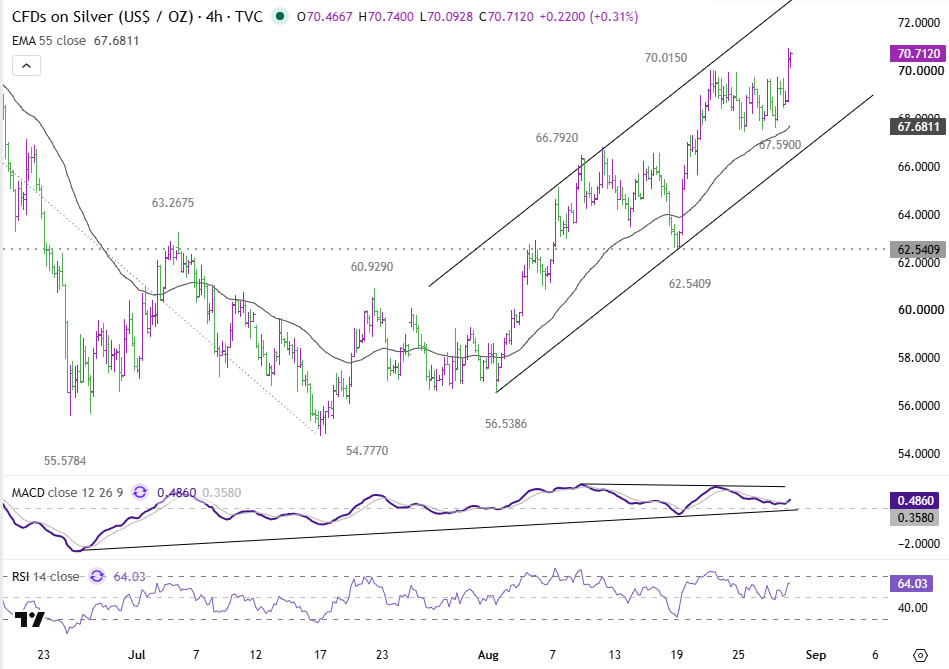

Timing makes this move worth watching. Gold has been among the most crowded precious-metal longs in CFTC-tracked positioning and is the metal most directly associated with this year’s fiscal-credibility and Fed-independence trade. Warsh’s speech is therefore a much more obvious binary catalyst for gold than for silver or platinum. Yet gold is precisely the metal sitting still into the event, while its peers continue higher.
That does not make silver’s advance a signal about what Warsh is about to say. It does, however, make relative performance notable enough to separate from the broader “precious metals are rising” narrative.
Today’s Precious Metals Snapshot
- Gold: essentially flat.
- Silver: +2.01%, above 70.
- Platinum: +2.64%.
- Gold-silver ratio: compressed further to 65.14.
Crowded Gold May Be Taking Event-Risk Pause
One possible explanation is simply positioning. Traders may be reluctant to add further exposure to gold immediately before a speech capable of testing one of the rally’s central narratives. If the market is already heavily positioned for fiscal-credibility concerns, adding more gold before Warsh carries asymmetric event risk: a strong defense of Fed independence could hit that trade quickly, even without conventional hawkish rate guidance.
Silver and platinum face less direct exposure to that specific catalyst, giving existing trends in both metals more room to continue while gold waits.
There is also the possibility of relative-value rotation within the broader hard-asset trade. If investors remain constructive on precious metals but regard gold as comparatively fully priced near term, incremental flows could shift toward silver and platinum instead. A falling gold-silver ratio would be consistent with that interpretation, though price action alone cannot establish whether actual portfolio rotation is occurring.
Silver and Platinum Have Their Own Stories
The simplest explanation may still have nothing to do with Jackson Hole.
Silver’s rally has been supported by its own industrial-demand narrative, including expectations surrounding AI-related power infrastructure and electronics demand. Platinum, meanwhile, has separate support from persistent South African supply constraints. Those catalysts can operate independently of the Dollar, Fed policy, or Treasury credibility.
That matters because the gold-silver ratio had already been compressing before Friday. Silver was not waiting for Warsh to begin outperforming. Today may therefore represent a continuation of an established relative-value move that happens to coincide with one of gold’s biggest event risks.
A more speculative interpretation—that traders are expressing an advance Warsh view through less crowded metals to avoid moving gold or the Dollar directly—is possible, but there is no flow evidence to support it. Without that evidence, it should remain the lowest-confidence explanation.
Gold After Warsh Will Provide Better Test
A more useful signal will come after the speech.
If gold suddenly catches up sharply in either direction while silver and platinum become less exceptional, that would suggest pre-speech divergence was at least partly about gold-specific event positioning. A Warsh message emphasizing monetary independence and market discipline could hit gold disproportionately. A more ambiguous or Treasury-accommodative interpretation could instead allow gold to surge and close the gap with silver.
If silver continues outperforming regardless of gold’s reaction, the case for an independent relative-value and industrial-demand story becomes stronger.
In other words, Friday morning’s divergence is interesting because it creates a testable setup after Warsh, not because it tells us the outcome beforehand.
FX Markets Are Mostly Waiting
Currency markets are far quieter by comparison. The AUD remains the strongest currency for the week, supported by a sharp repricing of RBA expectations after hawkish minutes, sticky inflation, and resilient household spending pushed more major banks toward another hike this year.
The Dollar ranks second, but its strength has looked more consolidative than conviction-driven. Markets have been reducing exposure into Jackson Hole rather than materially rebuilding a bullish Dollar rates story.
The CAD sits at the bottom of weekly rankings despite slightly firmer-than-expected monthly Canadian GDP, with the NZD second weakest. Those positions could change rapidly after Warsh, particularly if the speech produces a broad Dollar move.
For now, silver is making the clearest move into Jackson Hole. The question is whether it is telling us something about broader precious-metals positioning—or simply continuing a rally gold has temporarily chosen not to join.
Frequently Asked Questions
Q: Why is gold flat while silver and platinum are rallying today?
A: There’s no confirmed explanation yet. The most speculative readings include traders avoiding gold specifically because it’s the most crowded, most Warsh-exposed position while silver and platinum run on their own independent catalysts (AI-driven industrial demand for silver, a South African supply collapse for platinum), or a rotation within the same debasement thesis toward metals that look less fully priced than gold. However, the more mundane explanation—that the gold-silver ratio has simply been compressing for days on unrelated catalysts—is also the most likely one.
Q: Does this divergence mean something is about to happen at Warsh’s speech?
A: Not necessarily. The timing may be coincidental, a pre-existing relative-value trend between the metals that happens to be running through the same morning as the speech rather than being caused by anticipation of it. None of the three speculative readings offered are confirmable without actual positioning or flow data, which isn’t available in advance.
Q: What would confirm whether today’s divergence was really about gold being singled out?
A: Only the market’s reaction after Warsh’s speech actually lands. If gold catches up sharply in either direction while silver and platinum’s moves prove more muted by comparison, that would retroactively support the reading that gold was being singled out ahead of its own catalyst. That is a read available only after the fact, not a prediction that can be confirmed beforehand.
Key Takeaways
- Gold is flat while Silver and Platinum rally: Silver is up 2.01% and above 70, Platinum has gained 2.64%, compressing the gold-silver ratio to 65.14.
- Gold is the metal most exposed to Friday’s speech: It’s been the most CFTC-crowded long in recent weeks and the metal most directly tied to the debasement and Fed-independence trade Warsh’s remarks are meant to test.
- Three explanations are offered, and none are confirmable: Traders avoiding gold’s Warsh-exposed positioning, a rotation within the same debasement thesis, or quiet pre-positioning expressed through less-watched metals.
- The most likely explanation is also the most mundane: The gold-silver ratio has been compressing for days already, and silver and platinum both have well-established catalysts unrelated to Fed policy.
- The real test comes only after the speech: A sharp, comparatively larger move in gold versus silver and platinum would retroactively support the “gold singled out” reading.
- Currency markets stayed muted ahead of the speech: Aussie led the week on RBA hike speculation, Dollar’s second place looked consolidative rather than strong, and Loonie lagged despite a Canadian GDP beat.
Also Read
- JPMorgan’s IBIT-Linked Note Misses Early Call, Leaving Investors Exposed to Extended Risk
- Shiba Inu Exchange Inflows Surge, Raising Sell‑Off Concerns
- Ledger Confirms Prior Patch Addressed Viral Exploit, But Two Additional Flaws Persisted
- Dollar Markets Await Kevin Warsh’s Jackson Hole Speech as Fed‑Treasury Dynamics Shift


