







Silver Slides Below $70 as Key Support Level Crumbles, Triggering Market Structure Shift]
Silver’s sharp decline this week extends beyond rising Federal Reserve rate hike expectations. The decisive break below the critical $70 level has challenged one of the market’s most deeply held assumptions. What was once viewed as a structural floor supported by supply deficits and industrial demand now risks becoming a ceiling.
Like gold, silver has come under pressure as investors aggressively reprice U.S. interest rate expectations following last week’s stronger-than-expected nonfarm payrolls report. A stronger dollar and growing expectations that the Fed may need to further tighten policy have reduced the appeal of precious metals. However, silver’s decline carries broader implications given its unique dual role as both a monetary and industrial metal.
The bullish case for silver rested on two pillars. First, persistent supply deficits were expected to maintain tight physical markets. Second, robust industrial demand from sectors such as solar energy and AI-related technologies was seen as providing a durable foundation for prices. Together, these factors fostered a belief that silver would find strong support around the $70 mark even during periods of macroeconomic weakness.
The decisive break below that level now challenges that narrative. While markets can tolerate corrections, what changes sentiment is when a level widely viewed as structural support stops functioning as support. As a result, attention is shifting from whether silver can bounce to whether it can reclaim the lost ground.
The next phase may prove particularly important from an institutional perspective. In technical analysis, major support levels often undergo a polarity flip after breaking, transforming from floors into ceilings. That process becomes especially significant when large investors use relief rallies back toward the former support area as opportunities to reduce exposure.
In silver’s case, the key level to monitor is now $70 itself. If prices attempt to recover and repeatedly encounter heavy selling around that area, it would suggest institutional distribution rather than accumulation. Such behavior would indicate that the market’s long-standing structure is deteriorating and that investors are using strength to exit positions rather than build new ones.
Technically, the near-term outlook remains bearish while 73.08 resistance caps any recovery. The next downside target stands at 61.79, representing the 100% projection of the 89.37 to 73.08 range from 78.80 at 61.79. Strong support is expected between 61.79 and the prior low at 60.97.
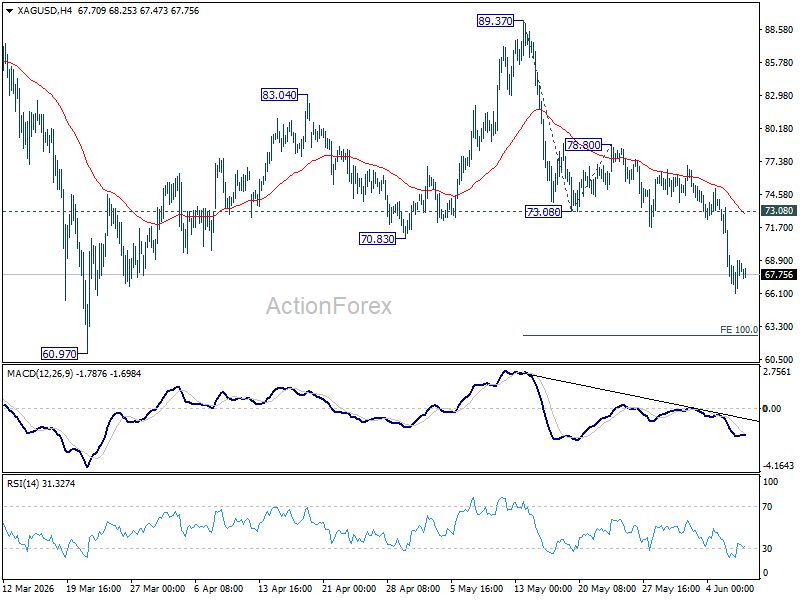

That support zone could still trigger a meaningful rebound. However, a decisive break below 60.97/61.79 would signal further acceleration in downside momentum. In that scenario, silver could extend toward the 161.8% projection at 51.72 and potentially challenge the major psychological level at 50.
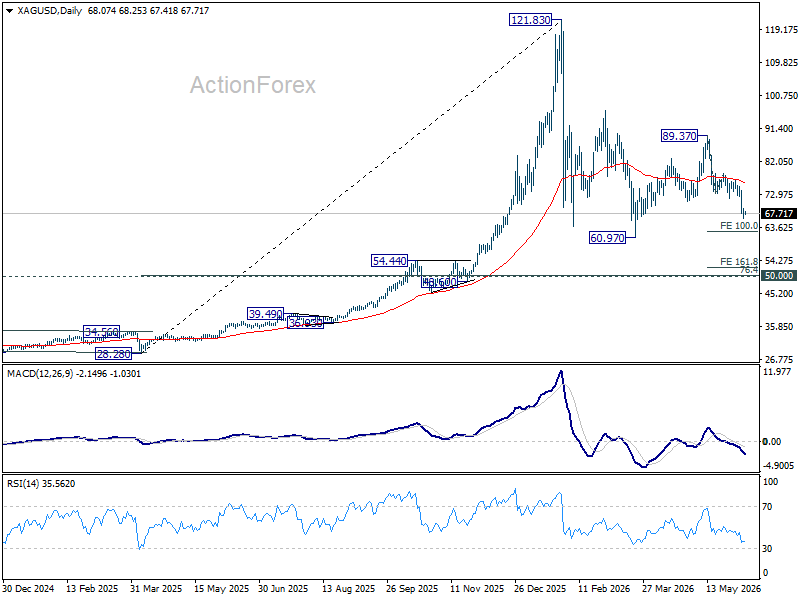
For now, the most important question is not how far silver has already fallen. It is whether the market can swiftly reclaim $70. If that level has indeed shifted from floor to ceiling, the implications for silver’s medium-term outlook could be far more significant than the current selloff alone suggests.
Also Read
- Rewritten Headline: Crypto Analyst Warns: Ripple’s Victory May Not Be the End of Clarification Debate
- Trump Says Iran Agreement Has Been Signed, Cites Reopened Strait of Hormuz
- Euro holds firm as traders assess US-Iran peace deal, Fed decision looms
- Strategy Enters Bitcoin Realm with 1,587‑BTC Acquisition Worth $100 Million


