



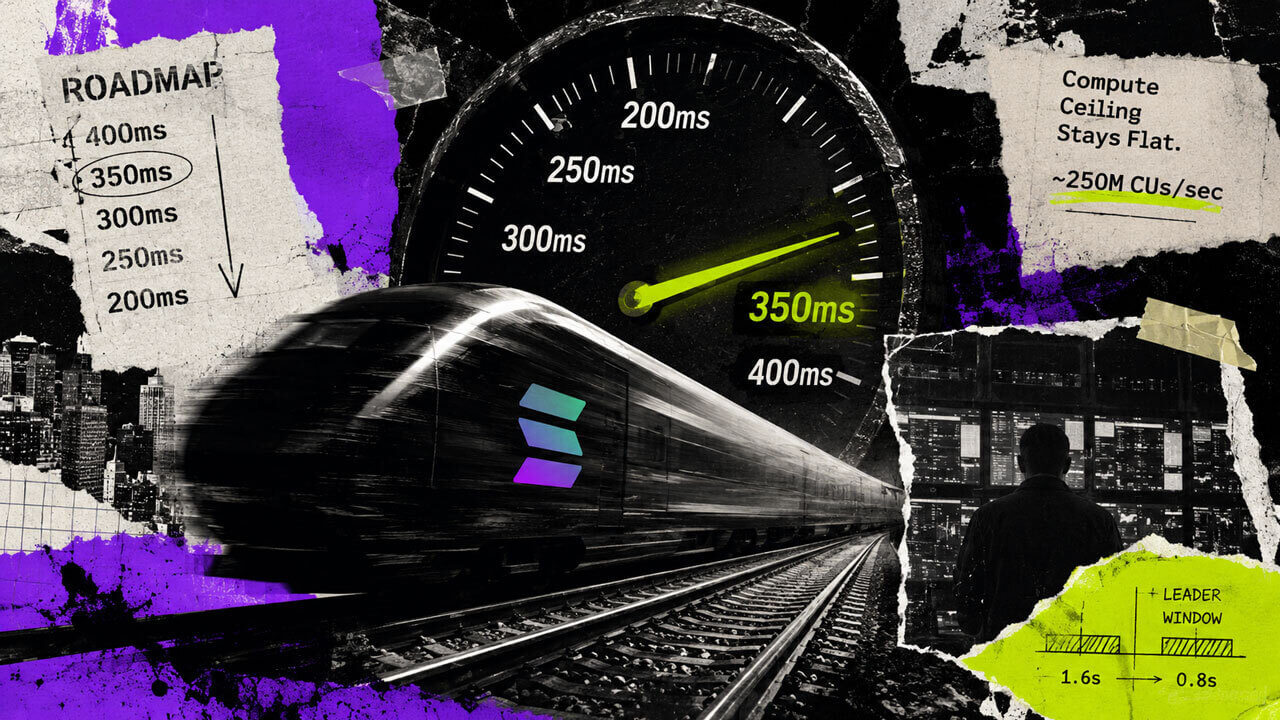
Solana’s transition to a 350ms Mainnet target slot time is scheduled to begin in epoch 1020, reducing from the current 400-millisecond target. While the feature was activated at the start of epoch 1019, a one-epoch delay ensures the network maintains existing parameters until the next epoch. This adjustment means blocks will have shorter production intervals without increasing the compute allowance per second.
The rollout is already progressing on other networks. Testnet currently operates at an effective 200ms target, while Devnet has reached 300ms and activated its 250ms gate without full implementation. Solana’s August 6 changelog previously indicated only the 350ms step for test environments, highlighting the rapid advancement in later stages.
Mainnet’s 350ms feature officially activated at slot 440,208,000, marking the first slot of epoch 1019. Under SIMD-0525’s delay mechanism, Mainnet will continue operating at a 400ms effective target through that epoch before transitioning to 350ms in epoch 1020.
SIMD-0525 remains in draft status, indicating that feature activation reflects cluster-level changes rather than final acceptance of the complete 200ms design framework. These figures represent target timings and should not be confused with observed block production metrics, confirmation latency, or economic finality measures.
Compute Ceiling Remains Constant Through Arithmetic Design
A key aspect of the proposal is that reduced workloads must fit within shorter slots as slot durations decrease.
Solana’s July 30 changelog confirmed that Mainnet had already implemented a maximum block limit of 100 million compute units. SIMD-0525 illustrates how this 400ms maximum integrates with various slot-time stages:
| Target slot | Example max block CUs | Theoretical max CUs per second | Four-slot leader window | 432,000-slot epoch |
|---|---|---|---|---|
| 400ms | 100M | 250M | 1.6 seconds | 48 hours |
| 350ms | 87.5M | 250M | 1.4 seconds | 42 hours |
| 300ms | 75M | 250M | 1.2 seconds | 36 hours |
| 250ms | 62.5M | 250M | 1.0 second | 30 hours |
| 200ms | 50M | 250M | 0.8 seconds | 24 hours |
Each configuration maintains approximately 250 million CUs of theoretical maximum block budget per second. Halving the target slot time thus preserves the overall compute ceiling while increasing scheduling frequency.

This ceiling represents maximum capacity under ideal conditions rather than guaranteed transaction throughput. Real-world performance depends on workload demands and network conditions. The 100 million figure serves as an example for maximum block CUs rather than a universal baseline.
The proposal also reduces per-slot budgets for account writes, votes, data allocations, data shreds, coding shreds, and partitioned rewards. These adjustments aim to create more frequent scheduling opportunities without unexpectedly increasing resource requirements for validators.
This distinction is crucial since block limits define maximum possible work rather than typical operational loads. Shorter target slots may change transaction inclusion timing without altering the theoretical per-second compute allowance.
Solana assigns four consecutive slots to each leader, creating a nominal leader window. At 400ms per slot, this equates to 1.6 seconds. At 200ms, the window contracts to 0.8 seconds.
This shortened timeframe reduces individual leader control periods and compresses the time needed to receive, validate, and build upon previous blocks while casting votes before network progression. Validators face tighter coordination and propagation margins as block production accelerates.
Increased frequency of vote and gossip events within the same wall-clock intervals requires block packing and Turbine protocols to enforce smaller, slot-aware budgets after each delayed transition. The staged approach pairs latency improvements with live coordination testing at each phase.
Epoch timing also experiences compression. Maintaining 432,000 slots per epoch means nominal duration decreases from roughly 48 hours at 400ms to 24 hours at 200ms. While slot counts remain consistent, their temporal significance shifts accordingly.
Compatibility challenges extend beyond validator operations. Some SDK constants and off-chain assumptions remain anchored to 400ms benchmarks, potentially causing applications using fixed slot multiplications to misalign with actual cluster behavior following faster implementation stages.
RPC clients, explorers, and off-chain services relying on slot distances for freshness estimation or elapsed-time calculations face similar risks. The long-term solution involves obtaining effective timing parameters directly from the cluster instead of treating compile-time constants as permanent values.
Alpenglow’s Validator Admission Ticket demonstrates economic implications of this timing mismatch. SIMD-0525 scaling applies only when supported by the Alpenglow VAT mechanism. In such cases, proposed fees would decrease from 1.6 SOL per epoch at 400ms to 0.8 SOL per epoch at 200ms, maintaining an approximate 0.8 SOL daily target. However, current evidence does not confirm VAT collection activation on any network.
For Mainnet, the immediate focus remains on implementing 350ms targets in epoch 1020 rather than jumping directly to 200ms. This measured approach allows Solana to improve scheduling frequency while preserving resource stability. The primary challenge lies in ensuring validators and supporting infrastructure maintain coordination effectiveness as slot durations decrease.
Also Read
- Bitcoin Surges 8.7% in Best Day Since March, Flipping Prediction Markets to a Toss-Up
- FOMC Minutes Show Fed Trying to Communicate Less Without Saying Less – Action Forex
- Trump Urges Senate Passage of Crypto Clarity Act, Signals Potential Bitcoin Accumulation
- Gold Surges Past $4,500 as Declining US Dollar and Yields Fuel Safe-Haven Demand