



_20251219080853100_7a1832.webp?w=1024&resize=1024,1024&ssl=1 "Bawany Air Products Announces Rs6bn Rights Issue at 73% Discount")





On August 12, the Solana network continued to produce blocks despite an infrastructure failure that prevented validators controlling nearly 29% of the network’s stake from casting votes, as reported by the Solana Foundation on September 14.
Although the blockchain remained operational, independent monitoring revealed a notable decline in performance. Leader slots were skipped more frequently, transaction throughput dropped significantly, and the time required to achieve settlement finality was extended.
The outage originated at Teraswitch, identified by the Foundation as Solana’s largest infrastructure provider. A postmortem from Teraswitch attributed the disruption to a stale default route on a Miami edge router, noting that provider traffic was fully restored 33 minutes after the initial alert.
Routine maintenance by a transit provider inadvertently triggered the route, while transposed values in a routing policy applied a “no-export” directive directed at Europe and the Asia-Pacific region.
Consequently, the faulty route propagated across Teraswitch’s network, blocking affected data centers from accessing the internet via healthy local routers. Twelve sites across Europe and Asia-Pacific lost internet and inter-site connectivity, including facilities hosting Solana validator and RPC nodes.
Independent blockchain risk monitoring firm Metrika corroborated the scale of the disruption while confirming ongoing block production. The firm’s data indicated that skipped slots exceeded 32%, and non-vote transaction throughput plummeted below 300 per second, a sharp decline from the typical range of roughly 1,100 to 1,300.
Metrika’s observer also documented approximately thirty minutes during which newly produced blocks had not yet reached finality—the stage at which transactions become irreversible. The transaction backlog cleared as connectivity was restored.
While Solana averted a chain-wide production halt, users and systems reliant on rapid settlement experienced materially degraded performance.

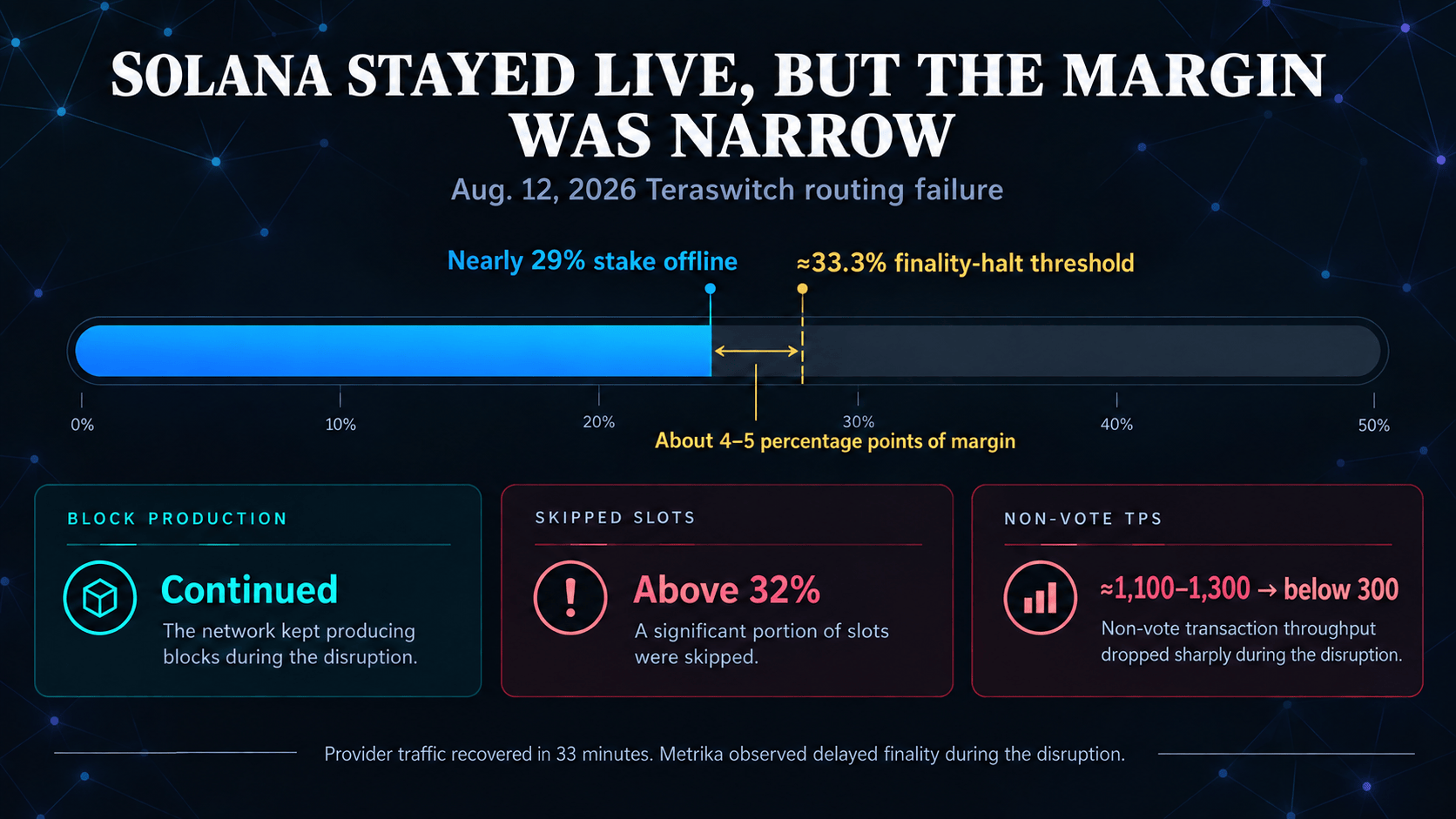
Solana requires more than 66% of staked assets to vote in order to maintain consensus finality. According to Metrika, the roughly 29% of stake that went offline remained approximately 4% to 5% below the corresponding 33% finality-halt threshold.
The Foundation noted that Teraswitch hosted 38% of the network stake in 2025, and its team had reduced the provider’s share to below 30% prior to the outage. Although the hosting share and the incident’s delinquent stake estimate measure different metrics, both underscore the risks associated with provider concentration.
Numerous independently operated validators lost connectivity simultaneously because they relied on the same provider failure domain.
Following the incident, Teraswitch implemented provider-side hardening that same day to ensure an invalid route can no longer prevent sites from utilizing healthy local edge routers. However, its September postmortem indicated that additional route monitoring remains a work in progress, leaving infrastructure diversity and observability as ongoing tests of the network’s resilience.
Also Read
- Senate setback for Clarity Act triggers $571 million in crypto long liquidations
- Cryptocurrency Market Plummets as Regulatory Clarity Act Fails in Senate
- Elliott Wave View: Dollar Index (DXY) Double Three Rally Likely to Break Lower – Action Forex
- Ripple’s university strategy is evolving from blockchain labs to XRP logos in packed stadiums


