







Circle President Heath Tarbert testified before Congress on September 2, emphasizing that integrating digital‑dollar infrastructure within U.S. regulatory frameworks could strengthen the network effects that sustain the dollar’s worldwide influence. His remarks positioned stablecoin and digital‑asset legislation as a strategic instrument for advancing the United States’ monetary power.
U.S. regulations have the potential to fortify private dollar‑token networks, while the allocation of official foreign‑exchange reserves operates on a distinct trajectory. Under a regulated regime, stablecoins can broaden the private adoption of dollar‑backed tokens, alter reserve composition practices of issuers, and generate incremental demand for short‑term Treasury securities.
Central banks retain the authority to determine the composition of their reserve holdings. Tarbert recognized this boundary, asserting that payment technology alone cannot replace prudent economic policy and that digital infrastructure cannot independently sustain the dollar’s dominant status.
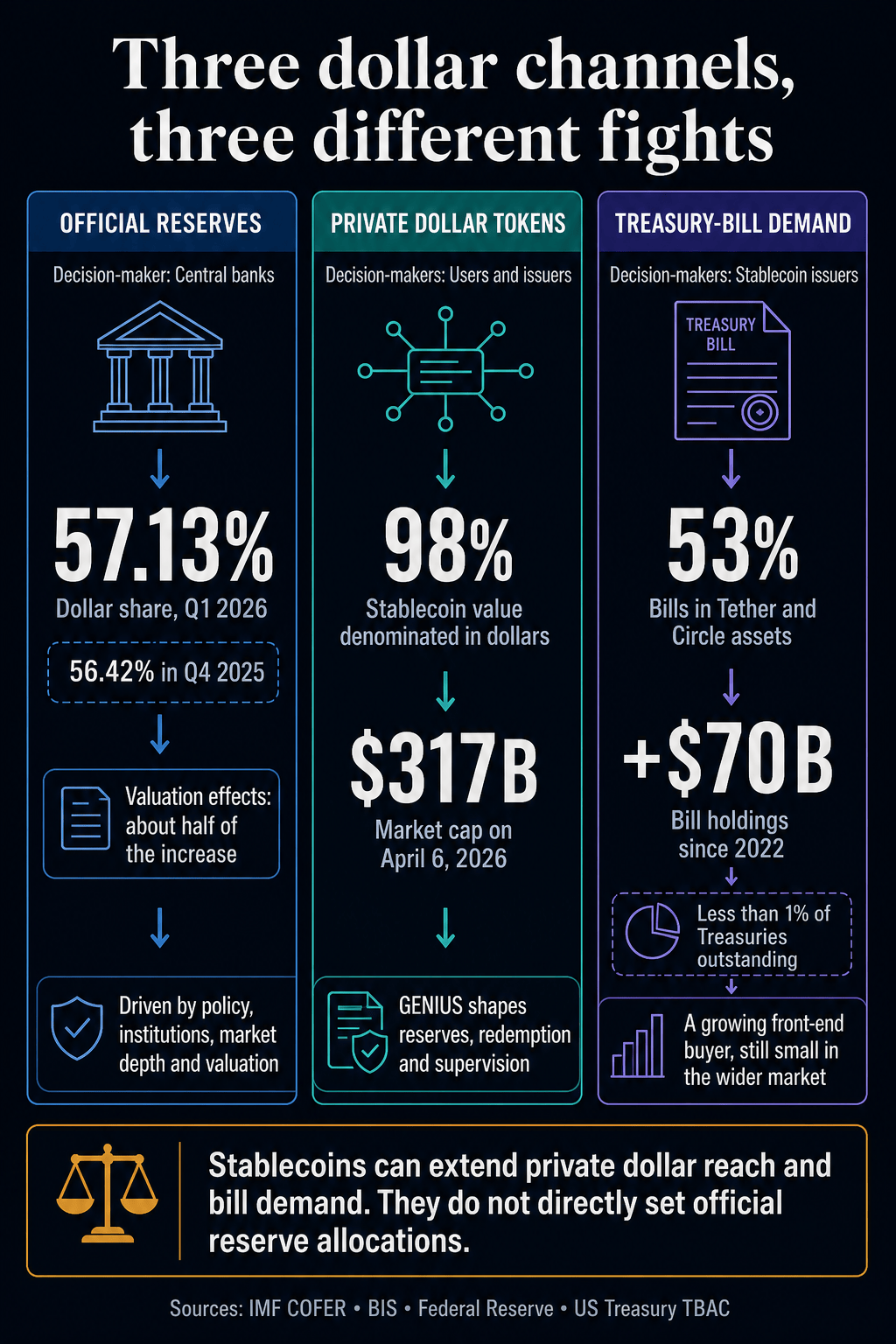
According to the International Monetary Fund’s most recent COFER report, the U.S. dollar represented 57.13% of allocated global foreign‑exchange reserves in the first quarter of 2026, rising from 56.42% in the fourth quarter of 2025. Currency‑valuation movements contributed roughly half of that quarter‑on‑quarter gain.
Despite a longer‑term trend of erosion in the dollar’s official reserve share, this quarter’s uptick reflects exchange‑rate effects rather than a direct boost from stablecoin uptake. Because valuation swings can alter the reported reserve composition without a corresponding portfolio decision, attributing the change solely to stablecoin adoption would be misleading.
COFER monitors reserve assets disclosed by monetary authorities, whereas stablecoin market capitalization quantifies the liabilities that private firms issue to token holders.
The Bank for International Settlements estimates that approximately 98% of stablecoin value is dollar‑denominated, underscoring the currency’s predominance in private token markets.
Nonetheless, BIS researchers anticipate that near‑term impacts will manifest primarily in private stores of value and payment mechanisms, rather than influencing official reserve management, currency intervention, or the anchor‑currency functions of central banks.
Consequently, stablecoins can broaden the dollar’s digital footprint, while fiscal credibility, institutional robustness, market depth, and valuation dynamics continue to drive official reserve demand. This distinction separates the decisions of consumers and businesses selecting a digital payment tool from those of monetary authorities managing reserve portfolios.
Implications of Regulated Stablecoins
The GENIUS Act’s issuer framework mandates one‑to‑one permitted reserves, par‑value redemption, comprehensive disclosures, supervisory oversight, and compliance with anti‑money‑laundering requirements.
These provisions can enhance reserve quality, affect the geographic footprint of issuers, determine whether unlicensed entities can offer stablecoins within the United States, and channel a greater proportion of issuer assets toward short‑term safe‑haven instruments.
Although GENIUS was signed into law in July 2025, its principal requirements had not yet taken effect at the time of Tarbert’s testimony. The Treasury’s August rulemaking notice indicated that the general effective date was anticipated to be January 18, 2027, unless final implementing rules triggered an earlier effective date 120 days after publication.
A broader restriction on the issuance of payment‑focused stablecoins by unlicensed providers is slated to commence on July 18, 2028.
Once operational, the framework will oversee backing, redemption mechanisms, and supervisory standards, while leaving central‑bank currency allocations to the discretion of monetary authorities.
CLARITY targets the trading and intermediary tier that sits above stablecoins. The House approved the bill, the Senate Banking Committee advanced its segment by a 15‑9 vote, and the merged Senate version was issued on July 22.
The bill’s core purpose is to delineate jurisdictional authority between the Securities and Exchange Commission and the Commodity Futures Trading Commission and to establish regulatory standards for digital‑asset intermediaries and markets.
If enacted, these provisions could streamline operations in U.S. digital‑asset markets and broaden the influence of regulated dollar tokens. The impact would operate through market structure, not through changes in official reserve allocations.
Stablecoin issuers require liquid assets to honor redemption obligations, and Treasury bills can fulfill that need. An analysis by the Treasury Borrowing Advisory Committee, drawing on data from major issuers through September 2025, revealed that Treasury bills constituted 53% of Tether’s and Circle’s assets, with their combined bill holdings rising by $70 billion since 2022.
Despite this expansion, stablecoin issuers collectively hold less than 1% of total Treasury securities outstanding. Their purchasing activity can exert marginal influence on the bill market, whereas broader Treasury demand and official dollar reserves remain driven by distinct factors.
Fed staff estimated the stablecoin market capitalization at $317 billion on April 6, 2026, representing a more than 50% increase from early 2025. The specific date matters because market capitalization fluctuates continuously, and comparing this figure directly with official reserves would be misleading.

The Fed’s analysis indicated that USDC maintains high‑quality reserves that match its stablecoin liabilities. By contrast, USDT reported total reserves of roughly 1.04 times its liabilities, though its higher‑quality reserves amounted to only about 0.74 times liabilities.
Regulatory frameworks can narrow these gaps and enhance the credibility of redemption commitments, offering a tangible pathway for GENIUS to reinforce private dollar infrastructure.
Fed staff cautioned that intricate intermediation, vertical integration, and tighter linkages to traditional finance can elevate opacity and contagion risks, magnifying operational or liquidity shortfalls. As adoption accelerates, these interdependencies may propagate problems further.
BIS researchers caution that widespread adoption of dollar‑pegged stablecoins could accelerate private currency substitution, erode domestic monetary‑policy effectiveness and capital‑control mechanisms, and divert emerging‑market savings toward U.S. Treasury bills. A run on a leading issuer could subsequently inject stress into local financial systems and short‑term dollar markets.
The shift of funding and intermediation away from traditional bank deposits toward stablecoins can occur even when issuers’ reserves are ultimately reinvested in government securities, moving activity outside conventional channels.
Tarbert’s argument is most compelling regarding these private payment rails. U.S. regulations can shape whether dollar stablecoins develop within a supervised environment, what assets back them, and which markets they interconnect. Expanded reach also widens the avenues through which runs, operational breakdowns, and currency substitution can propagate.
The IMF’s 57.13% figure captures the independent decisions of official reserve managers, whose allocations reflect economic credibility, deep liquid markets, institutional strength, policy considerations, and valuation dynamics.
Stablecoins can broaden the dollar’s private reach and generate demand for its shortest‑dated government debt. Nonetheless, the dollar’s share of official reserves continues to hinge on the policies that uphold confidence in the currency.
Also Read
- Elliott Wave Outlook: Gold (XAUUSD) Anticipates Minimum 3 Wave Rally
- Former Coinbase Co‑Founder Pursues Venezuelan Oil Stakes Amid U.S.–Backed Energy Overhaul
- South Korea’s Stablecoin Regulations Exacerbate the ‘Kimchi Premium’
- China’s RatingDog PMIs Climb in August as Services Activity and Hiring Gain Ground


