







The Senate failed to advance the CLARITY Act on Sept. 15, as a 49‑50 cloture vote fell short of the required 60 votes. Six days later, Coinbase CEO Brian Armstrong announced that Stand With Crypto had surpassed four million members.
In a post, Armstrong noted that “the 2024 election proved the importance of the crypto voter,” and warned that voters would remember who backed their interests.
The Senate vote was on whether to begin debate on H.R. 3633, not on the bill’s final passage. The timing highlighted Stand With Crypto’s challenge of turning its massive supporter base into the bipartisan Senate support required for legislation.
What Stand With Crypto’s four‑million figure measures
Armstrong’s announcement fulfilled a specific Coinbase goal. In October 2024, the exchange pledged to help Stand With Crypto reach four million advocates ahead of the 2026 midterm elections.
Coinbase also disclosed that it helped launch Stand With Crypto in 2023, making membership growth a core part of its policy strategy.
Armstrong referred to “members,” whereas Stand With Crypto has also described its audience as “advocates.” After the Senate vote, the group said its U.S. network comprised roughly three million advocates. In May, it reported more than 3.7 million members worldwide across six markets.
Because the figures were collected on different dates and cover varied geographies, they do not constitute a single growth trajectory and are not inherently contradictory. Moreover, the total cannot be directly equated to four million American voters.
Stand With Crypto’s privacy policy covers members, subscribers, account holders, partner data, and advocacy activity, but provides no details on deduplication, inactive record handling, or verification of U.S. voter status.
The four‑million figure demonstrates the group’s reach, though its electoral impact hinges on unquantified distinctions.
Coinbase confirms it helped launch Stand With Crypto and set the four‑million target, indicating a strategic and operational partnership. The exchange has not disclosed the organization’s total funding.
Stand With Crypto may benefit from a broader industry coalition, but its latest milestone remains closely linked to a Coinbase objective.
Membership serves as a valuable organizing benchmark, yet it does not by itself reveal the intensity, eligibility, or geographic leverage of its members. Determining this will dictate whether future growth translates into stronger electoral influence or simply expands the pool of people available for outreach.
Mobilization is visible; vote conversion is not
Stand With Crypto reports that its supporters sent over 925,000 emails to Congress in 2025, organized more than 600 events, and held 100 meetings with lawmakers. By August 2026, the group said the CLARITY Act had spurred over one million calls and emails.
Stand With Crypto also publishes advocate counts by House district, providing a geographic breakdown rather than a single national total.
The organization has not disclosed how many unique individuals generated the calls and emails, how many congressional offices responded, whether undecided senators changed their positions, or which arguments proved persuasive.
District totals do not indicate whether those supporters vote, how strongly they prioritize crypto, or whether they can sway a statewide Senate race.
The official CLARITY Act roll call recorded 49 votes in favor of cloture, 50 opposed, and one senator abstaining. Despite more than one million claimed bill‑related contacts, the coalition fell short of the 60 votes required.

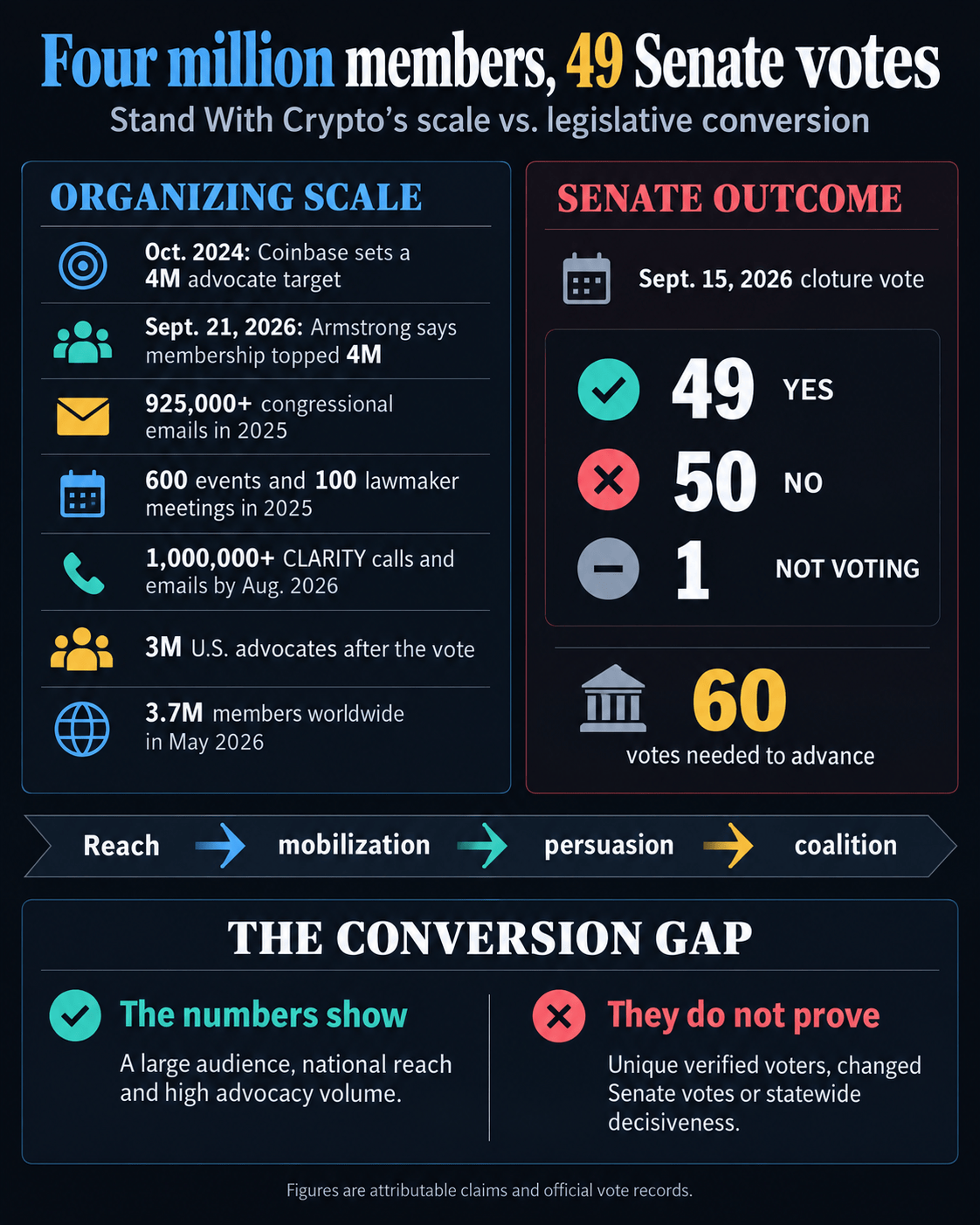
Stand With Crypto’s metrics reflect membership acquisition and activity, but legislative success hinges on persuading lawmakers to cross party lines. Tracking unique participants, office responses, and shifts in voting intent would more directly link outreach volume to political outcomes.
This distinction also affects how the group should evaluate its district network. House‑district totals can guide events and constituent outreach, but Senate influence is determined on a statewide basis.
A politically useful map should display not only where supporters appear in the database, but also where verified, engaged voters can influence the lawmakers whose votes are still up for grabs.
The coalition faced more than an ethics dispute
Democratic opponents highlighted presidential ethics concerns and the Trump family’s crypto interests. Senate Banking Committee Democrats also criticized the bill for weak enforcement and significant loopholes.
Senator Elissa Slotkin of Michigan cited ethics, anti‑money‑laundering safeguards, national security, and the CFTC’s capacity. Republican Senator Susan Collins of Maine described the bill as a moving target exceeding 600 pages and warned that stablecoin rewards could siphon deposits from community banks and credit unions.
Banking groups contended that a proposed regulatory circuit breaker would only mitigate yield‑driven deposit flight after substantial harm had already occurred.
Stand With Crypto has demonstrated its ability to build an advocacy audience and direct political outreach. The next step is to prove that its four‑million claimed members constitute a verified voter bloc capable of delivering a decisive Senate outcome.
Also Read
- Whitehats transfer 52.37 BTC from compromised Coldcard wallets into recovery trust
- Euro Area Consumer Confidence Takes Centre Stage as Energy Costs Rise
- Why Can’t the RBA Simply Look Through Higher Oil? Bullock Explains the Second-Round Risk
- X Integrates Crypto and Stock Trading Directly Into User Timelines


