






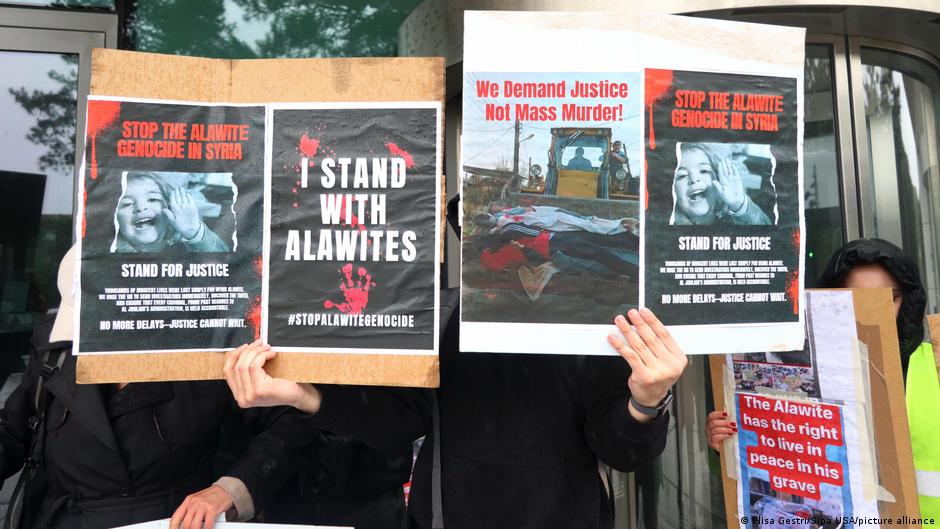
A knock on the door, a hushed warning, and then the decision to flee the country — that’s how Layla, a math teacher and mother of three in her 40s, recounts her family’s departure from Damascus. Until recently, Layla—who asked that Deutsche Welle withhold her full name for safety reasons—lived in Syria’s capital as part of the Alawite community, the same sect as the former ruling Assad dynasty, often viewed with suspicion by others who regard them as loyalists to the now-deposed regime.
“We never supported him—or his father, for that matter,” she told DW. “He killed members of my family. We hated him.” Yet despite this animosity, Layla admits feeling anxious when opposition factions advanced into Damascus in 2024 following the collapse of the Assad government. She described the newcomers as “extremists.”
Initially, she and her husband chose to remain. But everything changed when an unidentified man appeared at their home.
“He told me: ‘We know your daughter takes piano lessons and attends dance classes. You must stop that. Otherwise, we may send her to the house of the sisters,'” Layla recalls.
In conservative Islamic circles, female participation in music and dance is widely discouraged. And while Layla had heard whispers of the so-called “house of the sisters,” she says online accounts suggested it was a facility where women from other religious minorities were allegedly held and pressured into converting to Islam. Within days, her family resolved to leave. They now reside in Lebanon.
“I don’t want my children growing up like that,” she explained.
Unraveling the Myth of the ‘House of Sisters’
The first major media attention surrounding the phrase “house of sisters” emerged in May 2024 after Batoul Alloush, a 21-year-old Alawite university student, went missing before reappearing days later in modest Islamic dress, claiming she had voluntarily converted to Islam and left her family behind. Her case sparked widespread speculation, especially after other reports surfaced alleging similar disappearances involving women from the Alawite minority.
Psychologist Reham Suleiman, who works with the United Nations and engages directly with the Alawite community, confirmed to DW that she possesses documented knowledge of multiple abduction cases. However, she emphasized that not all incidents were identical in motivation or outcome. Some women returned with accounts of fleeing abusive households, escaping arranged marriages, or reuniting with romantic partners. Others claimed coercion or drug use.
Human rights organizations such as Amnesty International and the United Nations Commission of Inquiry on Syria have acknowledged between 40 and 60 reported cases but noted that investigations remain incomplete due to limited access and inconsistent documentation.
Politics and Propaganda
Syrian authorities did attempt to address public concerns regarding the alleged facility. Hind Kabawat, a spokesperson for the Ministry of Social Affairs, denied issuing any license for a site referred to as the “house of the sisters,” adding that unauthorized establishments of this kind would face immediate closure.
Local fact-checkers at Verify-Sy analyzed viral imagery associated with the rumor and determined that photographs purporting to show the building were digitally fabricated using AI tools. Their assessment highlights a broader pattern of misinformation spreading rapidly across social platforms.
“There is no shortage of unverified claims circulating daily — ranging from kidnappings to torture allegations in detention centers,” said a representative from Verify-Sy. “The challenge lies in authenticating reports without sufficient corroborating evidence from trusted open-source material.”
Regardless of truth, the narrative has been weaponized by various factions seeking leverage against rival groups, according to independent media collective Shaam News Network (SNN).
“Without concrete proof, online narratives quickly transformed the ‘house of the sisters’ into a symbol of systematic oppression targeting Alawite women,” SNN wrote in a recent analysis.
Foreign Actors Amplify the Narrative
A relatively new entity known as the Syrian Investigation Mechanism (SIM), founded in May 2026 and headquartered in Germany, has publicly linked the phenomenon to proselytizing efforts aimed at converting non-Muslims. SIM’s director, Yasser Shalati, stated during a YouTube interview that detained women were forcibly indoctrinated and confined against their will. Despite repeated attempts, DW did not receive a response from SIM for additional commentary.
Meanwhile, the Union of Syrian Alawites in Europe (USAE), based in Berlin, continues to amplify fears about the alleged abductions. One of its officials, Muaiad Ibrahim—identified in legal filings as deputy director—frequently uses Facebook to critique the new Syrian government while expressing nostalgia for figures tied to the old regime, including Ahmed Hassoun, a prominent religious scholar jailed last year for allegedly undermining state stability.
Several other diaspora-driven advocacy groups, some claiming millions of followers despite sketchy web presences, have echoedsimilar sentiments, raising questions about credibility. Notably, investigative platform DARAJ has criticized certain actors for appearing to support remnants of the Assad administration.
Divisions Within Communities
Gregory Waters, a senior fellow at the Atlantic Council and longtime observer of Syrian politics, warns that rumors like the “house of sisters” carry significant consequences beyond their factual basis.
“These stories gain momentum because they tap into deep-seated anxieties within minority communities,” he said. “They serve a dual purpose: isolating Alawites politically and emotionally, and reinforcing divisions between them and the majority population.”
Waters adds that digital disinformation thrives where real-world interaction is scarce, particularly in environments marked by trauma and mistrust.
He also notes that perspectives vary widely depending on geography and lived experience. “You’ll find individuals convinced that ethnic cleansing is underway, and others who insist conditions are stable and integration is progressing normally.”
While tensions persist in some regions, Waters believes that outright hostility hasn’t escalated nationwide. Instead, what we see is a cautious status quo: walls built slowly, not scaled dramatically.
Economic Recovery Offers a Glimmer of Hope
Naseef Naeem, director of research at the Berlin-based Candid Foundation, argues that long-term reconciliation hinges on restoring basic services and revitalizing the economy.
“Currently, the primary focus in Damascus is governance, security reform, and stabilization,” he explained. “But eventually, fostering dialogue between ethnic and religious groups becomes essential.”
Recent signs point to cautious optimism. According to Waters, summer tourism surged along Syria’s Mediterranean coast—an area traditionally dominated by Alawites—drawing large numbers of Sunni visitors from inland cities. Reports suggest minimal friction, bolstered by government initiatives to promote safe travel and cross-community engagement.
“When people interact face-to-face, fear gives way to familiarity,” Waters observed. “That kind of grassroots connection helps counteract the spread of harmful myths.”
Edited by: K. Hairsine
Also Read
- Video: Dozens protest potential Strait of Hormuz deployment
- German Chancellor Friedrich Merz Slams AfD’s ‘Remigration’ as ‘Ethnic Cleansing’ Following State Election Shock
- Singapore Prime Minister’s Compensation Set for 64% Increase Under New Pay Framework
- PSX Closing Bell: A Back-Foot Finish – Mettis Global


