






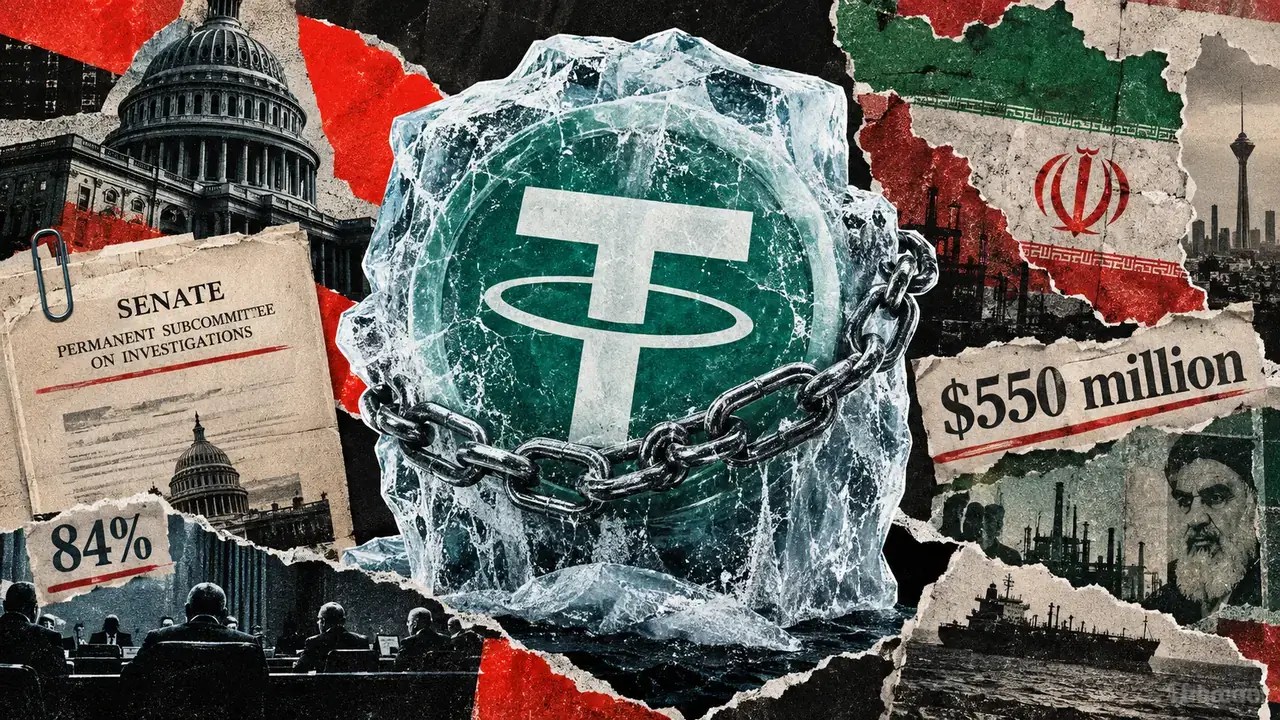
Tether announced it helped freeze nearly $550 million in Iran‑linked USDT during 2026, while Democratic investigators on a Senate subcommittee alleged that delays in blacklisting certain wallets allowed tens of millions of dollars to continue moving.
A preliminary report released on Sept. 28 by Democratic minority staff of the Senate Permanent Subcommittee on Investigations examined 846 crypto wallets that U.S. or Israeli authorities had sanctioned or targeted for seizure because of ties to Iran and related groups. The report found that about 84 % of those wallets transacted exclusively or almost exclusively in USDT.
Sen. Richard Blumenthal, the Connecticut Democrat and the subcommittee’s ranking member, referred the findings to the Treasury and Justice departments, requesting investigations into Tether’s anti‑money‑laundering and sanctions‑compliance practices.
The referrals do not establish that Tether violated federal law, nor do they indicate that either department has opened a new case.
Tether issued a statement on the same day, saying its actions had resulted in roughly $550 million in USDT being frozen across wallets identified by U.S. authorities as linked to Iran’s central bank and Iranian sanctions networks.
Funds that moved before the freeze
The 84 % figure from the Senate report reflects a selected group of wallets rather than the entire USDT ecosystem.
Investigators compiled the sample from wallets listed by the Treasury Department’s Office of Foreign Assets Control (OFAC) and Israel’s National Bureau for Counter‑Terror Financing as being associated with Iran or regional groups. The dataset covered more than five years of designations up to August 2026.
For the analysis, the Senate report defined a wallet as transacting “predominantly” in a digital currency when that asset accounted for more than 80 % of the dollar value of its total transactions.
Consequently, the figure does not indicate what proportion of all USDT transactions are illicit, nor does it measure crypto’s share of Iran’s overall sanctions‑evasion activity.
USDT is a dollar‑pegged stablecoin that can move across blockchain networks without traditional bank transfers. Tether, as the issuer, retains the ability to blacklist addresses and prevent USDT held at those addresses from moving.
This makes the timing of a freeze the critical issue for Democratic investigators.
The minority staff’s report focused on 39 wallets identified by Israel’s NBCTF in June 2023 as linked to Tawfiq Muhammad Sa’id al‑Law, who was later sanctioned by the U.S. Treasury for providing financial services to Hezbollah.
According to the report, five of the addresses had already been blacklisted, while the remaining 34 were not frozen until March 2024. Senate investigators calculated that more than $34.6 million in USDT moved out of those wallets after the Israeli seizure notice was published and before the remaining addresses were frozen.
Tether points to action before public designation
On April 23, Tether said it assisted U.S. authorities in freezing more than $344 million in USDT across two addresses after receiving information from OFAC and other law‑enforcement agencies.
The following day, OFAC updated its sanctions entry for the Central Bank of Iran to include those same two blockchain addresses as digital‑currency identifiers, linking the central bank to the IRGC‑Qods Force and Hizballah.
Tether also reported that over $130 million in USDT across four wallets was frozen in July as the Treasury expanded the list of sanctioned blockchain addresses linked to the Central Bank of Iran.
These two disclosed actions account for at least $474 million of the roughly $550 million Tether says was frozen in 2026. The company did not provide a wallet‑by‑wallet breakdown reconciling the disclosed examples with the full total.
CEO Paolo Ardoino stated that Tether acts when authorities provide credible information, noting that public blockchains give investigators visibility into fund movements that cash transactions do not.
Meanwhile, the Senate report indicated that Tether acknowledged receiving a June 4 request for information and documents from the subcommittee but had not responded at the time the report was published.
Tether’s Sept. 28 public statement did not directly address the report’s 846‑wallet analysis or the $34.6 million example of funds investigators say moved before the addresses were frozen.
A separate U.S. forfeiture case is seeking approximately $61 million in cryptocurrency allegedly tied to black‑market Iranian oil sales. Federal prosecutors claim the broader network moved more than $1.5 billion in proceeds and alleged that some funds were intended to benefit Iran’s government and military, including the Islamic Revolutionary Guard Corps.
The Justice Department said the forfeiture action targeted cryptocurrency linked to sanctions evasion and money‑laundering activities connected to Iranian petroleum sales.
These two sets of evidence highlight both sides of issuer‑controlled stablecoins: authorities can immobilize large balances once they identify addresses, while delays in blacklisting can leave funds free to move.
Whether the delays identified by Senate minority staff represent isolated enforcement gaps or broader compliance failures is now the question that Blumenthal has asked federal agencies to investigate.


