



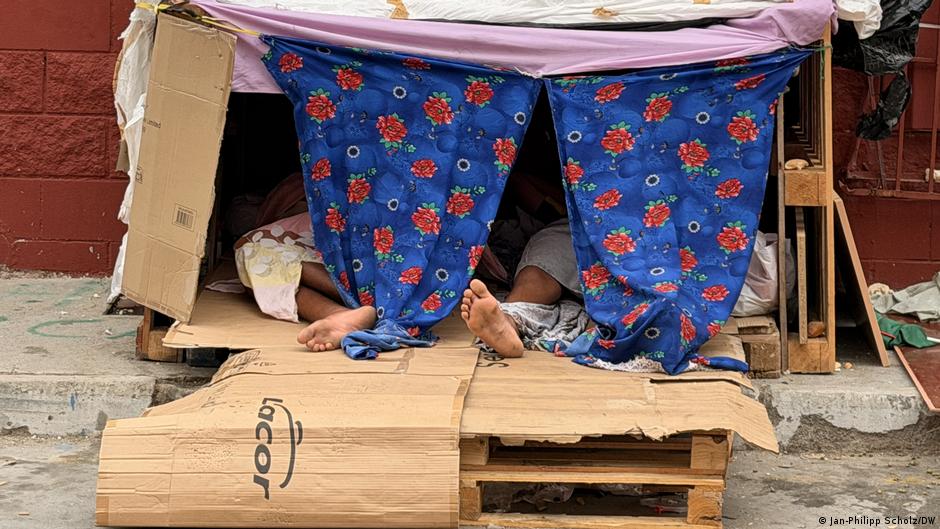
At 8 a.m. in Ceuta’s Tarajal industrial park, the usual bustle of warehouse workers and truck drivers has been replaced by rows of makeshift tents constructed from cardboard and plastic sheeting. Under threadbare blankets, children and teenagers huddle together for warmth in the early morning chill.
According to local estimates, between 3,000 and 5,000 unaccompanied minors currently live on the streets of this Spanish enclave. Many cannot secure spots in the already overwhelmed reception centers that dot the city.
Fourteen-year-old Amina (name changed), a Moroccan girl, arrived in Ceuta with her brother during the mass border crossing in late July that brought approximately 80,000 people into the territory. While most have moved on, around 9,000 newcomers remain, including numerous minors.
“What’s worst is that we don’t have toilets,” Amina explained. “We have to go somewhere in the bushes, but I don’t dare go alone.”
Nearby, Malika (also a pseudonym), a Moroccan mother of four, has laid out several blankets for her family. Speaking to DW, she described earning just €7 ($8) per day as a cleaner in Morocco—far too little to support her children adequately.
“That’s just not enough to provide for everyone,” she said. “School will start again soon, and I don’t have any money for books, nor even decent clothes for the children.”
Faced with these dire circumstances, Malika joined the mass border crossing after reading about it on social media. Now uncertain about her next steps, she faces additional challenges as her youngest child recently suffered from a high fever, requiring improvised home treatment due to lack of medical access.
Her greatest concern lies with protecting her 12- and 14-year-old daughters amid reports of escalating sexual violence. Local police are investigating at least 15 suspected rape cases, with authorities suspecting the true number may be significantly higher.
“One child got sick. He had a high fever, but I couldn’t get help anywhere,” Malika recounted. “In the end, I made compresses with water and vinegar to see if that would help.”
Conditions Particularly Difficult for Girls
Dr. Susana Ascaso, an emergency physician at Ceuta University Hospital, has treated multiple young patients in recent days.
“Just yesterday, another 12-year-old came to the emergency room,” Dr. Ascaso reported. “She said that other migrants had harassed her and touched her inappropriately. She arrived here completely terrified and in tears. She was with a woman who had found her on the street. That woman saved the girl.”
Dr. Ascaso emphasized that conditions pose particular risks for “girls under 18,” noting they are “especially vulnerable.” She highlighted the significant gender imbalance among migrants, adding that “that doesn’t help, of course.”
Did Morocco Instigate the Ceuta Migrant Incident?
To view this video please enable JavaScript, and consider upgrading to a web browser that supports HTML5 video
High-ranking Ceuta officials have appealed for increased support from Madrid. Regional Minister Nabila Benzina characterized the current situation as “the worst moment in Ceuta’s history,” emphasizing urgent needs for additional law enforcement personnel—particularly to protect young women and maintain public safety.
President Juan Jesus Vivas described a “high-risk situation” where maintaining essential public services becomes increasingly challenging. Regarding unaccompanied minors specifically, he stated the city is operating at “5,000% over capacity,” rendering adequate care impossible.
‘I’d Like to Be an Architect One Day’
The Spanish government has announced plans to relocate unaccompanied minors to mainland facilities, though no implementation timeline exists. Several autonomous regions governed by the far-right Vox party have refused to accept any migrants.
Vivas advocated for family reunification programs or Moroccan social services assuming responsibility for the minors. He stressed this approach represents the only sustainable solution, urging Madrid to initiate appropriate legal proceedings.
Ceuta Migrant Surge Puts Pressure on Spain and Morocco
To view this video please enable JavaScript, and consider upgrading to a web browser that supports HTML5 video
Despite facing harsh living conditions, many minors express determination to remain in Ceuta rather than return to Morocco or other African nations.
Seven-year-old Ibrahim from Sudan shared his aspirations: “I won’t give up until I can provide a better life for my parents back home.” Fourteen-year-old Amina echoed this resolve: “The schools here are really bad. I want a different future for myself. I’d like to become an architect someday.”
This article was originally written in German.
Also Read
- Hokkaido Seafood Bowls Adapt from Urchin to Tuna as Fisheries Shrink
- Wordle #1891 Solution Guide for Sunday, August 23: Tips, Hints, and Answer Revealed
- Cattle Futures Experience Volatility After USDA Report Reveals Lower Placements
- Solana Outpaces Ethereum in Tokenized Asset Inflows, Yet Investment Appeal Remains Uncertain