






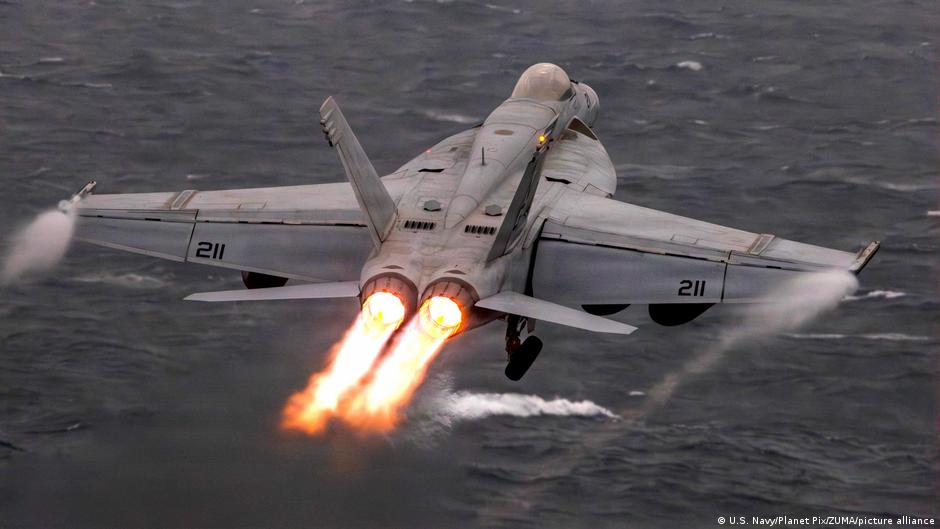
US President Donald Trump has outlined a relatively clear vision of what the next phase of the conflict with Iran might entail. Following the latest round of American airstrikes, Trump noted that Iranian forces had attempted to rebuild their radar infrastructure. “We waited until it was almost built, and then we hit it,” he stated.
On Tuesday, US forces launched fresh strikes against multiple targets inside Iran. According to US Central Command (CENTCOM), the demolished targets encompassed “air defense sites, radar systems, maritime assets and facilities, mine-laying capabilities, and communications sites.”
The “Mowing the Grass” Strategy
In response, Iran fired rockets and drones at US facilities across the region. This escalation marks a transition to the next phase of the conflict, aligning with the strategy that CENTCOM had hinted at just days prior.
According to the news portal Axios, Washington is considering limited, periodic strikes to prevent Iran from rebuilding its military capabilities in the Strait of Hormuz. To describe this approach, a US government official borrowed a concept from Israeli security policy, calling it “mowing the grass.”
This metaphor refers to a military strategy that does not seek to defeat an opponent once and for all. Instead, the goal is to routinely degrade the enemy’s capabilities to a level where the threat remains manageable. When the capabilities inevitably grow back, the US simply “mows” them down again.
In the context of Iran, this strategy would involve closely monitoring Tehran’s efforts to rebuild its military assets, launching strikes the moment these capabilities cross a pre-established threshold.
Temporary Successes, Lasting Challenges
Over the past few months, the US has achieved notable military successes. American forces have significantly degraded Iran’s military posture in the Strait of Hormuz and have initiated operations to clear Iranian sea mines.
However, these gains are temporary. Tehran is actively repairing or procuring new radar systems, anti-aircraft batteries, and anti-ship missiles. While US bombs can easily destroy key Iranian positions through targeted strikes, they cannot erase the underlying knowledge or the industrial infrastructure behind Iran’s military technology.
Consequently, reconstruction can be delayed but not prevented. The US will repeatedly face the same difficult choice: either accept that Tehran is steadily regaining its military capabilities, or launch another round of strikes to destroy them.
Mona Yacoubian, director of the Middle East program at the Center for Strategic and International Studies (CSIS) in Washington, warned back in April that this dynamic could lead to an “enduring low-intensity conflict punctuated by more intensive interventions.”
Trump’s Belligerent Warnings and Tehran’s Response
The “mowing the grass” strategy is showing its limits, partly because it was never designed for warfare against a sovereign state. Israel originally developed this concept to combat non-state actors such as Hamas.
However, as Yacoubian noted in her analysis, the Israeli academics who coined the term warned that if an adversary possessed “statist characteristics and/or more powerful capabilities, ‘mowing the grass’ might become an outdated military strategy.” This is precisely the situation in the Strait of Hormuz.
While the US requires the strait to remain reliably open, Iran only needs to convince the world that the passage remains dangerous. In this asymmetric dynamic, even a significantly weakened Iran can impose substantial costs on Washington.
Another challenge for Washington is that while the US can dictate the intensity of its own attacks, it has no control over Tehran’s response. This week, President Trump warned Iran against launching a retaliatory strike, threatening that the country would be “totally wiped out” if it did.
Despite these warnings, the regime in Tehran immediately launched missiles at American facilities in the region. Jordan alone reported 13 ballistic missiles in its airspace, successfully intercepting 10 of them.
The Nuclear Dilemma
But Mona Yacoubian argues that repeated American attacks carry a far greater risk. She warns that persistent strikes could lead Tehran to conclude that “pursuit of a nuclear weapon” is the only path to “lasting deterrence.” This suggests that, by attacking Iran, the US and Israel might actually accelerate the very nuclear development they seek to prevent.
From Washington’s perspective, the alternatives available to Trump do not look much better. If the president allows Iran to rebuild its military strength around the Strait of Hormuz, he risks renewed attacks on commercial shipping and the disruption of one of the world’s most vital energy routes.
The consequences for the global economy are well known. Despite the upheaval and repeated rounds of negotiations, a political agreement between Washington and Tehran has so far failed due to apparently insurmountable differences.
The Next “Forever War”?
For Donald Trump, the strategy of “mowing the grass” holds domestic appeal, despite the uncertainty it introduces to foreign policy. It allows the US president to avoid occupation, nation-building, and deploying large numbers of American ground troops. At the same time, it enables him to distance himself from the so-called “forever wars” he repeatedly accused his White House predecessors of pursuing.
Ultimately, however, this supposed method of avoiding a forever war could become one itself. Yacoubian describes it as a “Sisyphean attrition strategy without end.” As long as Washington is unwilling to accept the rebuilding of Iran’s capabilities, each successful strike merely sets the stage for the next one.
This article has been translated from German.


