






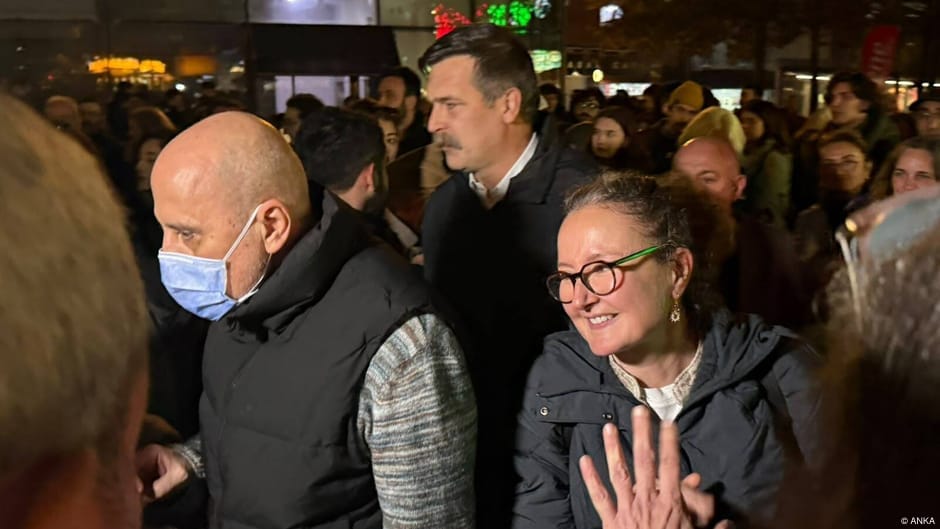
When police officers arrived at her Istanbul home last Wednesday evening, Yonca Verdioglu Sik was taken aback — and even more so when they brought her in for questioning. Her lawyer says she was accused of political and military espionage.
But transcripts of the interrogation published later show that Verdioglu Sik was never asked about espionage. Instead, prosecutors appeared far more interested in the work of the Heinrich Böll Foundation, the German organization for which she works. Born and raised in Germany, Verdioglu Sik has served as the foundation’s project coordinator for 18 years, organizing initiatives focused on democracy and on women’s, minority and LGBTQ+ rights.
During the interrogation, investigators discussed transfers of money from the foundation into her bank account. Verdioglu Sik also learned that she was now subject to a travel ban.
Pressure on Politicians
Verdioglu Sik was eventually released, but her arrest caused outrage among critics of the Turkish government. She is married to investigative journalist and parliamentarian Ahmet Sik, a member of the left-wing Workers’ Party of Turkey, or TIP, and one of the current government’s harshest critics.
Sik has recently been examining a stock market scandal that allegedly benefited members of the ruling Justice and Development Party, or AKP, led by Turkish President Recep Tayyip Erdogan, and their associates.
Opposition critics drew a clear conclusion: as a member of parliament, Sik has parliamentary immunity. Instead, they say, the justice system is applying pressure to him through his wife.
“If you take away a state’s law, what is left is no longer called a state, but a gang,” Sik wrote in response to the arrest.
Verdioglu Sik’s arrest is not the first such case in Turkey. Ever since the attempted coup against the Erdogan government in 2016, accusations of espionage have been leveled at a wide variety of groups: journalists, opposition figures and human rights activists, as well as employees of foreign embassies and staff of foreign institutions such as non-governmental organizations and foundations.
Diplomatic Disputes
Such accusations have often been followed by acquittals or convictions for other offenses, sometimes years later. What many of these cases share is a “chilling effect.” Any investigation can mean lengthy pre-trial detention, reputational and professional damage, and even social isolation.
In the past, such cases have even triggered diplomatic disputes.
In 2015, for example, Can Dundar and Erdem Gul, both senior journalists at the opposition daily Cumhuriyet, were accused of espionage after reporting that Turkey had tried to ship arms to rebels fighting the Syrian government. Dundar now lives in exile in Berlin.
In 2017, Erdogan said that reporter Deniz Yücel, then working for the German newspaper Die Welt, was a “German agent.” That led to a serious diplomatic crisis between Berlin and Ankara.
Espionage charges have also been brought against local employees of the US diplomatic corps and against a lawyer working for the German embassy. US pastor Andrew Brunson and his wife were also arrested over alleged links to Kurdish anti-government groups. Turkish philanthropist and human rights activist Osman Kavala, who was charged with espionage and attempting to overthrow the constitutional order, remains in prison.
Most recently, espionage charges have been brought against former Istanbul mayor and Erdogan’s political competitor Ekrem Imamoglu, along with a number of journalists.
‘Hostage Diplomacy’
Hakki Tas, a research fellow and expert on Turkey at the German Institute for Global and Area Studies, or GIGA, notes that the number of such cases has increased over the past few years.
On the one hand, Turkey has the right to protect itself from foreign intelligence services — especially given geopolitical competition and conflict in the region, he argues. On the other hand, there is a long tradition of bringing the Turkish opposition to court on security charges.
“What foreigners or employees of foreign institutions have experienced in recent years is a continuation of this pattern,” Tas told DW.
LGBTQ+ communities in Turkey fear intensifying clampdown
To view this video please enable JavaScript, and consider upgrading to a web browser that supports HTML5 video
Media outlets and NGOs critical of the government have faced investigations, trials and other state sanctions for years. The ruling AKP has also introduced its own version of a so-called “foreign agent law.”
These espionage cases serve both domestic and foreign policy functions, Tas observes.
For locals, “contact with a foreign institution, foreign funding or even a perfectly normal salary could become part of an investigation someday,” Tas explains. “For opposition figures and civil society organizations, in particular, this can become a security issue.”
In foreign policy terms, the cases also signal to other countries that there are limits to their activities inside Turkey. Such accusations appear to become more frequent when foreign policy tensions arise — for example, after Western criticism of how opposition groups were treated after the alleged 2016 coup, the disputes over arms deliveries related to Syria, or criticism from abroad about the removal of elected mayors in Turkey.
It can also serve as a kind of “hostage diplomacy,” Tas says.
Punishing Process
The case of US cleric Brunson is a good example. After his arrest, the Turkish government proposed a trade with the Americans. They wanted to exchange Turkish preacher Fethullah Gulen, who lived in the US and whom the Turkish government blamed for the 2016 coup attempt.
Tas points out that suspicion of foreign institutions is not something the Erdogan government invented. In the early 2000s, several representatives of German organizations were already standing trial in Turkey. At the time, it was alleged, among other things, that the German spy service was using German foundations as a front for conspiracy.
In some of the best-known cases, defendants often do not end up convicted of espionage.
The Kavala case demonstrates this. He was initially acquitted of espionage several times and spent two years in prison solely because of those charges.
But Tas says that is no surprise, referring to a 1979 work on the sociology of law by US law professor Malcolm Feeley. Its title: “The Process Is the Punishment.”
No future in Turkey?
To view this video please enable JavaScript, and consider upgrading to a web browser that supports HTML5 video
Also Read
- Burnham Hails Youth Jobs Review as “Watershed Moment” While Declining Full Commitment
- Houthi Militia Threatens Sanaa School Closures to Enforce Military Mobilization
- FIA Greenlights Argentina Candidate Rally, Setting Stage for WRC Return in 2028
- Pakistan and Ethiopia Forge Deeper Trade Ties, Commit to Resolving WTO Challenges


