




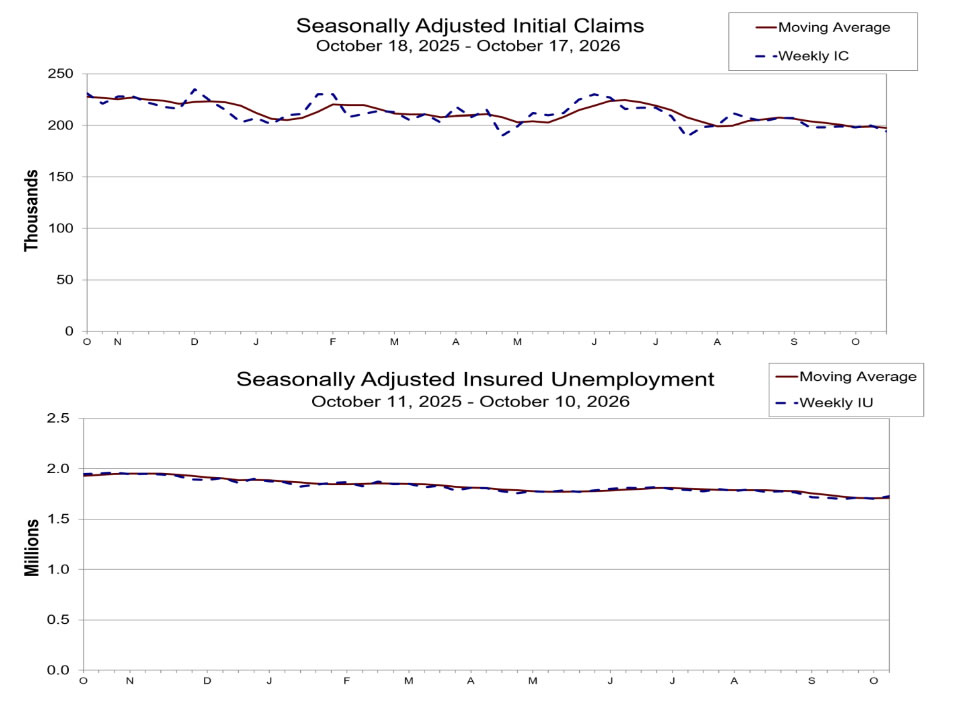
Initial U.S. unemployment claims fell to 194,000 for the week ending October 17, down from a revised 200,000 and below the 200,000 expected by economists. The prior week’s figure was revised up from 199,000. The four-week moving average also declined to 197,750 from 198,750, indicating that layoffs remain relatively subdued. Initial claims were well below the 231,000 recorded in the comparable week a year earlier.
Continuing claims moved in the opposite direction, rising to 1.728 million for the week ending October 10 from a revised 1.703 million. Their four-week moving average edged up to 1.711 million from 1.707 million, while the insured unemployment rate held steady at 1.1%. The increase suggests that slightly more unemployed workers remained on benefit rolls, although continuing claims were still well below the 1.947 million recorded a year earlier.
Seasonally unadjusted figures also pointed to limited new layoffs. Initial claims fell by 19,321 to 172,390, a larger decline than the 14,179 decrease anticipated based on seasonal factors. Taken together, the data continue to point to a relatively stable labor market with few signs of widespread job losses. However, the divergence between lower initial claims and higher continuing claims warrants attention, as low layoffs do not necessarily indicate equally strong hiring conditions.
Data Summary
Headline Claims Release
| Indicator | Previous | Expected | Current |
|---|---|---|---|
| Initial Jobless Claims | 200K | 200K | 194K |
Supporting Labor Market Data
| Indicator | Previous | Current |
|---|---|---|
| Initial Claims, 4-Week Average | 198.75K | 197.75K |
| Continuing Claims | 1.703M | 1.728M |
| Continuing Claims, 4-Week Average | 1.707M | 1.711M |
| Insured Unemployment Rate | 1.1% | 1.1% |
| Unadjusted Initial Claims | 191,711 | 172,390 |
| Unadjusted Continuing Claims | 1,462,489 | 1,481,260 |
Revisions: Previous initial claims were revised from 199,000 to 200,000, while continuing claims were revised from 1.710 million to 1.703 million.
Reporting periods: Initial claims cover the week ending October 17, while continuing claims cover the week ending October 10.
Year-over-year comparison: Initial claims stood at 231,000 in the comparable week of 2025, while continuing claims were 1.947 million.
Key Takeaways
- Initial claims fell below expectations: New unemployment filings declined to 194,000 from a revised 200,000, undershooting the 200,000 consensus estimate and reinforcing the view that layoffs remain limited.
- The short-term trend remains favorable: The four-week average eased to 197,750 from 198,750, providing further evidence that new unemployment claims remain subdued.
- Continuing claims rose modestly: The number of people receiving unemployment benefits increased to 1.728 million from 1.703 million, and the corresponding four-week average edged higher to 1.711 million.
- Annual comparisons remain reassuring: Initial claims are 37,000 below their year-earlier level, while continuing claims are 219,000 lower. The insured unemployment rate also remains below its reading a year ago.
- Unadjusted data support the headline improvement: New filings fell 10.1% from the previous week, compared with the 7.4% decrease anticipated by seasonal adjustment factors.
- Low layoffs do not necessarily mean strong hiring: The divergence between falling initial claims and rising continuing claims raises questions about how quickly unemployed workers are finding new jobs. However, the latest increase is not large enough by itself to signal a sustained deterioration.
- The broader labor market remains relatively stable: The report offers little evidence of widespread job losses, though continuing claims should be monitored for signs of persistent weakness.
Also Read
- Solana’s Alpenglow Upgrade Enhances Transaction Finality, Reducing Liquidity Demands for Financial Market Participants
- Ghana’s Cedi Registers Slight Gain Against US Dollar, October 22
- Kalshi Introduces Crypto-Backed Margin Loans Through Webull Amid Washington Data-Security Scrutiny
- Mark McMillan Assumes Global Head of Electronic FX Quantitative Trading Role at UBS After Nomura Stint