







UK private‑sector growth picked up modestly in August, with the composite PMI climbing to 52.5 from 52.2, a four‑month high. Services activity rose to 52.8 from 52.1, reaching a six‑month peak, and provided the main thrust for overall expansion. Manufacturing, however, weakened, as the PMI Manufacturing slipped to 51.5 from 51.9 and output fell to 51.2 from 52.9, both five‑month lows.
S&P Global said that sunny weather and technology investment supported activity in the services sector, while manufacturing lost momentum as earlier precautionary stock‑building faded. Business confidence improved to its strongest level since the Middle East conflict began, and job losses moderated. Nonetheless, cost pressures remained elevated, driven by energy prices, supply‑chain disruption and high staffing costs. The flash survey is consistent with roughly 0.3 % quarter‑on‑quarter GDP growth in Q3. For the Bank of England, resilient services reduce the urgency to support the economy, but persistent cost pressures argue against an early dovish shift. S&P Global expects the Bank to retain a hawkish bias while staying cautious, holding off on further hikes until growth and inflation signals become clearer.
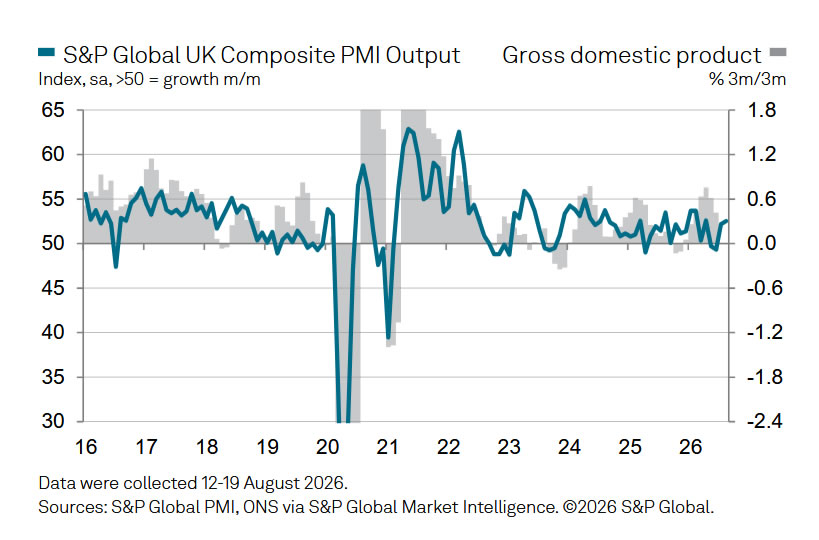

Data Summary
| Component | Current | Previous | Trend |
|---|---|---|---|
| PMI Composite Output | 52.5 | 52.2 | 4‑month high |
| PMI Services Business Activity | 52.8 | 52.1 | 6‑month high |
| PMI Manufacturing | 51.5 | 51.9 | 5‑month low |
| PMI Manufacturing Output | 51.2 | 52.9 | 5‑month low |
Key Takeaways
- UK PMI Composite Output rose from 52.2 to 52.5 in August, hitting a four‑month high.
- PMI Services Business Activity climbed from 52.1 to 52.8, a six‑month peak and the main driver of faster overall growth.
- Manufacturing lost momentum. PMI Manufacturing fell from 51.9 to 51.5, while PMI Manufacturing Output dropped from 52.9 to 51.2.
- S&P Global cited favorable weather and technology investment as supports for services, while earlier precautionary stock‑building in manufacturing started to fade.
- Business confidence reached its strongest level since the Middle East war began, and job losses eased.
- Cost pressures stayed high due to energy prices, Middle East‑related supply disruption and staffing costs.
- The flash survey is consistent with roughly 0.3 % quarter‑on‑quarter GDP growth in Q3.
- For the BoE, resilient growth and elevated costs sustain a hawkish bias, but softer manufacturing and lingering uncertainty argue for patience before another rate hike.
Also Read
- India’s Forex Surge, Europe’s Heatwave Impact, and Projected $50 B BOP Surplus Highlight This Week’s Economic Brief
- Silver Surges on Triangle Breakout as Treasury Buybacks Weigh on Yields
- MANTRA Chain Halts Network After Exploit as Token Hits Record Low
- BTCS Converts Ethereum Reserves to Settle Aave Debt Amid Q2 Liquidity Challenges


