






When Russian President Vladimir Putin announced the annexation of Crimea in 2014, violating international law, he justified the move by stating: “We could not allow NATO forces to eventually come to the land of Crimea and Sevastopol, the land of Russian military glory, and cardinally change the balance of forces in the Black Sea area.”
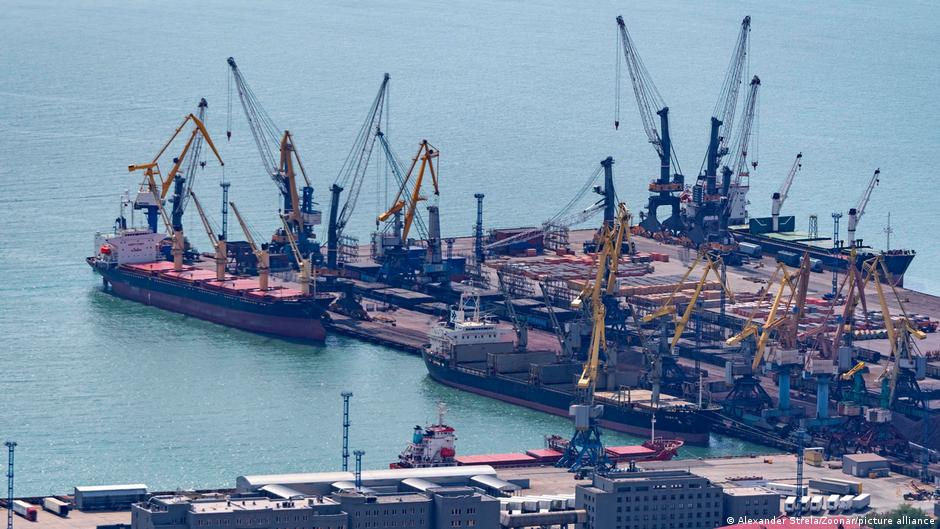
Today, that strategic calculus has been severely undermined. Intensified Ukrainian drone strikes on Novorossiysk, Russia’s largest commercial Black Sea port, have caused major disruptions to oil and grain shipments in recent weeks. Russian naval dominance in the region has been challenged, and exporting goods via the Black Sea has become increasingly difficult. While Moscow can partially reorganize its logistics, the long-term viability of these routes is in question.
Experts warn that if these attacks continue at such intensity, the consequences for Russian exporters and the national budget could be highly significant.
Novorossiysk: Russia’s Key Export Hub Under Threat
Novorossiysk has served as a vital hub for Russian exports since the 19th century. Today, it remains Russia’s largest port by cargo volume and one of the largest in Europe. The hub handles up to a third of the country’s grain exports, situated close to major agricultural regions. Additionally, massive volumes of crude oil, metals, and containerized goods pass through its terminals.
Recent Ukrainian maritime and aerial drone attacks have severely disrupted grain shipments. Andrei Sisov, head of the agricultural research and consulting firm SovEcon, tracks the situation via Telegram. On August 12, he reported that the Novorossiysk Bread Products Plant (NKHP) — one of Russia’s largest grain export terminals — and the Novorossiysk grain terminal had ceased operations. A day later, KSK, another major deep-water grain terminal, also halted operations. The Taman grain terminal had already stopped working in late July, following earlier Ukrainian strikes that paralyzed shallow-water ports in the Sea of Azov.
At the time of publication, only Tuapse, the smallest of Russia’s deep-water grain terminals, remained operational. “This means that virtually all Russian grain exports via the Azov-Black Sea basin are blocked,” Sisov noted.
Oil Exports Face Frequent Disruptions
While the situation regarding oil exports is not as dramatic as grain, shipments are frequently disrupted. According to Reuters, the Sheskharis terminal — Russia’s primary Black Sea oil export facility, handling around 700,000 barrels per day — suspended loadings on August 14, resuming operations only two days later.
According to London-based price reporting agency Argus Media, Russia could have 45 million metric tons of wheat available for export in 2026 and 2027. However, with approximately 90% of shipments typically routed through the Black Sea, ongoing instability will make it nearly impossible to supply the global market as usual.
Sisov of SovEcon estimated that “many Russian agricultural producers will not survive this season, especially following several years of deteriorating financial conditions.”
With exports at a standstill, surplus grain must be sold on the domestic market, exerting downward pressure on local prices. Even if exports eventually recover, logistical bottlenecks will persist. August typically marks the peak shipping season, and any undelivered grain from this month will struggle to be processed, as terminals operate at full capacity throughout the autumn.
Ukraine’s desperate search for farm labor
To view this video please enable JavaScript, and consider upgrading to a web browser that supports HTML5 video
Ukrainian Grain Exports Also Suffer
The escalation of hostilities in the Azov and Black Sea regions reverberates globally, particularly since Russia remains the world’s largest wheat exporter.
Ukrainian grain exports have also plummeted due to mutual attacks. Over the past month, Russia has intensified its strikes on Ukrainian ports and docked vessels.
“The disruptions have prevented strong wheat harvests in both Ukraine and Russia from reaching global markets,” Xiaoyi Deng from Argus Media told DW. “Both nations have struggled to utilize alternative infrastructure, such as Baltic ports via rail or Danube River ports, but these alternatives cannot fully replace the lost capacity.”
According to the Helsinki-based think tank Center for Research on Energy and Clean Air (CREA), Novorossiysk loaded 30% less oil in the first two weeks of August compared to the previous year. This decline followed a Ukrainian strike on the Caspian Pipeline Consortium (CPC) marine terminal on July 19.
How Ukraine fights in the Black Sea without a navy
To view this video please enable JavaScript, and consider upgrading to a web browser that supports HTML5 video
Isaac Levi, an energy analyst at CREA, noted that infrastructure damage was not the sole cause of shipment declines. He explained that “strikes on vessels have discouraged ships from calling at ports considered major targets.” According to Bloomberg, a Greek tanker suspected of carrying Russian oil was attacked on August 17.
“If these constraints persist through August, Russia will find it increasingly difficult to defer shipments and compensate for lost volumes later,” Levi explained. “Russia can reroute barrels, but it cannot reroute infrastructure. The most viable alternatives include the Baltic ports of Primorsk and Ust-Luga.
“However, rerouting oil through Baltic ports would significantly increase transportation times and costs compared to Black Sea exports, while available capacity remains too small to accommodate the massive volumes typically shipped from Novorossiysk.”
This article was originally published in Russian.


