






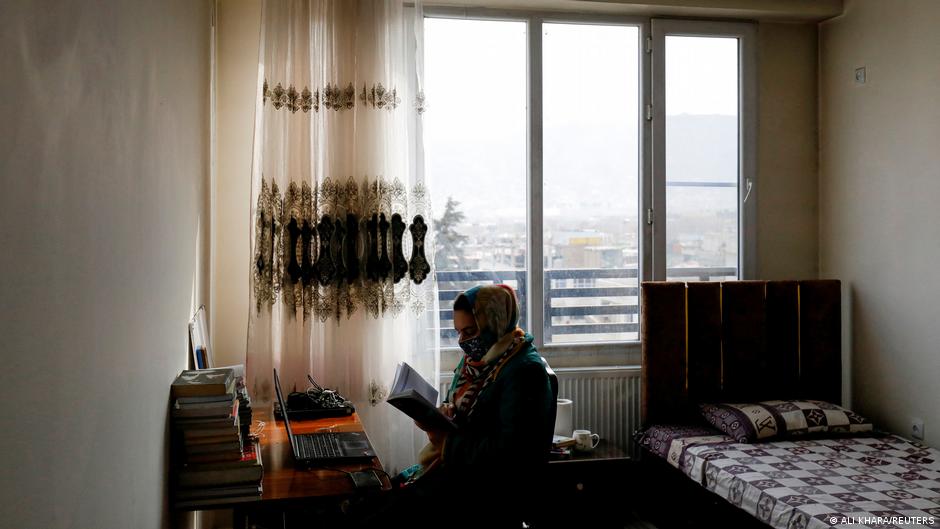
Laila awoke in the middle of the night for a glass of water, checked her phone by chance, and saw an email that sent a chill down her spine. The United States would cease funding the American University of Afghanistan (AUAF), one of the few institutions where women could still pursue higher education in the country.
She sat on her bed, staring at the ceiling, her mind replaying the past five years of hardship she had endured to obtain an education.
Finding a way to study in Afghanistan after the Taliban banned women’s education proved extremely difficult.
Although the AUAF campus was already under Taliban control, Laila managed to continue her studies through the university’s online program. Now that the university is losing its financing, she and her classmates fear it will shut down entirely. (Her name has been changed for safety reasons.)
In Afghanistan, girls study in secret to skirt Taliban ban
To view this video please enable JavaScript, and consider upgrading to a web browser that supports HTML5 video
A hidden education for women in Afghanistan
Laila, now in her mid‑twenties, is studying political science and international studies. She is one of roughly 1,000 enrolled students, three‑quarters of them women.
When the Taliban returned to power in August 2021, Laila was completing her final exams at a university in Kabul. In December 2022 the Taliban announced a blanket ban on women’s education, leaving her degree unfinished.
She secured a scholarship to AUAF and started over. “Not every girl got that opportunity,” she said. Most of her classmates use aliases and keep their cameras off for security; Laila only knows their voices.
English came naturally to Laila after she spent her childhood watching American cartoons. In her early twenties she deepened her knowledge of world politics and foreign governments.
Then, on August 14 2021, her life changed dramatically. After finishing an exam, she and a friend celebrated with coffee and cake in a Kabul restaurant. A man entered, stopped at the entrance, and shouted “Allahu Akbar,” declaring that the mujahideen would always triumph. That moment marked the Taliban’s return to power, and the subsequent enforcement of strict restrictions on women’s public lives.
Exiled Afghanistan envoy still advocating for women’s rights
To view this video please enable JavaScript, and consider upgrading to a web browser that supports HTML5 video
Laila recalls a moment of intense panic when she lost sensation in her hands and feet. She pulled money from her purse and slammed it on the table without counting the amount, convinced they might be their last day alive. Since then, several of her peers have received threatening calls and messages, and she fears that any departure from home could lead to a phone search by Taliban authorities.
“What if they see my emails from work or university?” she said. “It’s always in the back of my head that maybe tomorrow it will be my turn. Maybe they will detain me.”
Even her home is not safe. Laila said Taliban authorities have entered on several occasions to search their belongings. Despite the danger, she continues her studies, viewing the online program as a rare chance to graduate.
A place for Afghanistan’s ‘future leaders’
The loss of US funding has left Laila uncertain whether she can continue. The American University of Afghanistan was conceived primarily as an institution for women. When the campus opened in 2006, former First Lady Laura Bush announced that the United States had committed millions to support it, describing the university as a place to educate “future leaders,” especially women.
“These are more than just development projects,” Bush said at the time. “They also signify the bond between the American and Afghan people. They are symbols of our shared hopes and dreams.”
Patrick Fine, former USAID Afghanistan mission director, said the agency viewed the university idea as risky and that critics considered training elites a waste of money. The Bush administration, however, saw an opportunity to stabilize a fledgling democracy after the Taliban were driven from power in 2003.
By that time, the US wanted to foster goodwill for the US‑backed interim government, and the university served that goal while also offering “facets of advantage” in educating women, preparing future politicians, and supporting the Afghan economy. “It really impacted the lives of thousands of Afghan youth,” Fine said, noting that alumni have benefited despite the challenges.
How 5 years of Taliban rule have changed Afghanistan
To view this video please enable JavaScript, and consider upgrading to a web browser that supports HTML5 video
Washington pulls the plug
US support for AUAF continued for years, but scrutiny grew in Washington. In 2016, US inspectors opened a financial investigation after suspecting mishandling of funds. By 2018, investigators concluded they could not determine how US aid money was spent because the university’s accounting was so deficient.
John Sopko, a former US federal inspector who oversaw the probe, said he was surprised when DW contacted him that funding was still ongoing. “I was surprised they were still funding AUAF,” he replied.
This year, after the funding was withdrawn, the State Department Press Office told DW in an email that the decision was based on the university’s “history of repeated lack of accountability for millions of American taxpayer dollars.”
Patrick Fine rejected the fraud explanation, calling it “smear tactics.” He conceded that past audits found AUAF struggled to meet USAID’s extensive rules but said no major fraud was uncovered. “It is still a useful investment, a worthy investment,” Fine said, emphasizing that the university remains one of the few organizations reaching Afghan women.
The United States provided nearly 90 % of the university’s costs as of 2018, according to a US report. The State Department told DW that the university is “free to identify other funders and partners,” noting that the end of American funding does not necessarily mean an end to operations. However, without the $25 million grant that the State Department recently refused, the university’s future remains uncertain.
What is next for women students in Afghanistan?
Laila said she has lost all motivation and hope. Each time she prepares for a lecture, she wonders if there will be another. Since learning about the funding cut, she barely leaves her room, keeps the curtains closed, and has lost her appetite. “Maybe I’m so disappointed that I can’t even cry about it,” she said.
She was meant to graduate years ago and to be studying for a master’s degree abroad, aiming to make the world a better place. Now she thinks perhaps she can find a way in five or ten years.
Afghan female artists in exile showcase their culture
To view this video please enable JavaScript, and consider upgrading to a web browser that supports HTML5 video
Edited by: Wesley Rahn


