






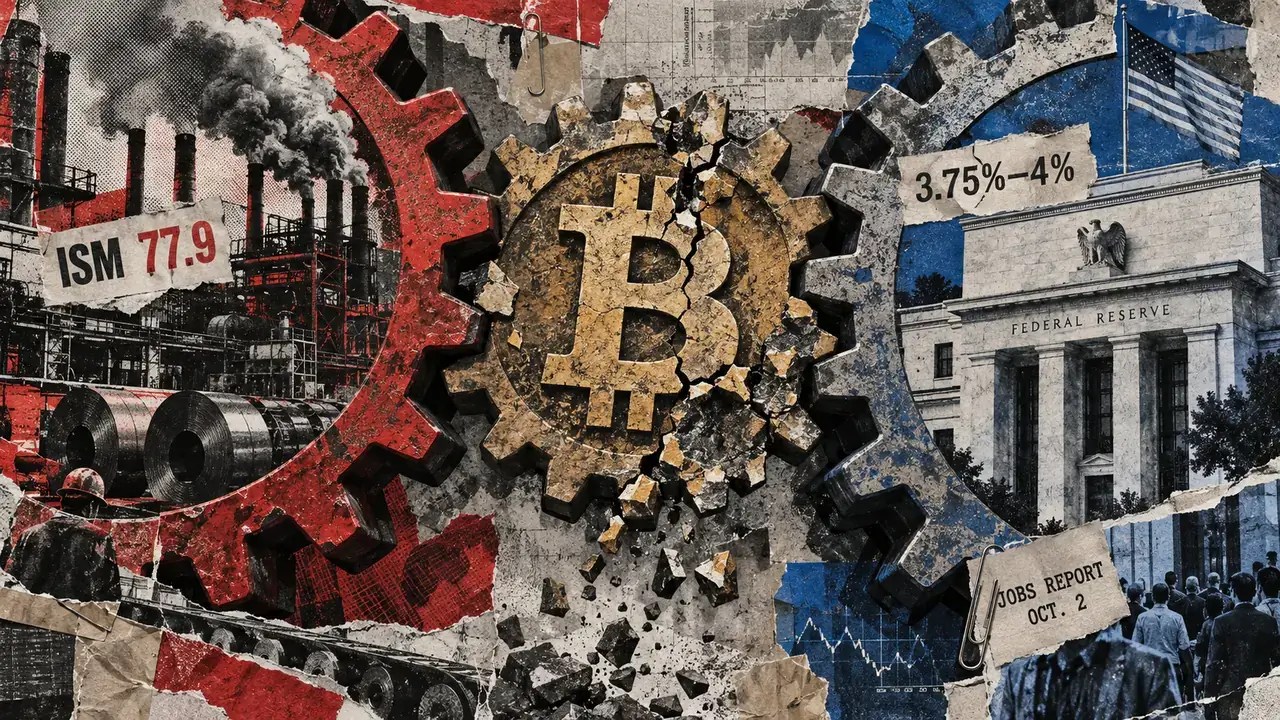
US manufacturers reported broader input-cost gains in September, creating a potential financing risk for Bitcoin if traders conclude that higher interest rates may be needed ahead of the upcoming jobs report.
The Institute for Supply Management’s Oct. 1 report showed the manufacturing prices index rising to 77.9, up 6.8 points from 71.1 in August. The manufacturing PMI stood at 54.5, while new orders were at 55.3 and employment at 52.7.
That mix is relevant to Bitcoin because a resilient industrial backdrop and rising cost pressures could make the case for lower interest rates less straightforward.
The prices gauge measures the breadth of reported monthly increases; a 77.9 reading does not mean a 77.9% inflation rate. Higher input prices were reported by 58.6% of respondents, compared with 46.2% in August. The diffusion-index calculation adds higher responses and half of unchanged responses.
Interest rates are the transmission channel
The policy context already includes a Federal Open Market Committee rate increase, which lifted the target range by 25 basis points to 3.75% to 4% on Sept. 16.
On Sept. 29, New York Fed President John Williams said an additional increase could be appropriate late in the year if the economy broadly tracked his forecast. He framed that as a conditional view and noted that there was still no evidence that the identified price shocks were spreading into broader, more persistent inflation.


The September factory survey adds new evidence on input costs to that policy debate. Under the Fed’s transmission framework, policy changes affect short-term borrowing costs and Treasury bill returns, while expectations of future policy shape longer-term rates and broader financial conditions.
For Bitcoin, the potential pressure operates in two ways: higher borrowing costs could make leveraged risk-taking less appealing, and higher returns on interest-bearing dollar assets could increase the return investors require for holding a non-yielding asset.
The Bureau of Labor Statistics has scheduled September’s Employment Situation report for Oct. 2, and the ISM manufacturing employment reading cannot replace that national jobs report.
Bitcoin’s response will depend on how investors interpret the combined data. If the jobs report strengthens expectations for higher rates, financing costs and competing dollar returns could become a more durable headwind. If front-end Treasury yields or expected policy rates decline, that proposed transmission channel would weaken.
A February 2023 New York Fed staff study found no systematic Bitcoin response to monetary and macroeconomic news in its historical intraday sample. The practical question, then, is whether rate expectations move and whether Bitcoin reacts—not whether a factory-cost increase automatically guarantees a sell-off.
Also Read
- Binance Burns 334 Million LUNC Tokens, But Price Remains Flat
- Spot Bitcoin ETFs Within $5 Billion of Record Flows After Extended Drought
- UK crypto rule transition: Timely applicants retain new‑business rights, while late filers face contract restrictions
- Stripe-Backed Open USD Launches With $468 Million Supply, Challenging USDT and USDC Dominance


