







The dollar-yen pair settled around 159.22 on Wednesday following a modest two-day advance. Trading sentiment remains cautious, caught between two competing forces: expectations of a Bank of Japan rate hike that lend support to the yen, and the possibility of additional Federal Reserve tightening that keeps the dollar well supported. With the US inflation report looming, market participants appear reluctant to commit to fresh positions.
Price pressures in Japan are building. The producer price index for services climbed 4.2% year-on-year in October, up from 3.8% the previous month and marking the fastest pace of growth since 1990. This trend strengthens the case for a BoJ rate increase in December. A further brake on any USD/JPY rally is the persistent threat of intervention by Japanese authorities.
That said, Japan’s policy direction for 2027 remains far from settled. The substantial interest rate gap between the United States and Japan continues to make carry trades appealing, capping the yen’s potential to strengthen. In the US, investors have fully priced in a 25 basis point Fed hike for December and are factoring in the prospect of continued tightening into early next year.
Adding to the dollar’s appeal is the deteriorating geopolitical backdrop. Talks aimed at resolving the US-Iran conflict have stalled once more, while mounting threats to shipping in the Strait of Hormuz and the Red Sea are refocusing investors on the risk of energy-led inflation.
Wednesday’s main event is the release of the US PCE index. A stronger-than-expected inflation reading could bolster the dollar, yet as USD/JPY edges toward the psychological 160.00 threshold, the risk of intervention rises in tandem. In this environment, scope for sustained upside looks constrained.
Technical Analysis
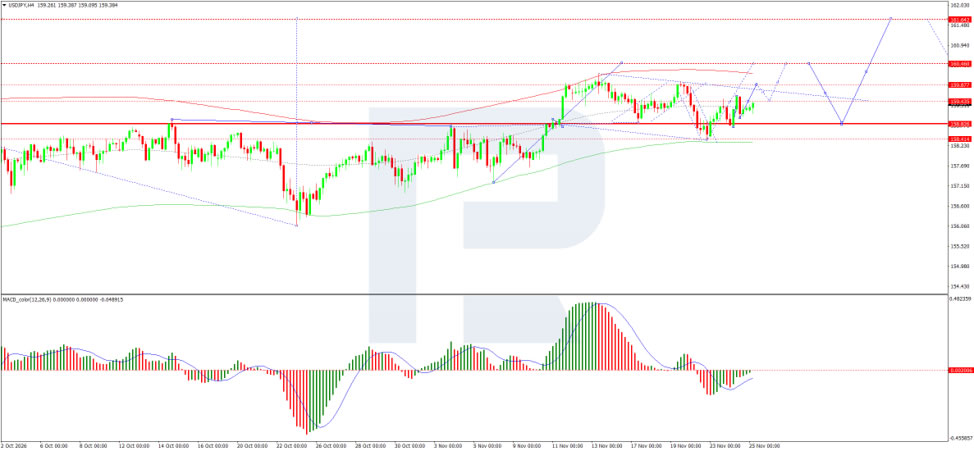

On the four-hour H4 chart, USD/JPY carved out an upward impulse to 159.57 before completing a pullback to 159.00. The broader advance is now unfolding within a consolidation range. The primary scenario points to a resumption of the rally once the local correction runs its course. A decisive break above 159.44 would open the door to a further rally toward 159.88, and clearing that level would pave the way for an extension toward 160.46 as the next local target. This outlook is reinforced by the MACD indicator, whose signal line sits below zero yet points firmly higher, while the shrinking negative values of the histogram signal fading downside momentum and a steady return of buying interest.
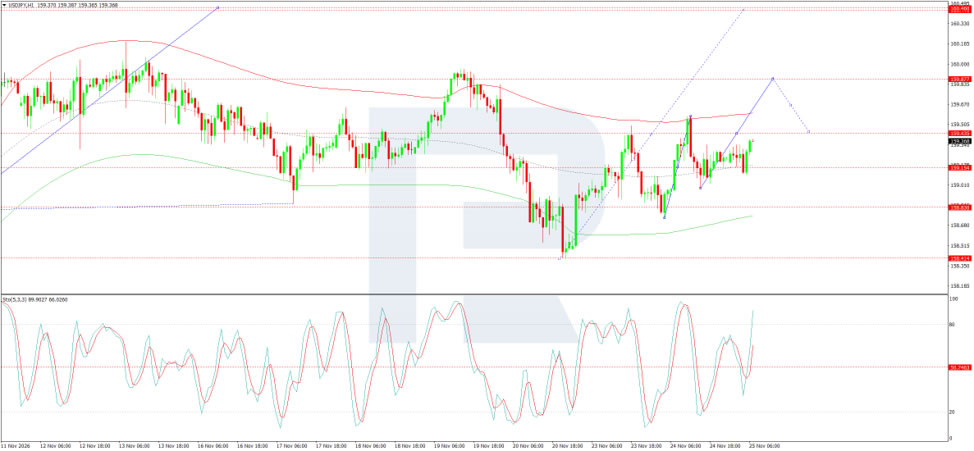
On the hourly H1 chart, the pair is building a tight consolidation range just beneath the 159.44 level. Today’s focus is on an attempt to clear the top of that range, which would set the stage for an upward wave toward 159.88. Once that mark is reached, a corrective dip that retests 159.44 from above is a possibility; holding this support would lay the technical groundwork for a further advance to 160.46. The Stochastic oscillator backs the buyers, with its signal lines above the 50 level and angled upward. However, the fast line’s drift toward overbought territory leaves room for a brief pullback before the uptrend resumes. The essential condition for the bullish scenario in the coming session is defense of support at 159.15 alongside a sustained push through nearby resistance.
Conclusion
USD/JPY is holding near 159.22 as markets await the US PCE release, with opposing forces keeping the pair range-bound. On one side, accelerating Japanese services inflation and anticipation of a December BoJ hike support the yen, together with the standing danger of intervention as the pair nears 160.00. On the other, the wide US-Japan rate differential, fully priced-in December Fed tightening, and fresh geopolitical strains in the Middle East continue to underpin the dollar. The PCE data stands as the pivotal catalyst: a robust reading could lend the dollar strength while simultaneously raising intervention risks around the psychological 160.00 level, thereby capping upside. Technically, the pair retains an upward bias above support at 159.15, with resistance at 159.44 and targets at 159.88 and 160.46 should the breakout materialize. A near-term correction cannot be ruled out given the Stochastic’s approach to overbought conditions, but the wider structure stays constructive so long as key support holds.
Also Read
- Chainflip Initiates Partial Refunds to Liquidity Providers After $12.6M Exploit, but Committed Capital Remains Locked
- Researchers find a way to make Bitcoin bridges dramatically cheaper to test
- Excess Supply Dampens Foreign‑Exchange Volatility
- US Banks Seek Holiday Fed Access as Bitcoin Futures Margin Waits on Settlement Calendar


