




Canadian Market Highlights
- The Bank of Canada delivered the widely expected 25-basis-point rate increase with no surprises, while leaving the door open to additional tightening.
- Canadian bond yields rose after the announcement, and the Canadian dollar later strengthened as the U.S. dollar weakened.
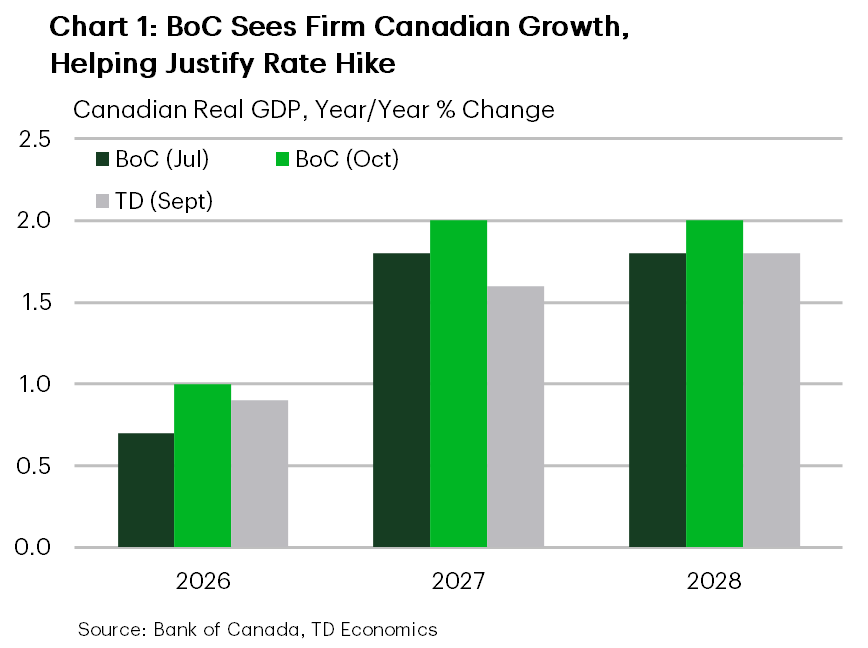
- The Bank raised its 2027 and 2028 growth forecasts to 2% and now projects overall inflation averaging above 3% in 2027.
U.S. Market Highlights
- Consumer spending and artificial intelligence-driven investment fueled the strongest quarterly GDP growth in a year during Q3.
- Persistent inflation supports further Federal Reserve tightening, notwithstanding this week’s policy pause.
- Next week’s jobs report will assess labor-market strength, while the midterm elections will shape the fiscal outlook for the next two years.
Canada: Bank of Canada Hikes Rates Amid Inflation Concerns
Just before Halloween, the Bank of Canada offered no tricks this week. It delivered the anticipated 25-basis-point increase to its policy rate, doing so despite lingering slack in the labor market and limited evidence that persistently high energy prices had broadened into general inflation. Still, the Bank judged that input-cost pressures would eventually filter through to consumer prices, and its own surveys indicated businesses were prepared to pass them on. With its Prima model projecting inflation above 3% in 2027, policymakers concluded a hike was necessary to contain price pressures.
Although the move was largely priced in, Canadian bonds still sold off, pushing yields higher. The subsequent press conference struck a hawkish tone, with Governor Tiff Macklem leaving the door open to further increases. The benchmark 10-year yield climbed about 5 basis points following the announcement and press conference. The Canadian dollar initially reacted modestly, then strengthened later after the U.S. Federal Reserve held its policy rate steady, which weighed on the U.S. dollar.
Policymakers would not have raised rates if they believed the move would unduly shock the economy. Nevertheless, the rate decision was accompanied by upgraded economic growth forecasts. The Bank now sees real GDP growth at 2% in both 2027 and 2028, up from 1.8% previously and above our own estimates (Chart 1). Business investment was a major driver of the upward revision, supported by the federal government’s Productivity Mega Deduction, reduced trade uncertainty, and other factors. The Mega Deduction permits businesses to immediately deduct the full cost of a broad range of new capital investments. The Ontario government introduced a parallel measure in its fall economic update this week.
Canadian and EU policymakers met in Montreal this week to strengthen bilateral ties. Deeper EU engagement could help Canada diversify its export base and attract investment, helping to alleviate trade uncertainty. These conclusions appear in a research report we released this week.
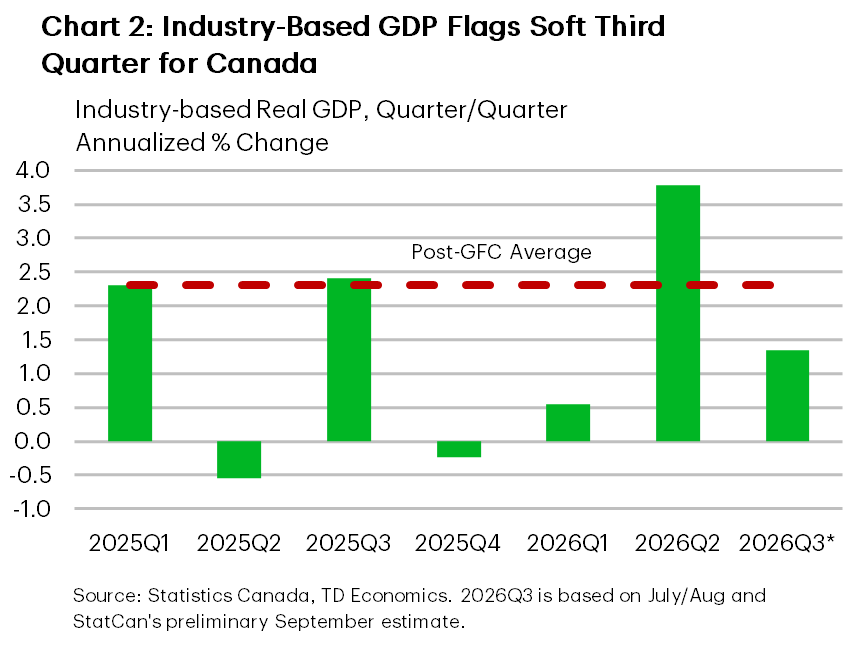
Nevertheless, growth momentum appears to be fading. August GDP was flat, and Statistics Canada’s preliminary estimate points to a 0.1% monthly decline in September, leaving industry-based real GDP growth at an annualized 1.3% (Chart 2). This soft reading raises downside risks to the Bank’s 2% Q3 forecast. Growth should remain weak in Q4 as U.S. tariffs imposed in August take effect, but a substantial shortfall relative to the Bank’s modest 0.8% forecast would likely be required to remove its hawkish bias. Given the Bank’s inflation outlook, we expect another hike next year, which would upwardly pressure yields and the Canadian dollar (see Dollars and Sense report).
United States: Resilient Growth Keeps Further Fed Tightening on the Table
Markets navigated a busy week of central bank decisions, economic data, and mega-cap earnings. The underlying message was one of resilient growth paired with persistent inflation. The Federal Reserve left the federal funds rate unchanged at 3.75% to 4.0%, though two officials dissented in favor of a hike, underscoring the FOMC’s hawkish bias. While big-tech earnings remained healthy, the mixed market reaction highlighted the growing importance of demonstrating returns on substantial AI infrastructure spending. Equities were mixed on the week: small-cap stocks rose 2%, the S&P 500 was flat, and the Nasdaq fell 1%. Meanwhile, ongoing Middle East tensions kept oil prices elevated, with WTI remaining above $100 per barrel for a third consecutive week.
The U.S. economy appeared to shake off headwinds from rising interest rates and elevated oil prices, posting its fastest expansion in a year during Q3 (Chart 1). Domestic spending underpinned the strength. The consumer remained a key anchor, accounting for three-quarters of the gain in real GDP, while business investment grew at its fastest pace since 2011, excluding the pandemic period. Federal spending also contributed, driven by sharp increases in both defense and non-defense outlays.
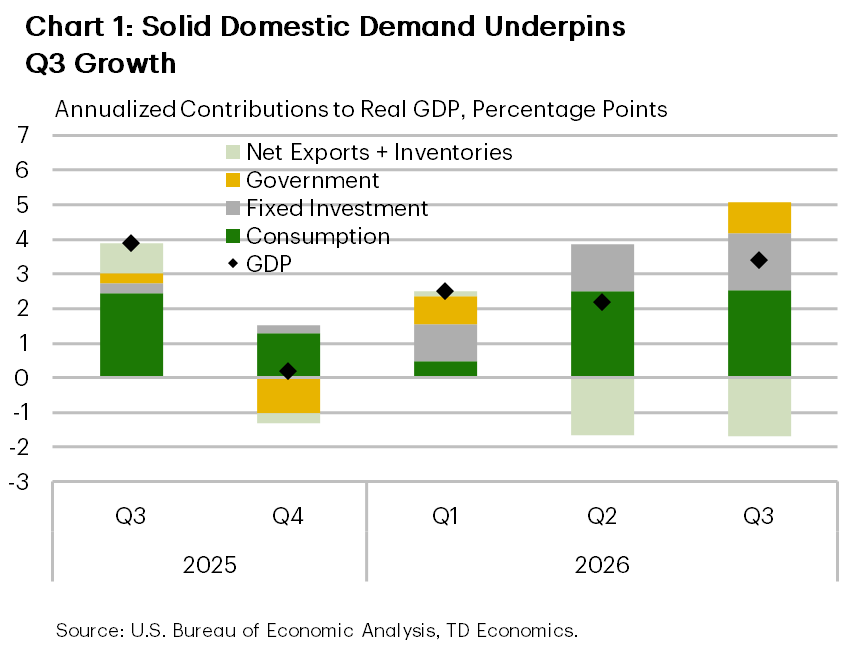
The broader question is how much of the growth reflects durable private demand versus concentrated investment in technology infrastructure. For Q3, roughly half of the increase in non-residential investment appears directly tied to AI. There are also numerous indirect effects, including the buildout of power and electricity infrastructure and spillovers into construction and industrial equipment. This does not even account for wealth effects that have likely supported consumer spending over the past six months. In short, the reach of the AI investment buildout is extensive.
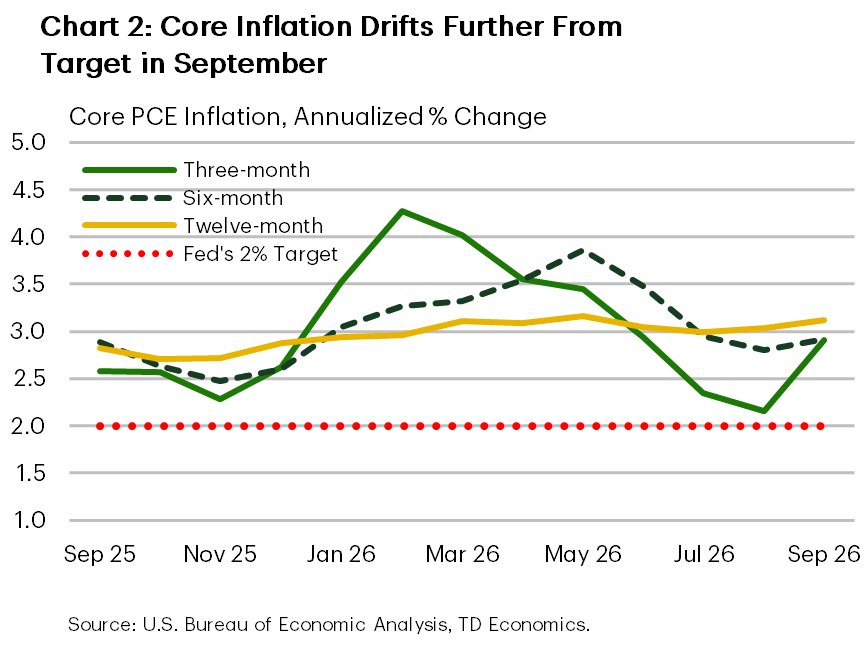
While the AI investment boom may raise the economy’s speed limit, it is also contributing to inflationary pressures. Core PCE inflation ran hot in September, with the 3-, 6-, and 12-month rates of change moving further from the Fed’s 2% target (Chart 2). Against this backdrop, additional policy tightening will likely be needed to restore price stability. If inflation trends follow our forecast and begin converging toward 2% by year-end, the Fed may be able to tighten only once more before pausing. More persistent price pressures would require further action.
Next week’s employment report will test whether the economy’s strong growth is translating into firmer hiring. Resilient job gains and wage growth would reinforce the case for further tightening, while a softer report would give the Fed reason to proceed cautiously. Meanwhile, Tuesday’s midterm elections will determine the balance of power in Congress and help shape the fiscal outlook over the next two years.
Also Read
- Aave Reopens Frozen Pools, Constrains New Collateral Access
- Global Economic Outlook: Key Central Bank Decisions and Economic Indicators Await Next Week
- MicroStrategy Q3 2026 Earnings Call: In-Depth Analyst Q&A on Bitcoin Financialization
- Maple Secures $280M in XRP Collateral as Key Loan Maturities Approach