






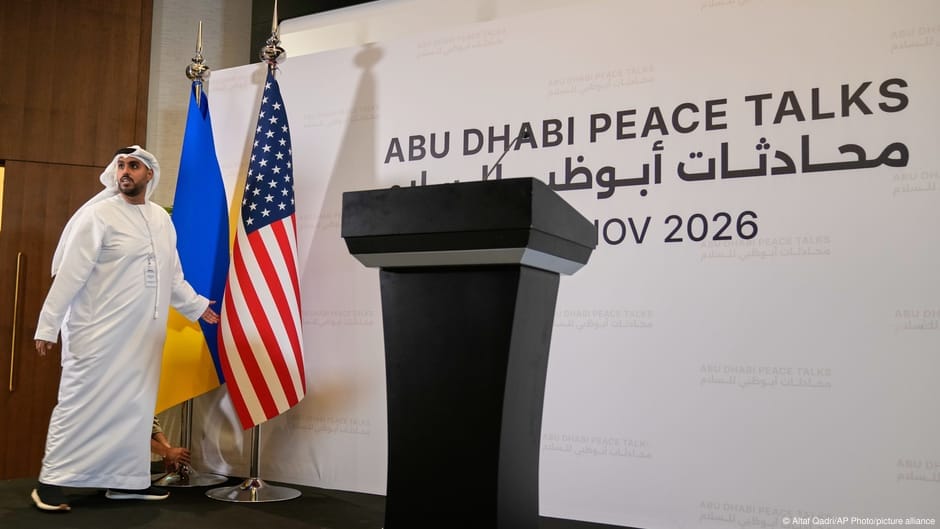
Abu Dhabi Summit: Ukraine, Russia and the United States End Without Ceasefire, Prioritize Prisoner Exchange
The two-day diplomatic discussions between delegations from Ukraine, the United States and Russia in Abu Dhabi on November 10 and 11 concluded without achieving a ceasefire agreement.
The principal outcome of the negotiations was an agreement on a prisoner exchange.
“We have agreed on the largest humanitarian release of prisoners, and tomorrow we will finalize the numbers,” Jared Kushner announced after the talks. US envoys Kushner and Steve Witkoff arrived in Moscow on Thursday, where they are scheduled to meet President Vladimir Putin.
Ukrainian President Volodymyr Zelenskyy had previously suggested an exchange of “1,000 for 1,000” or “1,500 for 1,500” prisoners. Russia indicated that a large-scale prisoner exchange with Ukraine could be arranged within the next two to three weeks.
After the meetings, Zelenskyy posted on Telegram that the parties discussed security guarantees, emphasizing that “the first step should be ending this war and ensuring Ukraine’s security.” He also stressed that Europe should be involved “at every stage of genuine diplomacy.”
How significant is the prisoner swap?
Experts interviewed by DW agree that the main outcome of the talks remains humanitarian in nature.
“The agreement on a prisoner exchange represents a major step forward,” says Artjom Bronzhukov of the Ukrainian think tank Polityka.
Pavlo Lakiychuk of the Ukrainian Center for Global Studies Strategy XXI also regards it as a “very tangible result.” He stated that “getting our people back is already a major success. That is why it is worth continuing.”
A real breakthrough would involve the release of civilian detainees from territories occupied since 2014, particularly civilians from Crimea who have been held in Russian prisons for years.
Russia, Ukraine exchange prisoners as talks end
To view this video please enable JavaScript, and consider upgrading to a web browser that supports HTML5 video
Empty diplomacy without a real breakthrough?
Davyd Arakhamia, head of the ruling Servant of the People parliamentary faction and Ukraine’s representative at the Abu Dhabi talks, offered a positive assessment of the trilateral discussions with the US and Russia, expressing hope that an agreement might be reached by year’s end.
“I believe the Russians entered the negotiations with extremely strict instructions, and it was difficult to ease the tone of the discussion. However, the way the US representatives structured the talks in consideration of the postwar situation in both countries opened a dialogue and allowed us to work together more productively,” Arakhamia said during a joint press conference with US and Ukrainian representatives following the talks.
Iuliia Osmolovska of the Kyiv office of the international think tank GLOBSEC cautions against reading too much into the positive assessments of the talks from Washington and Kyiv.
“Diplomats participating in negotiations will never claim that everything went badly and that they have no expectations. Even when no results are achieved, they will still emphasize that the talks were constructive,” she added. “For anyone familiar with diplomatic language, these are simply standard phrases.”
Experts: chances for Russia-Ukraine ceasefire low as things currently stand
Osmolovska points to a joint assessment by 71 Ukrainian security and defense experts published by GLOBSEC in the summer. According to the assessment, the probability of reaching a peace agreement or at least a ceasefire within this year or the next stands at just 19 percent.
She attributes this to the fact that neither side appears to be “ready” for genuine negotiations. Russia, in particular, has not accepted that its objectives can be achieved through military means. “What we are witnessing now is more of a farce, an attempt by all sides to project a brave exterior and create the impression that something is progressing,” Osmolovska said.
Artjom Bronzhukov views the talks as a strategic move for Moscow.
“The Russian delegation’s visits, particularly under the leadership of Vladimir Medinsky, amount to little more than an effort to stall and offer empty promises to the US administration in the form of grand agreements, in order to continue receiving so-called gestures of goodwill from Washington, such as the lifting of sanctions on Russian diesel,” the political scientist explained.
Redrawing borders to make Putin feel like a winner?
Prior to the talks, several Western media outlets reported on new US proposals concerning disputed territories. The Economist, for example, reported on a proposal to redraw the administrative boundaries of the Donetsk and Luhansk regions. However, a member of the Ukrainian delegation emphasized that “there has never been any discussion of concessions on territories occupied by Russia.”
Washington has not provided any official comment on the reports.
Kyrylo Budanov, a member of the negotiating delegation and head of the Ukrainian president’s office, declined to confirm whether Russia used the talks to demand that Ukrainian troops withdraw from the Donbas. When queried about whether Moscow still insists on Ukrainian troop withdrawal from the region, Budanov stated that the content of the negotiations would remain confidential until an agreement was reached.
“The matters discussed in the talks are matters for negotiation. The only critical element is the outcome. Once we achieve it, it will be made public,” Budanov said.
The head of the Russian delegation, Vladimir Medinsky, adopted a different tone, declaring that “every inch of our land will be returned to Russia one way or another.” He responded to reports in European media that Ukraine was rejecting territorial concessions.
Putin demands large swaths of Ukrainian territory
In addition to the Crimean Peninsula, annexed in 2014, Russian President Vladimir Putin claims the four Ukrainian regions of Donetsk, Luhansk, Zaporizhzhia and Kherson in their entirety as Russian territory, even though Russia lacks full military control over them.
“Putin is not fighting over villages and ruined cow sheds in the Donbas. He is fighting for geopolitical influence and attempting to exploit the collapse of the old world order,” says Artjom Bronzhukov.
The expert from the Polityka think tank recalls that Ukraine was asked in early 2026 to withdraw its troops from the part of the Donbas it controls and transform the area into a free economic zone. Such a zone “would very quickly become a Russian-controlled area,” he warns.
Is Trump trying to end the war in Ukraine, or helping Putin win it?
To view this video please enable JavaScript, and consider upgrading to a web browser that supports HTML5 video
Following the meeting between Jared Kushner, US special envoy Steve Witkoff and Vladimir Putin in Moscow, Volodymyr Zelenskyy stated that he wishes to “coordinate positions with the Americans once again.” No further trilateral meetings have been announced at this time.
Iuliia Osmolovska believes the parties will eventually have to acknowledge that the negotiations have reached a dead end. She expects each side to return to military action.
Pavlo Lakiychuk, by contrast, maintains that the talks should continue, at least to secure the return of prisoners. He is also convinced that Europe will remain engaged because the issue extends beyond the Russian-Ukrainian war but encompasses the security of the entire continent.
This article was originally published in Ukrainian.


