






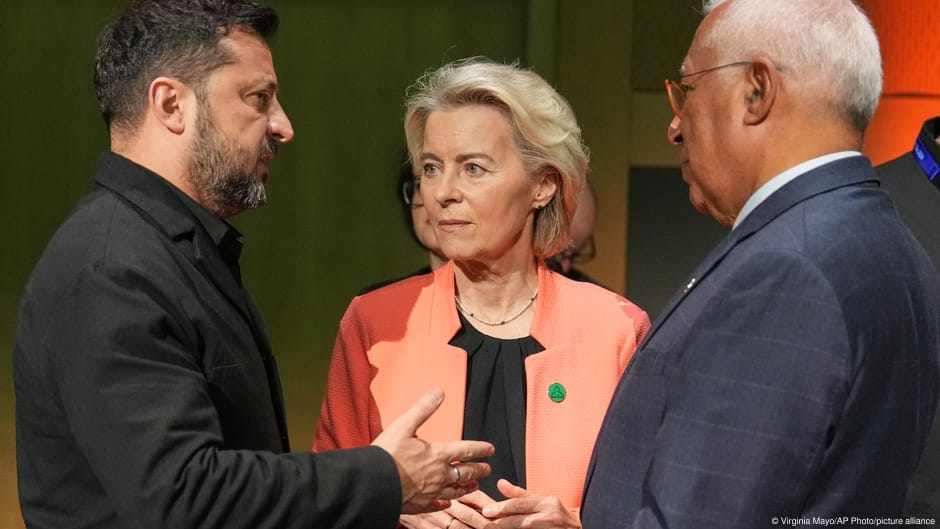
European leaders have managed to reach compromises in response to many of US President Donald Trump’s demands. Yet they were caught off guard when Trump revealed that he had discussed Europe’s security framework directly with Russian officials.
“It’s going to be a big agreement and it’s going to involve more than Ukraine,” Trump said after meeting Russian presidential envoy Kirill Dmitriev at the White House last week. He suggested the deal might encompass all of Europe, though his precise meaning remained unclear.
US envoy Jared Kushner likewise noted that Europe and Russia had struggled for more than three decades to establish a durable security framework.
Kushner said he was examining a “broader” European architecture ahead of his trip to meet Russian and Ukrainian representatives in Abu Dhabi.
European diplomats swiftly resisted Washington’s approach to securing peace in Ukraine, worried that any settlement might restore Russia’s sphere of influence and weaken NATO.
“We already have a European security architecture in place. NATO and the European Union both have their respective roles. We must ensure Ukraine is integrated into this architecture,” said Kaja Kallas, the European Union’s foreign policy chief.

The problem with rewriting Europe’s postwar security framework
During talks in Abu Dhabi earlier this week, Russia made clear that it wanted to address a broader European security framework before turning to the specifics of ending the war.
“Talk of the European security architecture is certainly a Russian talking point, and not merely a talking point but, to some extent, part of a media propaganda campaign designed to frame the war on Russia’s own terms,” said Michael Kimmage, a historian of the Cold War.
Russian leaders, including Vladimir Putin, have long claimed that the United States and NATO repeatedly broke promises made in the early 1990s not to expand the alliance into the former Soviet bloc. Moscow has viewed NATO’s subsequent enlargement as leaving it in a humiliating position, with little room to respond.
Yet the same era also saw the birth of the European project: the European Union, the single market that guaranteed the free movement of goods and people across member states, the Schengen agreement on border-free travel, and the euro. The underlying aim was to spread peace across the continent.
“Europe can mean many things, but the European project was never designed for war. It was designed for peace,” Kimmage said.
At one point during that period, there were even suggestions that Russia itself might join NATO.
That fragile stability unraveled after Russia invaded Georgia in 2008, annexed Crimea in 2014, and launched its full-scale invasion of Ukraine in 2022.
“Russia wants to redraw all of this by force. And I think that is fundamentally unacceptable to Europe, with all the diversity and variation you find across the Continent about what is and isn’t acceptable. The large-scale redrawing of borders by force is simply not the European project,” Kimmage said.
“So to the extent that redrawing borders by force is the lifeblood of Russian foreign policy — and I think that’s a fairly easy case to make — Russia and Europe are at an impasse,” he added.
What would happen to Ukraine’s security?
The Trump administration quickly moved to preserve “existing European security institutions,” with Kushner saying late Thursday that the next round of negotiations would include “our European partners.”
Kushner, together with Steve Witkoff, traveled to Moscow to speak with Putin after the Abu Dhabi talks, then flew on to Dublin, Ireland, to meet Ukrainian President Volodymyr Zelenskyy. Earlier that Thursday, Kushner had hinted at “really incredible” postwar plans for Ukraine, insisting that no such arrangement could be reached without Europeans at the table.
“We should not allow a Russian diktat that would impose some form of neutralization or a major reduction of Ukraine’s military going forward, because that would leave Ukraine extremely vulnerable to future aggression and pressure from Russia,” said Hiski Haukkala, director of the Finnish Institute of International Affairs.
Such an outcome would also leave Ukraine entirely dependent on whatever security guarantees the United States or Europe were willing and able to provide.
“We are supporting Ukraine because we are upholding international law and the basic norms of decency and international security — that is the vantage point from which we operate,” he said.
The European Union has repeatedly highlighted the core treaties Russia has broken, including:
- The UN Charter
- The Helsinki Final Act of 1975, which set out the ten core principles of European security, including the renunciation of the threat or use of force against territorial integrity
- The Charter of Paris for a New Europe, which built on the Helsinki commitments
- The Organization for Security and Co-operation in Europe (OSCE), one of the few multilateral forums where the West and Russia engaged directly
- The Budapest Memorandum of 1994, in which Russia, the United States, and the United Kingdom offered security assurances to Ukraine and others in return for their surrender of nuclear weapons
“Russia walked away from these principles and smashed them to pieces in the process. They have no interest in reinstating the previous security order — they want something different in its place. And as long as that is not on the table, the Russian method of negotiation is war. War is a form of bargaining,” Haukkala said.
“They are signaling a strategic intent to reshape European security, to subdue Ukraine, and to change the very essence of European security,” he added.
What comes next?
Daniel Fried, a former assistant secretary of state for European Affairs under President George W. Bush, observed that Russia is highly disciplined in pursuing its demands. He noted that Moscow knows how to negotiate but, as the Abu Dhabi talks showed, “right now, they are not negotiating.”
Some analysts argued that building a new security architecture with Russia is impossible at this stage, given the absence of trust or any shared vision on which to align with Moscow. Others, such as post-Soviet politics expert Balazs Jarabik, contended that Russia is part of the European security architecture whether Europeans like it or not.
“The question is whether it is included as our adversary. Obviously, Russia is not going to be a partner, right? We have to find a modus operandi to reduce the risk of horizontal escalation and, potentially, an even larger European war than the one we have now,” he said.
On Friday, a group of European leaders likewise rejected Russia’s demand to renegotiate Europe’s security framework. A spokesperson for the German government said Berlin intended to host a meeting of the “Coalition of the Willing” to secure funding for Ukraine’s defense and forge a common position ahead of future peace talks.
Can Germany make Europe pay more for Ukraine?
To view this video please enable JavaScript, and consider upgrading to a web browser that supports HTML5 video
Also Read
- Russia Dispatches High-Level Business Delegation to Kabul for Taliban Investment Talks
- Bus-Truck Collision in Northeast India Claims 24 Lives
- McKesson’s Specialty Pivot Drives Earnings Upgrade as Wholesaler Discount Persists
- Swiss Startup On Defies Industry Giants to Build a $12 Billion Sneakers Empire


