






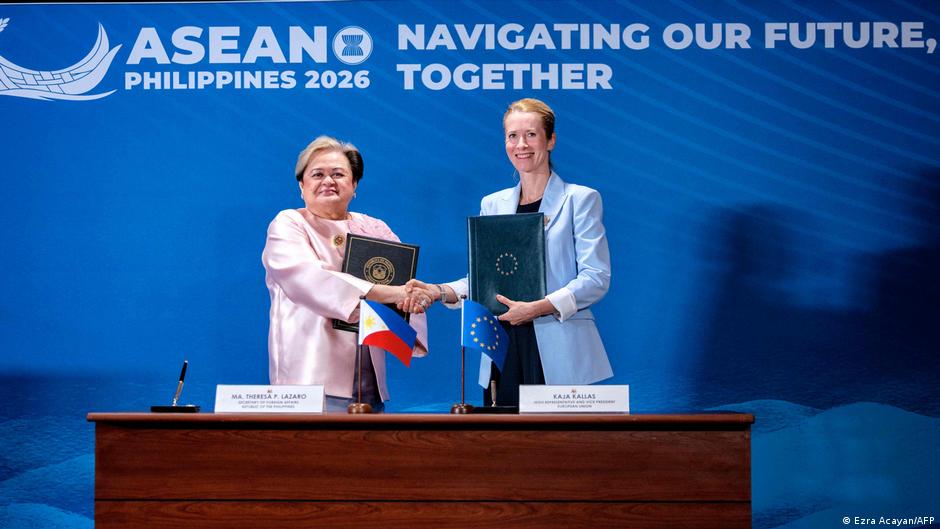
The EU and several Southeast Asian countries are close to finalizing bilateral trade agreements, and if timelines remain on track, the bloc could secure deals with six of the eleven ASEAN members by mid‑next year.
Trade pacts with Singapore and Vietnam are already active. Negotiations with Indonesia have wrapped up, and Jakarta plans to sign the agreement in October, aiming for implementation in early 2027.
Trade Reset: Europe’s Shift Away from China and the United States
To view this video please enable JavaScript, and consider upgrading to a web browser that supports HTML5 video
Discussions with Thailand, restarted in 2023, have now completed nine rounds of talks, and Malaysia resumed negotiations in early 2025 after a thirteen‑year hiatus. Both agreements are expected to be concluded by year‑end or early 2027.
Earlier this week, the EU and the Philippines said they had reached a substantive agreement on their free‑trade pact, positioning it for formal completion in the months ahead.
Trade Growth Exceeds 50% Over One Decade
Speaking to DW, Chris Humphrey, executive director of the EU‑ASEAN Business Council, said EU engagement with ASEAN on trade and investment has reached an all‑time high.
EU‑Southeast Asia goods trade amounted to €274.9 billion ($313.7 billion) last year, up roughly 6% from the previous year and more than 50% above the €177.9 billion recorded in 2016, according to EU figures.
The Association of Southeast Asian Nations (ASEAN) has become the EU’s third‑largest goods trading partner outside Europe, trailing only the United States and China.
The Philippines’ ASEAN Chairmanship: Its Priorities
To view this video please enable JavaScript, and consider upgrading to a web browser that supports HTML5 video
This week, Manila hosted the ASEAN‑EU Business Summit and the 22nd meeting of ASEAN economic ministers alongside the EU’s trade commissioner. The two sides pledged stronger cooperation to counter rising geopolitical tensions — including unilateral trade moves and regional conflicts — that they said collectively threaten the rules‑based international order.
What Makes Southeast Asia Vital for Europe?
Brussels is widening its global trade‑agreement network to reach new markets and build more resilient supply chains. Southeast Asia lies at the heart of supply chains for semiconductors, electronics, electric vehicles and batteries, attracting investment in data centres, renewable energy and digital services.
EU‑Mercosur Trade Deal: Who Benefits Most?
To view this video please enable JavaScript, and consider upgrading to a web browser that supports HTML5 video
An IMF article released this month notes that ASEAN’s eleven economies together constitute a $4.5 trillion bloc, expanding at over 4.5% annually.
That growth, together with multinational companies’ drive to shift production away from China, has made Southeast Asian markets increasingly attractive to European firms.
Alfred Gerstl, an expert on Indo‑Pacific international relations at the University of Vienna, told DW that geopolitical and geo‑economic shifts are also speeding up cooperation between the two regions.
He added that former US President Donald Trump’s protectionist and unpredictable trade policies have served as a key catalyst, while the EU’s de‑risking from China and supply‑chain diversification have heightened Southeast Asia’s strategic relevance.
A closer partnership with European nations also benefits Southeast Asian governments, which have long sought to maintain wide‑ranging economic ties with competing powers rather than rely heavily on China, the United States or any single partner.
EU Firms Advocate for an ASEAN‑Wide Agreement
The EU‑ASEAN Business Council, Humphrey said, is urging a region‑to‑region economic framework that includes a clear route toward a eventual bloc‑wide free‑trade agreement — something European businesses have long demanded.
“Such a framework could begin with a modular approach, for instance a region‑wide Digital Trade Agreement paired with an Investment Protection Agreement,” Humphrey told DW.
The concept is not new; the EU and ASEAN opened talks for a region‑to‑region pact in 2007, but the negotiations stalled due to vast economic disparities among ASEAN members and disagreements over the agreement’s scope.
The talks were suspended by mutual consent in 2009, prompting Brussels to pursue bilateral agreements with individual ASEAN states instead.
The core obstacle remains today: ASEAN groups wealthy Singapore with developing and least‑developed economies, making it hard to find common commitments that Brussels finds acceptable.
“Moreover, less‑developed ASEAN members often struggle to meet the EU’s stringent social, labour and environmental standards,” Gerstl noted.
Is the Commission Prepared to Raise the Stakes?
Even without an imminent bloc‑wide agreement, finalising the current bilateral deals would grant the EU preferential access to most of ASEAN’s largest economies and signal that Southeast Asia has climbed higher on Brussels’ trade priority list.
Humphrey, however, views this as a starting point rather than an end goal, warning that the European Commission may be reluctant to pursue a region‑to‑region framework.
“With 2027 marking the 50th anniversary of EU‑ASEAN relations, we hope the Commission will treat this milestone seriously and intensify work on a region‑to‑region economic architecture,” he told DW.
“Failing to act, he warned, would only lead ASEAN to conclude that the EU does not regard the region as a priority.”
Also Read
- Trump Courts Xi with Ceremonial Welcome as Bilateral Talks Loom Over Trade, Taiwan, and Iran
- Buy this cloud infrastructure stock as it leans into short-term contracts, JPMorgan says
- British Hawk jet crashes in Wales during training, pilots eject
- Netanyahu’s Short U.N. Visit Highlights Deteriorating U.S.-Israel Relations


