







The Japanese yen fell to a fresh four‑decade low, pushing USD/JPY above the 163 level as investors kept unwinding yen positions amid widening global yield gaps and rising energy costs. The slide has renewed focus on Japan’s currency policy, prompting the familiar question of whether officials will intervene to curb the decline.
Markets remain skeptical that intervention is imminent. While Japan has intervened when currency moves become disorderly, authorities usually shy away from opposing strong trends in deep‑liquidity environments, where action can be expensive and ineffective. Consequently, traders are asking a more fundamental question: does Tokyo possess any tools that could reverse the yen’s structural weakness, rather than just temper its decline?
The issue gains relevance ahead of the Bank of Japan’s July 31 policy meeting. Although intervention warnings can still spark short‑term volatility, the core concern for markets is whether a mix of monetary, fiscal and global interest‑rate forces has left Japan with limited viable options.
Intervention Threats Are Losing Their Bite?
Japanese officials reacted swiftly to the yen’s latest drop. After USD/JPY broke above 163 overnight, Finance Minister Satsuki Katayama restated the government’s familiar warning, noting that the stance “has not changed at all” and that authorities would “take decisive action appropriately at any time” if required. Chief Cabinet Secretary Minoru Kihara echoed the sentiment, saying the government is prepared to “respond as appropriate at any time.” Yet markets reacted weakly; traders largely brushed off the comments, highlighting how repeated verbal interventions have lost their punch over the past few years.
The silence of top currency diplomat Atsushi Mimura was equally telling. As the official markets view as having the biggest sway over intervention timing, his lack of public remarks gave investors little reason to expect imminent action. Authorities have shown a readiness to step in when volatility spikes, but they also prefer to act when liquidity is thinner, so that a smaller amount of firepower yields a larger impact.
This dynamic is especially relevant this week. With global markets fully staffed and liquidity deep through mid‑week, any attempt to counter a yield‑driven dollar rally would likely be costly and fleeting. Rather than confront the trend head‑on, Tokyo may choose to keep the element of surprise and rely on verbal warnings to deter speculative bets. So far, those warnings have gone unheeded, and investors are increasingly convinced that intervention can at most temper the yen’s fall, not reverse it.
BoJ Hike Speculation May Buy Time, Not Solve the Problem
The yen got a brief lift after Bloomberg reported that Bank of Japan officials are open to raising rates faster than economists currently anticipate, citing the currency’s persistent weakness as a source of upside inflation risk. The report indicated policymakers are growing worried that a weaker yen is magnifying imported inflation, even though markets still overwhelmingly expect the BoJ to keep policy steady at its July 31 meeting and consider another hike later this year.
Whether or not the leaks are official, they could be part of a broader effort to steady the yen ahead of next week’s meeting. If direct intervention has lost its punch, shaping expectations through calibrated rhetoric or selective leaks may offer a cheaper way to prop up the currency. By nudging investors toward a more hawkish BoJ outlook, officials could modestly tighten rate expectations and provoke short‑covering in the yen without tapping foreign‑exchange reserves.
This makes the coming days especially important. Market participants will be watching for any further signals from BoJ officials or government sources indicating growing discomfort with current exchange‑rate levels. A consistent stream of hawkish hints would suggest authorities are trying to prime the market for a firmer policy stance. Still, expectations alone yield only temporary support; unless the BoJ delivers a noticeably more aggressive tightening cycle than markets now price in, any yen bounce driven by talk is likely to fade quickly.
Japan’s Policy Dilemma Runs Deeper Than the Exchange Rate
Even if the BoJ opts for a more aggressive tightening cycle, it is uncertain whether that would spark a lasting yen recovery. The root of the yen’s weakness lies in structural yield differentials, not merely the prospect of an extra rate hike. With Brent crude edging above $94 a barrel, markets worry that renewed energy inflation could keep the Federal Reserve and other major central banks on a tighter path for longer. If foreign rates keep climbing in tandem with Japanese rates, the yield gap that drives yen weakness may barely shrink.
At the same time, the BoJ cannot ignore the bond market. Japan’s government‑bond sector is already under strain, with the 10‑year JGB yield hitting 2.90% earlier this month—the highest level since the late‑1990s—before pulling back to about 2.73%. The rise in yields stems not only from inflation worries tied to higher oil prices but also from unease over Prime Minister Sanae Takaichi’s fiscal expansion plans. Investors are demanding higher compensation to hold Japanese government debt as expectations of further monetary tightening clash with concerns over rising government borrowing.
This puts policymakers in a tough balancing act. Accelerating rate hikes could give the yen a boost, but they would also push JGB yields higher, tighten financial conditions and increase the government’s debt‑servicing costs. In short, the BoJ is juggling more than one goal: it must steady a weakening currency while avoiding undue stress in a bond market already dealing with multi‑decade‑high yields. Under these conditions, even a more hawkish BoJ is unlikely to deliver the sustained yen appreciation that markets hope for.
Technical Outlook: Bulls Eye 163.47 Before 166.70
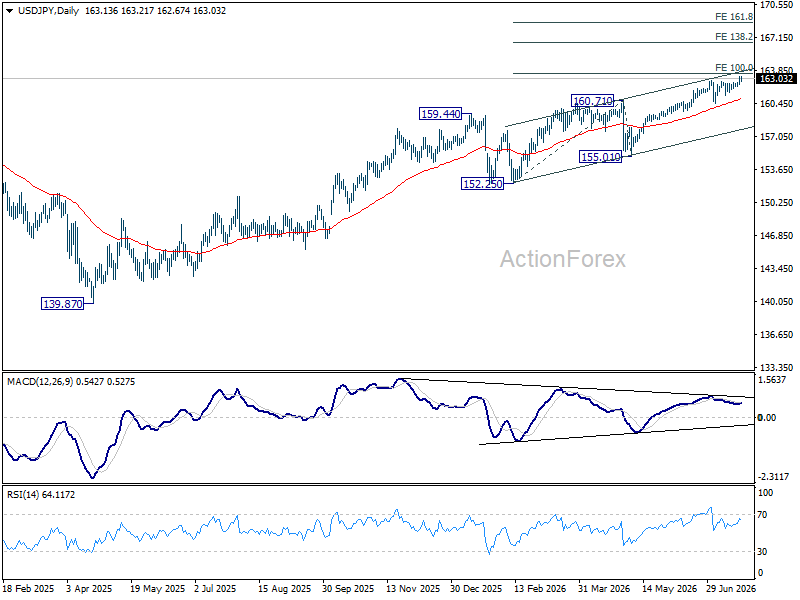
Technically, the next upside target for USD/JPY sits at the 100 % projection of the move from 152.25 to 160.71, anchored at 155.01, which places the level near 163.47. A decisive break above that point, with sustained trading above the rising channel’s ceiling, could open the way toward the 138.2 % projection around 166.70.
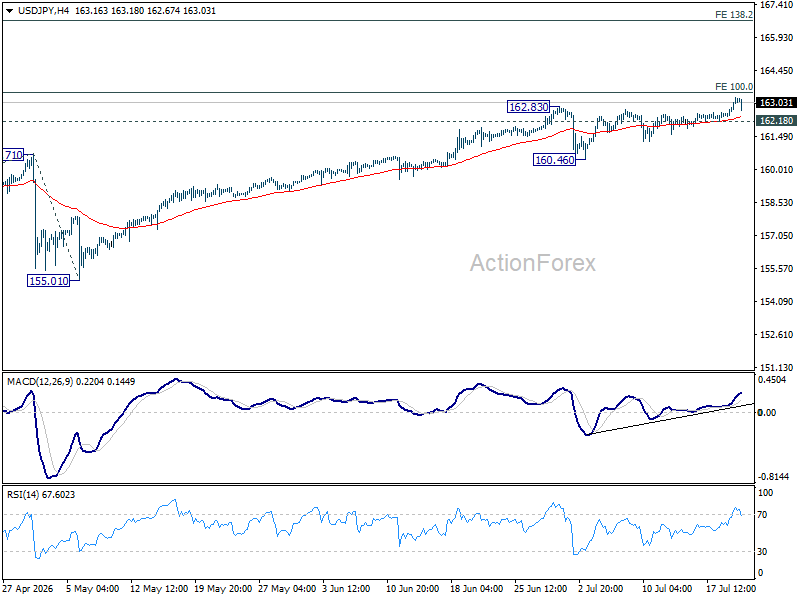

On the downside, a break below the 162.018 minor support level could trigger further consolidation, but the near‑term bias remains bullish as long as the 160.46 support holds, even if the pair experiences a deep pull‑back.
Also Read
- USD/SGD Forecast 22/07: Defends Key 1.2900 Support – DailyForex
- Japanese Yen Weakens Further Amid Mounting Expectations of BOJ Rate Hike, MUFG Reports
- Bitcoin Holds Near $66K Ahead of Alphabet Earnings as Traders Gauge AI Investment Outlook
- NZD/USD Volatility: Fed Policy and Technical Crossroads Ahead


