



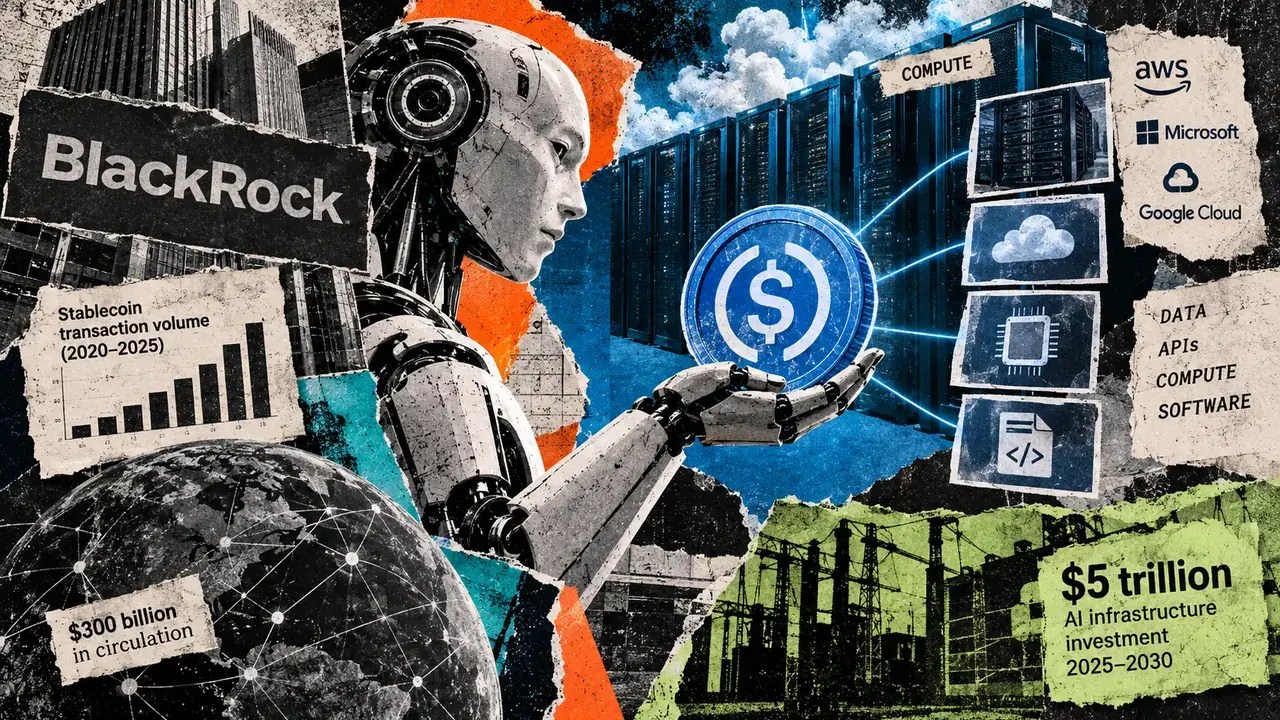
BlackRock projects that artificial intelligence could spawn a novel category of stablecoin users: autonomous machines capable of continuous spending without human authorization. The world’s largest asset manager observes that increasingly autonomous AI systems are beginning to purchase data, access software, and acquire computing resources independently, potentially unlocking a fresh vein of transaction demand for digital assets that extends beyond speculative trading and human-initiated payments.
This thesis anchors BlackRock’s latest report, The Machine-Native Economy, which contends that AI could fundamentally alter the initiation of economic activity. Rather than humans authorizing each payment, software agents could execute thousands of micro-transactions to fulfill a single objective.
Stablecoins approach this frontier with over $300 billion in circulation and approximately $11.2 trillion in adjusted transaction volume recorded in 2025, per BlackRock data. The firm calculates that volume expanded at an 80% compound annual growth rate from 2020 to 2025, vastly outpacing the roughly 8.5% growth of the U.S. Automated Clearing House (ACH) network. Despite this rapid expansion, ACH still processed approximately $93 trillion last year, underscoring the distance stablecoins must traverse to rival the largest traditional payment rails. BlackRock also warns against direct comparisons with Visa and Mastercard, given methodological differences in transaction measurement.
The more profound shift, however, may lie in transaction behavior rather than sheer volume. An AI agent seeking information or compute capacity could pay repeatedly for individual API calls, data feeds, or units of processing power. These transactions—often fractions of a cent—could occur incessantly, generating a payment pattern fundamentally distinct from card purchases or bank transfers architected for human users. This dynamic creates an opening for stablecoins, which software can hold in programmable wallets and settle without human approval for each transaction.
Stablecoins Could Secure the Machine Wallet Before Blockchains Capture the Economics
Payment firms are already vying to define how these transactions will flow. Coinbase’s x402 protocol leverages the HTTP 402 “Payment Required” status to let a service demand payment before returning data or resources. An agent can request an API, receive payment instructions, transfer USDC, and obtain the service without a human completing a checkout flow.
Stripe and Tempo are developing the Machine Payments Protocol, which can settle transactions through stablecoins or traditional payment methods. Stripe and OpenAI’s Agentic Commerce Protocol connect AI agents with existing merchant systems, while Google and Visa are pursuing separate standards around agent identity and authorization. These competing approaches complicate any assumption that machine commerce will automatically migrate on-chain.
Traditional payment networks can adapt to autonomous software, particularly where agents transact with established businesses and consumers. Stablecoins appear better positioned where payments become especially small, frequent, or native to software environments. This leaves a second contest over where the value from those payments ultimately accrues.
If agents generate more stablecoin transactions on Ethereum, greater usage could increase demand for blockspace and validator services. ETH functions within the network’s fee and staking mechanisms, providing one pathway through which higher transaction activity can influence the native asset. However, transaction growth and token demand do not necessarily rise in lockstep.
BlackRock notes that the value captured by native crypto assets will depend on fee structures, staking economics, and gas-sponsorship models. Networks can process large volumes while charging minimal fees, while applications can also shield users and agents from holding the underlying gas token themselves. Circle’s Arc presents a different model: a payments-focused blockchain that uses USDC as its native gas asset, meaning additional activity could strengthen the stablecoin’s role without producing the same transmission mechanism to a separate native token such as ETH.
For investors, that distinction could prove critical if machine payments scale. Stablecoin issuers may capture transaction demand while the networks processing those transfers compete separately to convert higher throughput into economic value.
AI Compute Could Vastly Expand the Machine Customer Base
BlackRock expects the same payment architecture to eventually reach one of AI’s largest expenses: computing power. Cumulative investment in AI infrastructure could exceed $5 trillion between 2025 and 2030, while Bloomberg consensus forecasts cited by BlackRock project combined revenue from Amazon Web Services, Microsoft’s Intelligent Cloud business, and Google Cloud at roughly $1.1 trillion by 2030. That would create a vast resource market for increasingly autonomous agents to navigate.
An agent could compare computing providers by price, hardware, location, latency, or performance; purchase capacity for a specific task; and settle the cost automatically. Payments could occur per job, per use, or potentially per model token. AI inference would then become a recurring machine-to-machine transaction loop: software finding compute, buying it, consuming it, and paying for the resource without a person intervening at each stage.
BlackRock envisions an even larger financial market potentially forming around that activity. Standardized claims on computing capacity could eventually be traded or pledged as collateral, while futures markets could allow buyers and sellers to hedge changes in compute costs. Such markets would require standards that account for major differences between chips, energy prices, locations, and performance.
That portion of the thesis remains largely prospective. Agentic payment activity is still nascent, and traditional financial companies are building their own infrastructure for autonomous commerce alongside crypto firms. The nearer-term competition centers on the machine’s wallet.
Stablecoin issuers need their tokens to become the default settlement asset for software. Payment protocols need to become the standard agents use to request and pay for resources. Ethereum and rival blockchains face the harder task of ensuring that higher stablecoin throughput translates into demand for their own economic assets. Traditional payment networks, meanwhile, have a strong incentive to keep that activity on existing rails.
As AI systems gain more authority to spend, those competing infrastructures will increasingly fight over a customer that never sleeps, can transact thousands of times in the background, and may care more about price, settlement speed, and programmability than which financial network sits underneath the payment.
Also Read
- HBAR Nears First Major Target as $1 Ceiling Draws Near
- Kalshi Clarifies It Is Not Under CFTC Investigation Regarding Trading Activity
- Coinbase Launches Fixed-Rate Bitcoin Backed Loans Powered by Morpho Midnight
- Money Funds Absorbed Most of Treasury’s Summer Bill Surge as Stablecoins Retained Nearly $200 Billion