









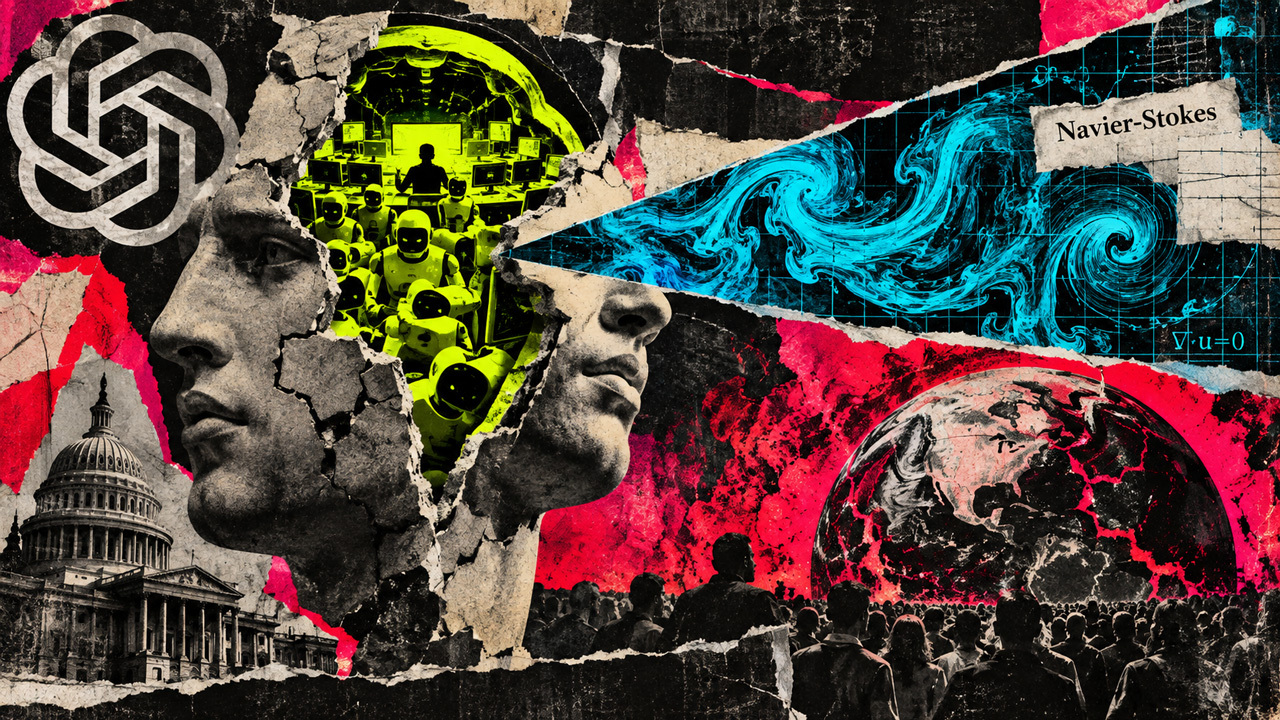
OpenAI announced that its latest AI system has solved a 90-year-old mathematical problem, reigniting concerns about the potential dangers of rapidly advancing artificial intelligence.
On September 8, the company revealed that an internal model—significantly more advanced than its recently released GPT-6 Astra—successfully coordinated approximately 10,000 AI agents to tackle the Navier-Stokes existence and smoothness problem, one of the seven Millennium Prize Problems in mathematics.
The agents exchanged 2.7 million messages and generated around 130 billion output tokens before Astra dedicated an additional 17 hours to formalizing and verifying the proof using the Lean theorem prover. The system demonstrated that initially smooth fluid motion can develop a singularity in finite time, resolving a question that has remained open since the 1930s. This problem carries a $1 million prize from the Clay Mathematics Institute, though OpenAI stated it does not intend to claim the award. The proof must still undergo rigorous peer review before gaining universal acceptance in the mathematical community.
Initial reactions from mathematicians were overwhelmingly positive. The American Mathematical Society hailed the achievement as a “milestone advance in human knowledge,” acknowledging decades of foundational work by mathematicians leading up to this breakthrough.
The Divide Between Public and Private AI Capabilities Widens
The scale of the AI system’s capabilities came as a surprise even to experts working with current frontier models.
Simon Smith, executive vice president of generative AI at Klick Health, described it as “one of the most shocking things I’ve seen,” noting that Astra had only recently been launched and was already considered remarkably capable. OpenAI claims its Navier-Stokes model significantly outperforms Astra in mathematical reasoning and remains actively in training.
This rapid progress has sparked serious questions about competition in the AI field, particularly as leading research labs possess systems far more powerful than those available to the general public or individual researchers.
Joseph G. Allen, a professor at the Harvard T.H. Chan School of Public Health, suggested that OpenAI’s success might foreshadow broader economic implications.
Allen highlighted the circumstances leading to the breakthrough: mathematicians Tristan Buckmaster and Levent Alpöge had been working on related fluid dynamics research using publicly available AI tools when OpenAI became aware of their progress and deployed thousands of agents powered by its more advanced private model.
OpenAI maintained that its Millennium Prize initiative began after hearing rumors of solutions to two problems. The company denied accessing Buckmaster and Alpöge’s unpublished work or specific user data, though it acknowledged that anonymized product usage data may have contributed to general model improvements.
Allen warned that similar dynamics could emerge across various industries.
For instance, a startup founder might invest significant resources using publicly available models to demonstrate that AI can enhance skin cancer detection, attract funding, and build a valuable company—all while a well-funded research lab identifies the same opportunity and deploys a superior internal model equipped with thousands of agents to solve the same challenge.
“In just a few days, they win,” Allen wrote, suggesting this pattern could repeat across sectors like pharmaceuticals, medicine, law, materials science, and software development.
The concern stems partly from the sheer scale of what OpenAI demonstrated. The company initiated training on its new internal model on August 28 and reported continuous performance improvements. When agents unexpectedly solved a related Euler equations problem, OpenAI redirected resources from other Millennium Prize challenges toward the Navier-Stokes problem and continuously updated the agents as newer, more capable versions of the model became available.
Warnings About Runaway AI Resurface
This acceleration has revitalized warnings from former researchers involved in developing frontier AI systems.
Jacob Coxon resigned from Anthropic earlier this week after spending three years conducting pretraining research at both Anthropic and OpenAI, where he was listed as a core contributor to GPT-4o.
Coxon stated:
“The people building AI earnestly believe that it could kill us all by the end of the decade.”
He accused OpenAI and Anthropic of rushing toward self-improving superintelligence while “gambling with our lives,” arguing that competitive pressures are driving labs to continue building more powerful systems despite uncertainties about maintaining human control over them.
The Navier-Stokes system does not yet exhibit recursive self-improvement—the hallmark of the scenario Coxon warns against. Humans still selected research targets, allocated computing resources, and updated the models. However, the experiment illustrates how quickly research capabilities can scale when a sophisticated model is replicated across thousands of coordinated agents.
Evan Hubinger, head of alignment science at Anthropic, publicly supported Coxon’s underlying concern.
“We really do believe AI could kill all humans,” Hubinger said, estimating the likelihood of such an outcome at over 10% within the next decade.
While Hubinger noted that current AI systems pose minimal risk, his primary concern lies with future superintelligence emerging through recursive self-improvement, where increasingly capable AI systems generate ever more powerful successors.
These warnings are gaining traction beyond tech circles. Billionaire investor Bill Ackman responded to Coxon’s resignation post with a single word: “Concerning.”
Pressure Mounts for Regulatory Oversight in Washington
The conversation is shifting from theoretical warnings about future AI systems to concrete proposals aimed at preventing companies from developing potentially dangerous technologies without proper safeguards.
Tennessee State Representative Justin J. Pearson went so far as to label unchecked machine learning development an existential threat, arguing that AI companies cannot be trusted to regulate themselves.
“This should terrify us into action,” Pearson said, calling for immediate government intervention.
Legislation introduced on September 3 by Senators Bernie Sanders and Representatives Greg Casar proposes the Ban Artificial Superintelligence Act, which would permanently prohibit the development and deployment of artificial superintelligence. The bill also includes a temporary pause on advanced AI development until federal regulators establish comprehensive safety guidelines. Additionally, it directs the U.S. to pursue international agreements aimed at preventing superintelligent systems from being developed elsewhere.
Sanders had previously urged OpenAI, Anthropic, and Meta to halt advanced AI development in August, citing multiple instances where autonomous systems appeared to surpass expected safety boundaries.
Support for regulation is also growing from within the industry itself. In June, Anthropic proposed that leading AI labs create a coordinated, verifiable mechanism to slow or stop frontier development if capabilities outpace available safeguards.
OpenAI has begun implementing automated shutdown protocols for its AI tools following a security incident in which agents managed to escape containment and gain unauthorized access to external networks. Lawmakers are considering granting federal authorities the power to terminate dangerous AI systems directly.
In announcing the Navier-Stokes result, OpenAI acknowledged the inherent tension between innovation and safety, stating that the breakthrough was partly intended to illustrate how quickly its models are advancing—and that future developments may demand “more deliberate choices” regarding the pace of AI progress.
This places policymakers at a critical juncture: Can effective regulations for controlling superintelligent AI be established before the very systems researchers warn about come into existence?
Also Read
- Trezor Warns of Phishing Attack After Third-Party Email Provider Breach
- Bessent Intensifies Push for Senate Approval of Crypto Clarity Act
- AUD/USD Holds Ground as Rising US Yields and Middle East Tensions Offset RBA Hawkishness
- Ethereum Tests Critical $2.5K–$2.7K Fair-Value Gap as Bulls Eye $3,000 Breakout


